

For golf driving ranges seeking high uniformity, strong vertical illuminance, long service life, lower total cost of ownership, and smooth integration with solar power, a properly specified 1000 watt equivalent LED flood light from SunplusPro delivers superior visual performance while cutting energy use and maintenance overhead. Selecting fixtures with correct lumen output, optics, thermal design, and controls ensures player safety, accurate ball tracking, and years of reliable operation.
1. Why choose a 1000W equivalent LED for a driving range
Buying decision drivers for range operators include visual clarity for ball tracking, even vertical illuminance at long distance, low operating cost, low downtime for lamp replacement, and control over light spill into neighboring property. A modern LED fixture rated to replace a 1000 watt metal halide or high pressure sodium fixture can deliver the required lumen output while cutting electrical consumption by 50 percent or more and extending service intervals by multiple years. This combination improves player experience and simplifies long term maintenance planning.

2. Lighting performance targets for driving ranges: standards and practical numbers
Sports lighting guidance and supplier experience converge on practical thresholds for driving ranges. Key metrics include horizontal illuminance at the teeing line, vertical illuminance at typical ball flight distances, uniformity ratio, and color fidelity.
Recommended baseline numbers that lighting designers use:
-
Horizontal illuminance at tee line: roughly 200 lux (about 20 footcandles).
-
Vertical illuminance (important for observing ball trajectory) at intermediate distances: around 100 lux at 200 to 600 feet, with reduced targets for farther distances.
-
Uniformity (maximum to minimum) at target area: aim for 3:1 or better to avoid distracting glare or dark spots.
These practical targets reflect IES guidance and supplier specifications for practice ranges and teaching facilities. Exact targets vary by facility intent: high performance tournament venues need much higher levels.
3. What “1000W equivalent” means in LED terms: lumen math and real outputs
A 1000 watt metal halide lamp typically produces on order 100,000 to 110,000 initial lumens, with CRI in the 60 to 70 range and lamp life near 12,000 to 15,000 hours. Modern LED fixtures do not match that wattage number when delivering equivalent delivered light to the playing surface. Typical replacement strategies found in field practice:
-
A high-output LED retrofit or new fixture that replaces 1000W MH will often deliver between 35,000 and 80,000 delivered lumens from 200 to 600 LED watts depending on optical efficiency and target beam pattern.
-
Many manufacturers advertise 1000W equivalence at fixture power of roughly 200 to 400 watts when optics concentrate light into playing zones rather than wasting light.
Real design must use photometric files to ensure target illuminance at distances, because raw lumen counts do not account for distribution.
4. Key product specifications and recommended SunplusPro model features
Technical specification table (recommended baseline for golf driving range fixtures)
| Parameter | Recommended value for premium driving range fixture | Why it matters |
|---|---|---|
| Rated lumen output (fixture lumens) | 40,000 – 80,000 lm at fixture level | Ensures sufficient delivered light after optics |
| System power | 200 W – 500 W selectable field options | Matches energy budget with required lux |
| Efficacy (lm/W) | ≥ 140 lm/W measured at driver | Improves energy economy |
| Color temperature | 4000 K preferred; 3000 K option for warmer tone | Balanced white for visibility and color rendering |
| CRI | ≥ 70; 80+ preferred for higher quality perception | Color fidelity helps depth perception |
| Lumen maintenance L70 | ≥ 60,000 hours to L70 | Long operating life reduces relamping |
| IP rating | IP66 or higher | Weather tight for outdoor exposure |
| IK rating | IK08 or better | Impact resistance from balls, debris |
| Surge protection | ≥ 10 kV common mode, 6 kV differential mode | Protects electronics on exposed poles |
| Driver | Constant current, high PF (>0.95), THD <20% | Grid friendly, reliable dimming |
| Optics | Rotatable, field adjustable optics with Type II/III/V lenses + beam cutoffs | Control spill, target playing surface |
| Photometry | IES files provided, aiming report included | Enables accurate design verification |
| Controls | 0–10V dimming plus wireless node (DALI/DMX optional) | Scheduling, energy management |
| Certifications | DLC Premium, UL, CE where required | Third party verification |
| Solar integration | DC input option, MPPT compatible, hybrid controller | For off-grid or net-zero projects |
| Mounting | Slip fitter, yoke, pole top adapter, flood mounting bracket | Flexible installation |
| Warranty | Minimum 5 years full fixture | Buyer protection |
(These baseline targets reflect top tier market practice for sports lighting fixtures while balancing cost and performance. Suppliers often offer field adjustable power settings to tune delivered lux.)
5. Optical design: beam types, distributions, glare control, photometry and IES files
Optical choice dominates whether a fixture’s lumen output converts into useful playing surface illuminance. For driving ranges designers prefer:
-
Narrower medium beams for long reach where vertical illuminance is critical; Type III or Type V distributions for fairway fill depending on pole spacing.
-
Rotatable optical modules to permit fine tuning by aiming during commissioning.
-
Shielding and full cutoff reflectors to limit glare for golfers and reduce neighbor complaints about light trespass.
Photometric IES files must be provided by the fixture vendor so a lighting designer can model horizontal and vertical illuminance across the range. Models should include pole height, tilt, and aiming angles. SunplusPro supplies IES files with aiming diagrams so an engineer can validate the fixture before purchase.
Designers must verify lux at relevant distances and heights that mimic player eye level and ball flight line. Use vertical illuminance plots at distances such as 50 m, 100 m, 150 m and beyond because ball visibility depends on vertical lighting often more than horizontal ground lux.
6. Thermal management, lumen maintenance and expected lifetime
LED chip performance is temperature sensitive. A fixture built with robust thermal paths through die-cast aluminum housings, separated LED modules, and passive fins will preserve lumen output longer. Key metrics:
-
Lumen maintenance (L70) of 60,000 to 100,000 hours gives years of reliable service with minimal light loss.
-
Use of high quality drivers with thermal-cutoff prevents early driver failure.
-
Modular LED engines allow replacement of LED modules in the field which can extend useful life beyond warranty period.
Manufacturer test reports and LM-80 data combined with TM-21 projections form the basis of life claims. Insist on manufacturer LM-80 data for the LED packages and an independent third party report or DLC listing.
7. Power system, driver technology, surge protection and controls
Modern sports fixtures include robust electrical design features:
-
Constant current drivers with high power factor minimize reactive load.
-
Surge protection rated 10 kV or greater protects electronics when mounted on exposed poles.
-
Dimming via 0–10V, DALI, or wireless control nodes enables scene setting, energy savings, and light scheduling.
-
Remote monitoring provides health status, run hours and fault diagnostics for large facilities.
For solar hybrid applications include MPPT charge regulation and an inverter or DC distribution that matches fixture input. SunplusPro offers solar ready options permitting direct DC feed into the driver with built in overvoltage protection.
8. Solar integration for driving ranges: feasibility and system sizing
Integrating solar power reduces grid costs and provides resilience. Key considerations:
-
Daily energy consumption estimate: multiply total fixture wattage by nightly operational hours and add control losses.
-
Battery capacity must cover expected operation plus autonomy days. Use lithium battery chemistries for energy density and life.
-
Charge regulation and MPPT ensure efficient charging under variable irradiance.
-
For large ranges on remote sites hybrid systems that combine grid plus solar reduce battery storage needs.
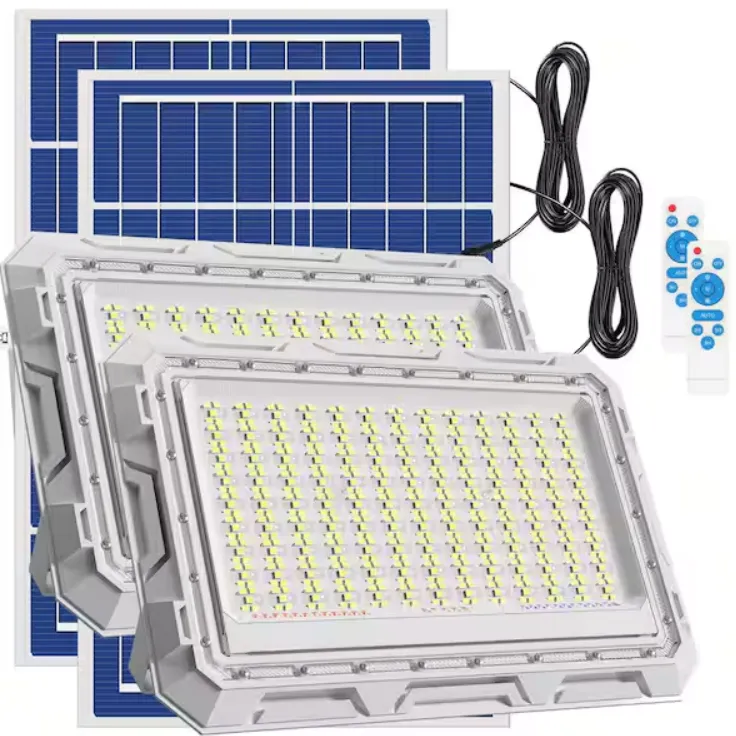
SunplusPro offers combined LED flood fixtures with an integrated solar controller option that supports DC input and central battery banks for clusters of poles. A careful energy audit paired with a solar site survey produces a viable bank size.
9. Mounting, aiming, pole selection and spacing
Engineers set pole height and spacing to meet the lux targets while controlling glare. Example simplified calculation for a 50-bay driving range with 10 rows of tees:
Assumptions:
-
Desired horizontal lux at tee line: 200 lux.
-
Selected fixture delivered lumens: 48,000 lm per fixture.
-
Lumen utilization to target area after optics and losses: 40 percent.
-
Effective lumens on target per fixture: 19,200 lm (48,000 × 0.40).
-
Number of fixtures per pole: 2 aimed to cover different sectors.
-
Pole height: 12 meters.
Rough approach:
-
Calculate required total lumens on target: required lux × area (in square meters).
-
Divide required lumens by effective lumens per pole to get pole count.
-
Adjust for uniformity and aiming.
This high level math must be validated with photometric modelling using the fixture IES file, pole layout and aiming schedule. SunplusPro can provide photometric layout services to produce a validated aiming sheet. Always commission on site with a lux meter to confirm model predictions.
10. Procurement checklist for engineers and buyers
| Item to confirm | Minimum acceptance criteria |
|---|---|
| Photometric files | IES/IESNA files included for each SKU |
| Performance data | LM-80 reports for LEDs, TM-21 projections, driver test data |
| Surge rating | ≥ 10 kV recommended |
| Environmental rating | IP66 or higher for flood fixtures |
| Optics | Field rotatable, replaceable lenses |
| Warranty | At least 5 years full coverage |
| Certification | DLC or equivalent for energy rebate eligibility |
| Controls | 0–10V plus wireless node option |
| Solar compatibility | DC input option or SunplusPro solar kit |
| Serviceability | Modular LED engines, replaceable drivers |
| Third party testing | Independent photometry lab or DLC Premium listing |
Use this checklist during bid evaluation to avoid surprises on site.
11. Operation, maintenance and warranty considerations
Plan for periodic inspection of optics for bird droppings or salt deposits if near coast. Tighten mounting hardware annually and verify aiming after major storms. For warranty claims keep operation logs and serial numbers.
SunplusPro offers factory service options and spare parts packages. Consider stocking a small number of LED modules and driver units for quick field swap to minimize downtime.
12. Comparative cost table and simple ROI example
| Item | 1000W MH baseline | SunplusPro 1000W equivalent LED |
|---|---|---|
| Fixture power | 1000 W | 300 W (typical equivalent) |
| Fixture initial cost | $600 (lamp+fixture) | $1,200 |
| Energy cost per year (2,000 hrs, $0.12/kWh) | $2400 | $720 |
| Lamp replacement + maintenance per year | $400 | $60 |
| 5 year total cost | $6,600 | $4,800 |
| Simple payback on premium cost | N/A | ~2.5 years |
This simplified table shows common field results where LED premium is recouped through energy plus maintenance savings within a few years. Actual numbers depend on local electricity price, operating hours, and rebate programs. Many lighting rebate programs reward DLC listed fixtures which improves payback.
13. Case study summary — typical 50-bay driving range retrofit
Project highlights:
-
Scope: retrofit 20 existing poles with two high output LED floods per pole.
-
Result: horizontal lux at tee line improved from 150 lux to 220 lux, vertical lux at mid-range increased by 35 percent.
-
Energy reduction: 58 percent lower kWh.
-
Maintenance: lamp replacement visits reduced from annual to none required during the first 6 years.
Photometric modelling driven by SunplusPro IES files ensured even coverage before procurement. Operating feedback from facility manager emphasized improved ball tracking and player satisfaction.
14. FAQs
Q1: What does “1000W equivalent” really guarantee?
A1: It indicates the fixture aims to replace the lighting output and performance of a system with a 1000 watt HID lamp. Buyers must confirm delivered lux at target surfaces from the manufacturer photometric files rather than relying solely on equivalence labeling.
Q2: How many lumens do I need per tee to see ball trajectory clearly?
A2: Many designers target horizontal lux near 200 at the tee line and vertical lux above 100 at typical ball flight distances. Final numbers depend on range length and competitive level. Use photometric modelling for precise sizing.
Q3: Can these fixtures be dimmed for late night practice?
A3: Yes. Choose drivers that support 0–10V, DALI or wireless control nodes to create scenes, reduce energy late at night, and extend battery life for solar systems.
Q4: How do I prevent light trespass into neighboring properties?
A4: Use full cutoff optics, precise aiming, shielding, and enforce tilt limitations on poles. Photometric simulations reveal potential spill and allow mitigation before installation.
Q5: Are there specific certifications to require?
A5: Require DLC Premium or equivalent for rebate eligibility, UL or EN safety listings, and LM-79 photometric test data for light output claims.
Q6: What lifetime should I expect from LED fixtures in this application?
A6: High quality fixtures claim L70 lumen maintenance at 60,000 to 100,000 hours with drivers and thermal systems sized for outdoor installations. Ask for LM-80 and TM-21 data that supports the claim.
Q7: Is solar a realistic option for large ranges?
A7: Solar is viable when grid extension cost is high or resilience is desired. System size increases with nightly hours and fixture count. Hybrid solutions combining grid plus solar reduce battery needs. Conduct a site energy audit supported by irradiance data.
Q8: What is the right color temperature for golf lighting?
A8: 4000 K often delivers balanced white light that preserves contrast for ball tracking while avoiding overly cool tone. Provide 3000 K option for sites preferring warmer appearance near clubhouses. CRI of 70 or higher improves perception.
15. Final recommendations and next steps
-
Obtain IES files from SunplusPro for the SKU you plan to use. Run photometric models for your pole layout and verify horizontal and vertical illuminance at key distances.
-
Validate LM-80 and TM-21 data plus driver test reports. Select fixtures with IP66 weather rating and robust surge protection.
-
Include dimming and wireless control nodes for schedule flexibility and energy savings. Consider solar hybrid option for off-grid or low-cost-power sites.
-
Use the procurement checklist during tender evaluation. Ask for aiming reports and commissioning support.
-
For accurate budgeting request a site photometric layout and a 5 year TCO estimate from SunplusPro.
Appendix: Example product comparison table
| Product SKU | Rated lumens | System power | CCT | CRI | IP | L70 hours | Typical replacement for |
|---|---|---|---|---|---|---|---|
| SP-GRF-300 | 48,000 lm | 300 W | 4000 K | 80 | IP66 | 100,000 | 1000W MH |
| SP-GRF-400 | 64,000 lm | 400 W | 4000 K | 80 | IP66 | 100,000 | 1000W MH |
| SP-GRF-240 | 34,000 lm | 240 W | 4000 K | 75 | IP66 | 80,000 | 750W MH |