

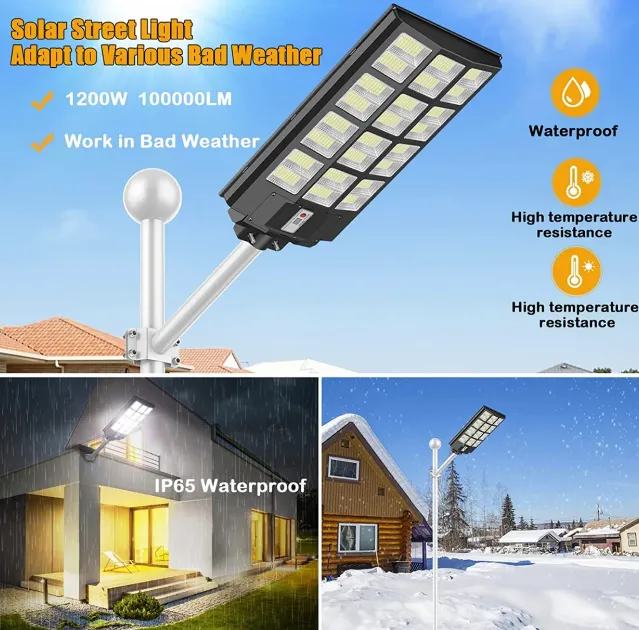
If your project requires extremely high output outdoor lighting, a true 100000 lumen solar light can work for parking lots, sports fields, perimeter security and temporary event illumination, provided the product uses high-efficiency LED modules, a suitably large solar array and a high capacity, long-life battery chemistry. For reliable field performance choose systems built around certified luminous output figures, conservative lumen depreciation estimates, LiFePO₄ battery packs and an engineered optics package. When these elements are matched properly you obtain multi night autonomy, predictable maintenance intervals and lower total cost over five to ten years compared with unreliable, underspecified imports.
1. What does 100000 lumens really mean
A lumen is the SI unit of luminous flux. It measures the total quantity of visible light emitted by a source in every direction. Stating a lamp produces 100000 lumens describes total emitted light, not the amount that lands on a surface or the light perceived at a distance. For design work you convert lumens to illuminance units such as lux or foot-candles depending on mounting height and beam control.
Practical takeaway: a claim of 100000 lumens requires careful interpretation. Without optics and beam control those lumens scatter and do not guarantee required lux levels on target surfaces.

2. Typical applications and reasonable expectations
Commercial uses that might justify a 100000 lumen solar light include:
-
Large parking lots and loading yards.
-
Sports practice fields and small stadiums.
-
Construction site tower lighting for short term use.
-
Perimeter security for industrial campuses.
-
Event lighting where temporary grid-free illumination is needed.
Expect that a solar system delivering 100000 useful lumens at night will demand a large solar array, a high capacity battery bank and robust thermal management. Many consumer listings promote the figure for marketing appeal without revealing panel area or battery autonomy figures. Verify those two items before purchase. Product advertising often bundles peak luminous flux with short run times that do not meet operational needs. This marketplace pattern has been observed in multiple retail listings and wholesale catalogs.
3. How vendors report lumens and why to be careful
Several issues cause confusion and buyer disappointment:
-
Manufacturer lumen figures sometimes represent theoretical LED chip output rather than delivered lumens after optics and drivers.
-
Marketing may quote initial lumens without disclosing lumen depreciation over time. LEDs lose output gradually; design should use L70 or L90 projections.
-
Efficacy claims influence power and run time numbers. Realistic LED efficacy for commercial products is commonly 100 to 160 lumens per watt in fielded systems. The best class devices may exceed 200 lm/W under lab conditions but such figures rarely translate to fully integrated, weatherproof solar fixtures.
Buyer action: ask for measured delivered lumen data at the driver output and request photometric files in IES format. Photometric files yield candela distributions and allow you to compute lux at any mounting height.
4. Core technical elements explained
Below are the parts that determine if a 100000 lumen solar light will meet your needs.
LED modules and efficacy
-
LED type: high flux SMD arrays or high-power mid-power chips
-
Typical real world efficacy: 100 to 160 lm/W for commercial outdoor modules; higher values may be lab claims. Use net system lm/W (lamp plus driver losses) for realistic power budgeting.
Optics and beam control
-
Beam angle determines distribution. Flood optics spread light wide while narrow lenses concentrate lux on small targets.
-
Good optics raise usable lux without increasing total lumens.
Solar array
-
Panel wattage and array area determine how much energy can be captured each day. Panel output depends on irradiance, tilt, shading and local climate. A 100000 lumen system frequently needs hundreds to thousands of watts of module capacity depending on runtime requirements.
Battery and chemistry
-
LiFePO₄ batteries are now the preferred option for outdoor solar lighting due to thermal stability, longer cycle life and safety profile. They support deeper discharge with longer usable life than many other lithium types. Verify cycle life at rated depth of discharge and ambient temperature specs.
Charge controller and MPPT
-
Maximum power point tracking controllers increase energy capture from panels compared with PWM. For large arrays MPPT yields measurable gains that reduce panel area or increase autonomy.
Housing, ingress protection and thermal management
-
Look for IP66 or higher for dust and water protection. Thermal control is crucial to maintain LED life and battery temperature. Corrosion resistant alloys or powder coated die cast aluminum are typical for long life.
5. Sizing examples and calculation tables
Below are two practical tables to help translate lumen goals into system components. These are simplified examples for quick procurement checks. Final design must include local irradiance data and IES photometric modeling.
Table 1: Rule of thumb: required LED wattage for 100000 delivered lumens
| Assumed system net efficacy (lm/W) | Required LED power to deliver 100000 lumens (W) |
|---|---|
| 100 lm/W | 1000 W |
| 125 lm/W | 800 W |
| 150 lm/W | 667 W |
Note: net efficacy includes driver losses and thermal derating. Higher system efficacy reduces energy draw and battery sizing.
Table 2. Example battery sizing for one full night plus 2 nights autonomy using 125 lm/W assumption
Assumptions: 100000 lm target, system net efficacy 125 lm/W, average LED draw 800 W, desired nightly runtime 10 hours, autonomy 2 extra nights, usable battery depth of discharge 80 percent.
| Item | Calculation | Result |
|---|---|---|
| Nightly energy need | 800 W × 10 hours | 8000 Wh |
| Autonomy days | 3 nights total | 3 × 8000 = 24000 Wh |
| Adjust for DOD 80% | 24000 / 0.8 | 30000 Wh required battery capacity |
| Battery bank voltage | Example 48 V system | 30000 / 48 ≈ 625 Ah |
This table demonstrates why truly portable 100000 lumen solar units require substantial battery capacity or shorter runtimes.
Table 3. Rough solar array sizing for a moderate sun region (4.5 peak sun hours)
| Needed daily energy (Wh) | Panel wattage required (W) at 4.5 PSH | Add 20 percent losses |
|---|---|---|
| 8000 Wh | 8000 / 4.5 ≈ 1778 W | ≈ 2134 W |
Real installations must consider winter insolation and latitudinal variations.
6. Mounting, distribution and standards to check
When planning placement follow these steps:
-
Obtain IES photometric data from the vendor and model target lux levels. IES recommended practices describe roadway and parking facility criteria that designers use to set minimum illuminance and uniformity metrics. Request references to IES RP documents where applicable.
-
Select mounting height and tilt in CAD or lighting software to achieve target lux and to control spill light and glare.
-
Ensure poles, anchor bolts and wiring are sized for wind load and local code. Large solar panels add wind area and load to mounts.
-
Include motion dimming and zoned control to extend battery life during low traffic periods.
Regulatory note: in urban settings low glare and light trespass controls may be enforced by local authorities; provide shielding and cutoff optics to avoid violations.
7. Durability, maintenance and lifecycle economics
Key lifetime drivers:
-
Battery cycle life and temperature resiliency factor heavily into total cost of ownership. LiFePO₄ can typically outlast other chemistries under high cycle counts.
-
LED lumen depreciation: request L70 or L90 curves and driver current settings.
-
Warranty: insist on separate warranties for LEDs, battery and structural housing. Typical useful life for LED modules is 50,000 to 100,000 hours depending on thermal design.
Cost dynamics: while initial price for a robust 100000 lumen solar installation may be higher than a simple grid fixture, savings on trenching, utility connection and energy may justify the capital outlay for remote or temporary applications. Consider life cycle cost modeling across five to ten years when comparing alternatives.
8. Procurement checklist for large output solar fixtures
When buying insist the vendor supply the following:
-
Measured lumen output with test method and date, not only manufacturer rated figure
-
IES photometric file for the specific product configuration to enable lux calculations
-
LED module specifications including bin data, drive current, efficacy and L70 estimate
-
Battery specification with chemistry, cycle life at stated DOD and temperature range
-
Solar module spec sheet with STC watts, dimensions and temperature coefficients
-
Controller type and efficiency, including MPPT details if present
-
Ingress code, corrosion resistance class, and IP rating
-
Mechanical drawings with mounting details and wind load ratings
-
Third party certifications if available such as UL or IEC listings and test reports
-
Clear warranty terms with response time and replacement logistics
SunplusPro tip: require factory acceptance test photographs or videos and agree on sampling for incoming inspection on large orders.
9. Market reality and price signals
A review of retail and wholesale listings shows a wide spread of claims and price points. Many off the shelf units marketed to consumers or small commercial buyers show 100000 lumen figures but pair them with small internal batteries or tiny solar panels that cannot support full night operation. Buyers should view those offerings skeptically and confirm energy budgets directly. Pricing depends strongly on battery chemistry and panel area. Market examples in retail and trade catalogs demonstrate the range of offering types from low cost short runtime units to fully engineered systems.
10. SunplusPro product positioning: what to request from us
SunplusPro focuses on supplying factory direct, customizable solutions for high output requirements. When contacting us provide:
-
Target lux or uniformity requirement and mounting height
-
Desired autonomy in nights
-
Local climate and latitude for solar sizing
-
Preferred battery chemistry and warranty window
-
Any control features needed such as motion dimming, remote telemetry or scheduling
We will return an IES file, full BOM, and realistic run time estimates. For high output orders we support LiFePO₄ packs, MPPT controllers and modular panel arrays to match performance expectations.
11. Example procurement scenarios
Scenario A: municipal parking lot replacement
-
Requirement: achieve average 20 lux on a 40 m × 60 m lot with 6 m mounting
-
SunplusPro approach: deliver modular 100k lumen fixture with narrow optics and 48 V LiFePO₄ 30 kWh battery bank, MPPT, and 2.5 kW of panel per pole in a distributed configuration. Outcome: consistent overnight lighting with two nights autonomy.
Scenario B: remote construction site
-
Requirement: temporary illumination for 12 hours per night for two weeks
-
SunplusPro approach: supply portable 100k lumen tower with trailer mounting, high discharge LiFePO₄, and foldable panel array sized for local sun hours. Outcome: rapid deployment and predictable battery performance.
These are representative scenarios; real specification requires photometric modeling and local solar insolation tables.
12. How to evaluate specification sheets quickly
-
Confirm system net lumens not only LED chip output.
-
Ask for IES photometry and check candela distribution.
-
Check battery Wh and chemistry, compute autonomy.
-
Verify panel watts and calculate expected charge per day given local sun hours.
-
Confirm IP and IK ratings for weather and vandal resilience.
13. Common pitfalls and how to avoid them
-
Pitfall: Buying by headline lumen number only. Remedy: insist on photometric files and energy budgets.
-
Pitfall: Accepting unknown battery chemistry. Remedy: require LiFePO₄ or provide warranty making replacement cost clear.
-
Pitfall: Ignoring thermal design. Remedy: review heat sink, thermal graphs and operating ambient spec.
14. Sample specification template (short form)
Project title: ____________________
Target average lux: _______________ at mounting height ______ m
Required autonomy nights: _______
Minimum battery chemistry: LiFePO₄ with cycle life ≥ ______ cycles at 80 percent DOD
Solar array minimum daily yield: ______ Wh at site latitude
Required photometric deliverable: IES LM-63 file for installed configuration
IP rating: minimum IP66; wind rating: ______ m/s
15. FAQs
Q1: Can a single solar fixture truly run at 100000 lumens for a full night?
A1: It can, when designed with sufficient LED power, a large battery bank and an appropriately sized solar array. The key variables are system net efficacy, local sun hours and desired runtime. Never accept the lumens headline without seeing autonomy calculations.
Q2: Why do some 100000 lumen listings have tiny batteries and short run times?
A2: Marketing often focuses on peak luminous output rather than energy storage. Small batteries can support a burst of high output for short durations but will not sustain full brightness through the night. Ask for Wh battery specifications, not only mAh.
Q3: Which battery chemistry is best for commercial solar lights?
A3: LiFePO₄ is favored in commercial systems because it offers superior thermal stability, long cycle life and safer failure modes relative to many other lithium chemistries. Verify rated cycles at your chosen depth of discharge.
Q4: How can I confirm the true light distribution on my site?
A4: Require an IES LM-63 photometric file. Use lighting design software to simulate lux levels at intended mounting height and arrange a site pilot if the budget permits.
Q5: What efficacy should I expect from a real world system?
A5: For integrated commercial outdoor fixtures expect net efficacy commonly between 100 and 160 lumens per watt. Use net efficacy to size panels and batteries.
Q6: Are 100000 lumen lights safe regarding glare and light pollution?
A6: They can create glare and light trespass if not properly shielded. Choose optics with cutoff distribution, specify mounting height and use zoned controls to reduce unnecessary output during low activity periods.
Q7: What warranties should I insist on?
A7: Separate warranties for LEDs, battery and structural components. Minimum recommended: LED and driver 5 years, battery 3 to 5 years with clear cycle life commitments, structural finish 3 years. Longer coverage on batteries increases procurement confidence.
Q8: How do I compare SunplusPro offers with other suppliers?
A8: Compare delivered photometry, battery Wh and chemistry, MPPT presence, and third party test reports rather than the headline lumen number. SunplusPro provides factory direct customization and will supply IES files with proposals.