

The SunplusPro 100W LED street light provides a high-efficiency, durable, and cost-effective lighting solution for urban roadways, residential streets, parking areas, and campus pathways. It delivers typical lumen outputs in the 13,000 to 16,000 lumen range when paired with quality LED chips and drivers, offers long operational life that reduces replacement events, meets common outdoor protection standards, and integrates easily with photocells, motion sensors, or solar power systems for full off-grid operation.
1. What is 100W LED Street Light used for?
The 100W SunplusPro LED street light is engineered for public thoroughfares, minor collector roads, residential districts, campus drives, industrial perimeters, and medium-size parking lots. It provides a compact footprint while producing lumen levels that replace older high-pressure sodium or metal halide fixtures rated at two to four times higher wattage. The fixture is offered in grid-tied versions for standard mains, and in solar-integrated variants that include polycrystalline or monocrystalline panels plus battery packs for off-grid sites. Custom optics, mounting adapters, and pole-top brackets are available on request through SunplusPro factory channels.

2. Key technical specifications and what they mean
Below is a typical technical specification set that procurement teams should request from manufacturers. SunplusPro can supply tailored options; the buyer must confirm exact numbers for each order.
| Item | Typical value (request OEM data sheet) |
|---|---|
| Rated input power | 100 W |
| Typical lumen output | 13,000 to 16,000 lm (depending on LED efficacy) |
| Luminous efficacy | 120 to 160 lm/W (chip and driver dependent) |
| Color temperature (CCT) | 3000K, 4000K, 5000K options |
| Color rendering index (CRI) | 70 or 80+ options |
| LED chip brand | Lumileds / Cree / Nichia / Samsung (specify) |
| Driver type | Constant current, programmable, 0-10V dimming optional |
| IP rating | IP65 common; higher ratings available for harsher sites |
| IK rating | IK08 or higher for vandal resistance |
| Lifespan | L70 > 50,000 to 75,000 hours typical |
| Operating temperature | -40°C to +50°C typical |
| Warranty | 3 to 7 years typical, 5 years common |
Key notes: lumen output and efficacy may vary by LED chip selection and optical design. For procurement, request measured photometry (IES file) and LM-79 reports. Typical lumen ranges reported by several manufacturers for 100W road lights fall between 13,000 and 15,000 lumens.
3. Photometric performance: lumens, beam control, CCT, CRI
Photometry determines the real-world performance for roadway illumination. Watts alone do not indicate brightness. Lumen output combined with optics and beam distribution determines roadway illuminance and uniformity.
Important photometric items to request:
-
IES/LM-63 files for intended beam types (Type II, Type III, Type IV for roads and sidewalks).
-
Candela distribution plots to verify cutoff and glare control.
-
Adjusted lumen output at expected drive current and temperature.
Practical tip for engineers: use lumens per watt (lm/W) to compare fixture efficiency. Modern quality fixtures reach 130 lm/W to 150 lm/W in many product lines. Higher lm/W reduces energy draw for equivalent light levels.
4. Efficiency metrics and energy savings calculation
Electrical efficiency, driver efficiency, and optical losses combine to determine system efficiency. The table below shows a simple lifetime energy comparison between a legacy 400W metal halide and a 100W LED that achieves the same roadway lumen distribution.
Assumptions for the example
-
Hourly operation: 11 hours per day
-
Days per year: 365
-
Electricity cost: $0.12 per kWh
-
LED efficacy results in equivalent illuminance to 400W MH with 100W LED due to superior optics and lumens per watt.
| Item | 400W Metal Halide | 100W LED | Annual consumption (kWh) | Annual cost |
|---|---|---|---|---|
| Fixture power (W) | 400 | 100 | ||
| Hours per year | 4,015 | 4,015 | ||
| Annual kWh per fixture | 1,606 | 402 | ||
| Annual energy saving | 1,204 kWh saved | $144.48 saved | ||
| 10-year energy saving | 12,040 kWh | $1,444.80 |
Total cost savings grow when factoring reduced maintenance, longer lamp life, and potential dimming schedules. Use the table when presenting payback calculations to stakeholders.
Important note: Do not select based on wattage only. Specify target lux or lumen requirement per square meter. Many manufacturers recommend buying on lumens and distribution rather than watts.
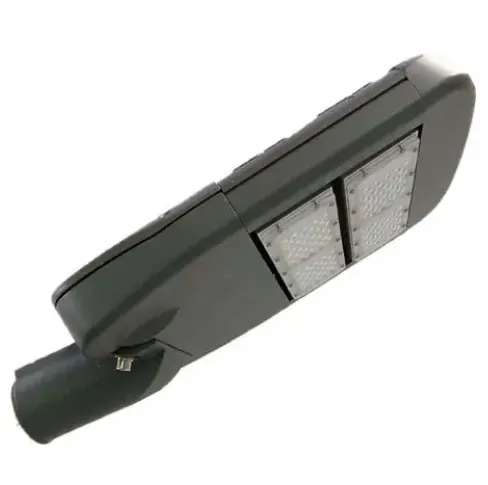
5. Mechanical design: housing, optics, mounting, ingress protection
Materials and mechanical design affect longevity.
Key mechanical elements:
-
Body: die-cast aluminum with corrosion-resistant powder coating. This ensures structural integrity and heat conduction.
-
Lens: polycarbonate or tempered glass with anti-UV treatment to prevent yellowing.
-
Gaskets: silicone or EPDM for IP protection.
-
Mounting interfaces: slip fitter for standard poles, adjustable tilt brackets for solar panel alignment, and trunnion mounts for wall or facade mounting.
-
Ingress protection: IP65 is commonly offered, protecting against dust and jets of water. For marine or heavy salt environments, request IP66 or higher and stainless fasteners. IP ratings are commonly listed on product pages and datasheets.
6. Thermal management and reliability factors
LED lifetime relies on junction temperature control. Efficient thermal path from LEDs into the heat sink maintains lumen depreciation at acceptable rates.
What to check:
-
Thermal resistance data or LM-80 test reports for LED chips.
-
Driver location and thermal isolation, since high driver temperatures shorten life.
-
Heat sink fins geometry and material, which remove heat via conduction to the housing then through convection.
-
Ingress-sealed design that does not trap moisture near electronics.
Recommendation for engineers: require thermal measurements (LM-80/LM-79 combined testing and thermal mapping) under your site ambient temperature conditions.
7. Electrical system: drivers, surge protection, dimming, control options
Drivers: constant current drivers with high power factor (>0.9) and low total harmonic distortion are preferred. Look for programmable drivers that allow current reduction schedules for dimming during low-traffic hours.
Surge protection: built-in surge protective devices rated for at least 4kV to 10kV are common. For high-exposure environments, consider higher surge ratings and external SPD devices.
Control options:
-
Photocell for dusk-to-dawn operation.
-
Motion sensors for adaptive dimming in low-traffic corridors.
-
Remote control via wireless networks, NEMA or Zhaga smart node sockets for smart city integration.
-
0-10V or DALI dimming for central control systems.
Request driver efficiency and dimming curves. Some product listings provide PF, THD, and driver efficiency numbers.
8. Solar-ready options and battery sizing basics
SunplusPro offers full solar street light variants that combine the LED fixture with photovoltaic panels and a battery system. Key sizing considerations follow.
Steps for basic solar sizing:
-
Calculate required daily energy: Fixture wattage × operational hours × system losses.
-
Select battery capacity with usable depth of discharge (DoD) margin; LiFePO4 batteries are common for longer cycle life with typical usable DoD around 80 percent.
-
Choose panel capacity factoring regional insolation and days of autonomy. Monocrystalline panels yield better power density and smaller array size for limited pole surface area.
-
Include charge controller and MPPT selection to optimize energy harvest.
Example simplified table (illustrative only)
| Parameter | Value |
|---|---|
| Fixture power | 100 W |
| Nightly run time | 10 hours |
| Daily energy need | 1,000 Wh |
| System losses and inefficiencies | 20 percent |
| Effective daily energy requirement | 1,200 Wh |
| Battery usable capacity (2 days autonomy) | 2,400 Wh |
| Battery nominal capacity (80% DoD) | 3,000 Wh |
| Panel daily generation (average) | 300 W panel × 4 peak sun hours = 1,200 Wh |
Final sizing must use local solar irradiance data. For procurement, request vendor calculations based on your site latitude and seasonal worst-case sun hours. Many industry analyses list brand recommendations and tradeoffs for panel type and battery chemistry.
9. Installation best practices and pole spacing table
Correct mounting height and spacing deliver uniform light coverage.
General recommendations:
-
For local streets and sidewalks, use pole heights between 4.5 m and 8 m.
-
For collector roads, heights commonly range from 8 m to 12 m.
-
Use Type II or Type III distributions for pedestrian areas. For wide roads, Type III or Type IV distributions often perform better.
Example pole spacing table (typical values; require photometric verification)
| Pole height (m) | Suggested spacing (m) | Lighting goal |
|---|---|---|
| 4.5 | 10 to 12 | Walkways, alleys |
| 6 | 12 to 18 | Residential streets |
| 8 | 18 to 22 | Collector roads |
| 10 | 20 to 28 | Urban arterials |
| 12 | 25 to 36 | Highways, wide boulevards |
Engineers must obtain the fixture IES file, then run lighting calculations in Dialux or AGi32 to confirm illuminance and uniformity prior to installation.
10. Compliance, certification, and testing you should require
Prioritize fixtures that carry certified test data and safety marks.
Documents and marks to request:
-
LM-79 photometric test report for luminous flux, efficacy, and electrical measurements.
-
LM-80 test data plus a lifetime projection report (TM-21) for the LED chips.
-
Safety listings such as UL 1598, ENEC, or CB scheme certification.
-
CE marking for sale in Europe, RoHS compliance for hazardous substances.
-
Salt spray reports or corrosion resistance tests for coastal applications.
-
Vibration and mechanical stability test records for highway installations.
Certifications reduce procurement risk and simplify acceptance testing. Industry reference: many reputable fixtures list IP65 ratings and warranties in product documentation.
11. Procurement checklist for engineers and buyers
Use this checklist during specification and tender.
-
Confirm required average lux and uniformity metrics for the site.
-
Request LM-79 and LM-80/TM-21 data.
-
Specify LED brand and binning tolerance.
-
Confirm driver brand, model, efficiency, and dimming protocol.
-
Verify IP and IK ratings for environment.
-
Ask for surge protection specification.
-
Require IES files for photometric simulation.
-
Confirm warranty details and spare parts access.
-
Confirm packaging, shipping, and customs lead time from factory. SunplusPro offers factory pricing and customization; request MOQ and lead time in the purchase order.
-
Schedule acceptance testing on delivery: sample test for power, lux, photometry, and thermal behavior.
12. Maintenance, lifecycle cost analysis, warranty considerations
Lifecycle costs often dominate procurement decisions.
| Cost factor | Typical range or note |
|---|---|
| Purchase price | Varies by optics, LED chip, driver, warranty |
| Energy cost | See energy savings table earlier |
| Maintenance cost | LED reduces lamp replacement events; driver replacement may still be needed |
| Expected lamp life | 50,000 to 75,000 hours typical |
| Warranty term | 3 to 7 years typical; 5 years common |
Include spare parts and plan for mid-life driver replacement in long-term budget planning. Verify whether warranty covers light output retention or only manufacturing defects.
13. Real-world deployment scenarios and short case examples
Scenario 1: Residential neighborhood retrofit
-
Problem: 250W HPS on 6 m poles created poor color rendering and frequent lamp changes.
-
Solution: Replace with 100W LED with Type III optic, 4000K, CRI 70, and dusk-to-dawn photocell.
-
Outcome: Improved color rendering, 60 to 75 percent energy savings, reduced maintenance costs.
Scenario 2: Off-grid rural road
-
Problem: No grid available.
-
Solution: SunplusPro solar-ready 100W street light with 300W panel, LiFePO4 battery sized for three nights autonomy.
-
Outcome: Reliable illumination without trenching, break-even over 4 to 6 years depending on local fuel and labor costs.
14. Frequently asked questions
Q1: What lumen level should I expect from a 100W LED street light?
A: Typical lumen output ranges from 13,000 to 16,000 lumens depending on LED chip efficacy and optical losses. Always request the LM-79 photometric report for the exact measured lumen figure for the model you plan to buy.
Q2: Can a 100W LED replace a 400W metal halide on a roadway?
A: Yes. With correct optics and higher lumens per watt, a 100W LED can produce equivalent roadway illuminance and better uniformity, leading to major energy savings.
Q3: What is the expected lifetime of a typical 100W LED street fixture?
A: LED lifetime is usually stated as L70 hours. Typical values offered in the market are from 50,000 to 75,000 hours depending on thermal management and chip selection. Request TM-21 projections that use the manufacturer’s LM-80 data for a documented lifetime forecast.
Q4: What ingress protection rating should I require?
A: For general outdoor sites, ask for IP65. For coastal or high-pressure wash sites, require IP66 or IP67 and stainless fasteners to resist corrosion.
Q5: What dimming or control options should I specify for smart-city readiness?
A: 0-10V and DALI remain widely supported. For wireless control, request NEMA or Zhaga compatible sockets and confirm support for your preferred protocol like LoRaWAN, Zigbee, or cellular nodes.
Q6: How do I size a battery for a solar-integrated 100W luminaire?
A: Start with daily energy need: wattage times operational hours. Factor in inefficiencies and days of autonomy. For instance, 100W running 10 hours needs 1,000 Wh plus system losses. Confirm local sun hours and adjust panel capacity accordingly.
Q7: What surge protection rating should be included?
A: Many fixtures include internal SPD rated around 4kV. For high lightning risk sites, choose SPDs rated 10kV or higher and consider external protective devices.
Q8: Which test reports must the vendor provide before shipment?
A: Request LM-79, LM-80, TM-21 lifetime projections, and safety certifications such as UL or ENEC. Confirm that all data reflect the exact LED bin and driver revision planned for your order.
Practical procurement language
Below is template wording procurement teams can copy into a tender document to require minimum information from bidders.
-
Provide LM-79 photometric test report for the exact model and LED bin shipped.
-
Provide LM-80 results for the LED chips and TM-21 life projection.
-
Provide driver datasheet stating PF, THD, dimming capability, and surge rating.
-
State IP and IK ratings with test certificates.
-
Provide a five-year minimum warranty covering LED lumen depreciation below 70 percent and manufacturing defects, or explain deviations.
-
Ship sample units for site acceptance trials before bulk release.
Why choose SunplusPro for 100W street lights
SunplusPro provides factory-direct pricing, OEM customization, and support for solar integration. Buyers who require logo marking, modified optics, or specific driver brands can place OEM customization orders through SunplusPro’s factory channel. For large-scale projects, SunplusPro can provide sample verification, engineering photometry, and site-specific battery sizing for solar options.
Closing summary
A 100W LED street light from a reputable supplier delivers strong energy savings, modern color rendering, and lower maintenance needs compared with legacy lamps. For procurement teams, insist on measured photometry, documented LED lifetime data, driver performance metrics, and adequate ingress and surge protection. For engineers, validate lighting design using the fixture IES file in professional lighting simulation software. SunplusPro supports customization and factory pricing for projects that require volume procurement or unique design features.