

If you need powerful, low-maintenance outdoor illumination for a yard, parking area, construction site, or commercial lot, a properly engineered 100W solar flood light with remote control will deliver strong daytime charging and reliable night lighting while cutting operating cost to nearly zero. For most installations, choose a unit that offers at least 4,000 to 10,000 lumens, a quality LiFePO4 or high-grade lithium battery, a separate solar panel sized to local insolation, IP65 or higher weather rating, and a remote that supports dimming and timed modes. These choices produce the best balance of brightness, lifespan, and predictable operation.
1. Product summary and intended uses
A 100W solar flood light with remote control pairs an LED flood fixture rated for 100 watts with a photovoltaic charging system and a battery that stores energy for night operation. Remote control provides convenience for brightness adjustment, timed operation, motion-trigger priority, and manual override. This product category fits medium-to-large residential projects and small commercial applications such as driveways, loading bays, small parking lots, sports courts, and building façade lighting. Multiple professional models provide lumen outputs ranging from several thousand lumens up to 10,000 lumens for very bright installations.

2. Core components explained
A high-quality 100W solar flood light contains four main subsystems:
-
LED light head: High-efficiency LEDs, driven by a constant-current driver, determine lumen output and color temperature.
-
Solar panel: Monocrystalline or polycrystalline module that harvests sunlight and charges the battery. Panel wattage selection affects available runtime.
-
Battery pack: Common chemistries include LiFePO4 and high-grade lithium-ion. Battery capacity determines night runtime and reserve for cloudy days.
-
Power management & controller: MPPT or PWM charge controller with built-in protections, optional motion sensing and daylight detection, plus remote-control receiver.
Practical performance depends on how these parts match. For instance, a high-lumen LED paired with an undersized panel or a small battery will produce short runtime or reduced brightness. Industry suppliers offer models with tunable color temperature and higher lumen efficacy that compete with mains-powered fixtures for many uses.
3. Typical technical specifications and performance (table)
This table shows typical spec ranges you will find in the market and targets for professional installations.
| Item | Typical consumer entry-level | Recommended professional spec | Why it matters |
|---|---|---|---|
| LED rated wattage | 50W – 100W | 100W | Higher wattage often equals more LED chips, higher lumen output for large areas |
| Lumen output | 1,500 – 5,000 lm | 4,000 – 10,000 lm | Lumens measure visible light delivered; plan by area |
| Solar panel wattage | 10W – 30W | 80W – 240W (separate panel options) | Larger panels shorten charge time and handle cloudy days |
| Battery capacity | 6,000 – 20,000 mAh | 20,000 – 100,000 mAh / LiFePO4 | Bigger capacity extends runtime and increases cycle life |
| IP rating | IP65 common | IP66 or IP67 recommended | Better ingress protection improves durability |
| Remote range | 3 – 8 m | 10 – 20 m | Longer range improves user convenience and remote setup |
| Motion sensor | Optional | Optional with priority modes | Useful for security and energy saving |
| Typical runtime (full brightness) | 3 – 6 hours | 6 – 12+ hours | Depends on battery, panel, and usage patterns |
Note: Market models vary widely. Some professional 100W solar flood fixtures reach near 10,000 lumens when paired with large battery banks and panels.
4. Brightness planning — lumen guide for common areas
When choosing a model, plan lumen requirements by the task. The table below gives practical targets.
| Application | Recommended lumen range | Notes |
|---|---|---|
| Pathway, porch lighting | 300 – 1,000 lm | Lower brightness, accent or safety lighting |
| Backyard, garden | 1,000 – 4,000 lm | Comfortable ambient lighting for gatherings |
| Driveway, garage front | 2,000 – 6,000 lm | Task-oriented, require good shadow control |
| Small parking lot, loading bay | 6,000 – 12,000 lm | Uniform area coverage and security illumination |
| Sports court, large façade | 10,000+ lm | Specialist fixtures and mounting height required |
Measure the area and ceiling height before specifying lumens. Higher mounting height increases required lumen output due to inverse-square falloff. Lumens are the correct metric for brightness; titled watt numbers on consumer listings can be misleading.
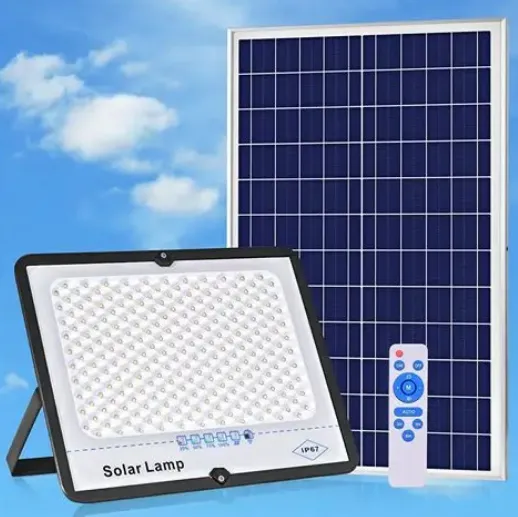
5. Remote control features and user modes (table)
Remotes vary from simple on/off transmitters to multi-button controllers that let users schedule, dim, and toggle modes.
| Remote function | Typical use case | Benefit |
|---|---|---|
| On / Off | Basic control | Easy manual override |
| Brightness dimming (steps) | Adjust ambient level | Extends runtime by lowering output |
| Timed modes (e.g., 3h / 5h / 8h) | Night schedule management | Energy management for multi-night autonomy |
| Motion priority mode | Low dim until motion | Maximizes battery life while providing security light-up |
| Color temperature selection | Warm / neutral / cool | Tailors mood and visual comfort |
| Reset / pairing | Troubleshoot remote or add extra remotes | Field maintainability |
Remote control improves user experience strongly when it includes dimming plus timed schedules. Some systems include smartphone app connectivity or RF pairing to multiple units for synchronized control across a site.
6. Installation, mounting, and panel placement tips
Correct installation makes or breaks system reliability.
-
Separate panel preferred: Install the solar panel in a location that receives unobstructed sun for most of the day. Panel orientation and tilt should match local latitude and avoid shading from trees or buildings. Separate panel units permit optimal placement while locating the fixture for best light distribution.
-
Mount height and angle: For area lighting, mount the fixture higher to increase coverage angle; increase lumen target for higher mounts.
-
Cable routing: Use UV-resistant conduit for long runs. Keep the solar cable run minimal to avoid voltage drop.
-
Fasteners and sealant: Use stainless steel fasteners and silicone where the housing meets wall surfaces to maintain IP rating.
-
Ventilation: Avoid enclosed cavities that trap heat from the driver or battery, since high temperature shortens battery life.
-
Access for maintenance: Mount so battery swap and driver access are straightforward.
A professional installer will test solar harvest during the day and confirm the battery shows full charge within expected hours in good sunlight conditions.
7. Weather protection, housing materials, IP ratings and lifespan
Look for housings made from die-cast aluminum with corrosion-resistant coatings. IP65 rating blocks dust and jets of water, while IP66 and IP67 provide greater protection for heavy rain, pressure washing, or temporary immersion. Proper thermal design with heat sinks helps LEDs maintain lumen output and prevents premature driver failure. Typical lifespans vary:
-
LED chips: rated for 30,000 to 60,000 hours depending on quality and thermal management.
-
Battery: LiFePO4 may provide 2,000 to 5,000 cycles; lower-grade lithium or lead-acid variants will provide fewer cycles.
-
Panel: solar modules commonly carry 10-year performance warranties with expected life of 20+ years under good conditions.
Selecting a product with IP66 or IP67 and a robust thermal path will reduce unplanned replacements.
8. Battery technologies and expected cycles
Battery choice impacts runtime, safety, and lifecycle cost. Common chemistries used in solar flood lights include:
-
Lead Acid (sealed SLA): Lower upfront cost, heavy, limited cycle life, poor depth-of-discharge behavior. Not recommended for professional installations where long life and frequent cycling are expected.
-
Lithium-ion (standard): Higher energy density, better efficiency, but safety and thermal behavior require careful management. Cycle life varies widely.
-
LiFePO4: Best compromise for outdoor solar lighting. Offers higher cycle life, improved thermal stability, and deeper discharge tolerance. Many professional 100W solar flood systems specify LiFePO4 for long-term reliability.
Sizing guidance: aim for battery capacity that gives at least 2 to 3 nights of autonomy at typical use if the site experiences occasional cloudy weather. This reduces the risk of dark nights after multi-day overcast periods.
9. How to choose between integrated and separate-panel systems
There are two common packaging styles:
-
Integrated solar flood lights: Solar panel and light head are permanently attached. Pros: compact, easy to install. Cons: panel placement may be suboptimal if fixture location has shading.
-
Separate-panel systems: Panel mounts separately with cable to the light head. Pros: panel can be sited for best sun exposure; permit larger panels and bigger batteries. Cons: slightly more installation work and cable management.
For reliable, bright 100W systems intended for commercial or security use, separate-panel designs are often preferred because they permit larger panel wattages and better long-term performance.
Also read: Waterproof Outdoor LED Solar Lights with Sensor.
10. Troubleshooting and routine maintenance checklist
Common issues and remedies:
-
Light does not come on: Check daylight sensor setting, battery voltage, panel wiring. Replace remote battery if remote fails.
-
Reduced runtime: Verify panel receives full sun, check for dust on panel, consider battery aging. Clean solar panel monthly in dusty climates.
-
Intermittent operation: Inspect connectors for corrosion, check controller logs if available, confirm firmware or mode settings via remote.
-
Motion sensor not responding: Confirm sensitivity and angle settings; check for reflective surfaces triggering false activation.
Routine maintenance: clean panel surface, inspect cable glands, verify mounting hardware tightness, check battery health annually.
11. OEM and custom ordering advice for SunplusPro buyers
SunplusPro provides factory-direct pricing and customization. When ordering in volume or for a tailored project, provide the following details to your supplier:
-
Required lumen target and color temperature
-
Intended mounting height and area dimensions
-
Local climate profile (sun hours per day, humidity, storm exposure)
-
Desired autonomy nights and runtime at full brightness
-
Preferred battery chemistry and warranty term
-
Any additional features: motion sensor logic, emergency flash, remote group control, or app integration
SunplusPro can recommend panel wattage, battery capacity, and housing options that match conditions and budget. Bulk orders typically allow for negotiated battery and panel upgrades to meet stricter uptime requirements.
12. Sample technical data sheet (table)
Below is a compact sample spec sheet you can use when comparing models.
| Field | Sample value |
|---|---|
| Model | SP-100W-FL-RC |
| LED power | 100W |
| Luminous flux | 5,000 – 10,000 lm (model-dependent) |
| Luminous efficacy | 100-120 lm/W |
| Color temperature | 3000K / 4000K / 6000K selectable |
| Solar panel | 80W monocrystalline, separate mount |
| Battery | 36V LiFePO4, 40,000 mAh |
| Charge controller | MPPT with overcharge, over-discharge protection |
| Remote | IR/RF remote with dimming, timer, motion priority |
| Mounting | Wall bracket, pole mounting kit optional |
| Ingress protection | IP66 |
| Operating temp range | -20°C to +60°C |
| Warranty | 3 years on fixture, 2 years on battery (example) |
Use these values as a baseline when requesting quotations or testing samples.
13. Frequently asked questions
Q1: How bright will a 100W solar flood light really be?
A: Brightness depends on LED efficiency and driver tuning. Typical units offer from around 4,000 lumens up to near 10,000 lumens for professionally engineered systems. Compare lumens rather than watt claims when choosing.
Q2: How long will the light run on a full charge?
A: Runtime depends on battery capacity and selected brightness. With a high-capacity LiFePO4 battery, many 100W units can provide 6 to 12 hours at medium brightness or several nights at reduced levels using timed or motion modes.
Q3: Do I need a professional installer?
A: Simple installations can be DIY if you are comfortable with mounting, wiring, and working at modest heights. For large sites, higher poles, or multiple fixtures, hire a professional to ensure correct panel siting and cable routing.
Q4: What is the recommended IP rating for coastal sites?
A: Choose IP66 or IP67 and a corrosion-resistant finish. Coastal salt spray accelerates corrosion, so stainless fasteners and marine-grade coatings are recommended.
Q5: Can the remote control operate multiple units together?
A: Many RF remotes allow pairing with several fixtures for synchronized control. Check the protocol and pairing method in the product manual.
Q6: How do I size the panel and battery for two nights of autonomy?
A: Estimate nightly energy use (lumens needed and approximate watt draw), multiply by nights desired, add margin for inefficiencies, then pick a battery capacity that meets that energy. Panel wattage and hours of sun determine daily recharge; oversize panels in low-insolation locations.
Q7: Is LiFePO4 worth the extra cost?
A: For commercial reliability and long life, LiFePO4 often proves cost-effective over time due to higher cycle life and better thermal stability.
Q8: What warranty and certifications should I check?
A: Look for CE, RoHS, and if relevant, ETL or UL listings. Confirm battery and fixture warranty durations and what is covered.
14. Final recommendations and next steps
-
Specify lumen target first, then choose battery capacity and panel wattage to meet runtime goals. Use lumens to size brightness, not LED watt figures alone.
-
Prefer separate-panel systems for reliable charging and longer runtimes in shaded or obstructed fixtures.
-
Favor LiFePO4 batteries for professional applications, given their cycle life and thermal characteristics.
-
Require IP66 or higher for long outdoor life and request sample performance data including real-world lumen output and measured runtime under local sun hours.
-
For bulk or custom orders, provide SunplusPro with site details so the factory can propose an optimized panel-battery-driver combination.
Quick comparison table: Typical market models versus SunplusPro (factory-direct)
| Feature | Typical off-the-shelf model | SunplusPro factory-direct option |
|---|---|---|
| Panel size | Often 10W – 30W | Custom 80W – 240W options |
| Battery chemistry | SLA or low-grade Li-ion | LiFePO4 standard options |
| Remote features | Basic timers, on/off | Multi-mode, dimming, group pairing |
| Warranty | 1 year typical | Extended options available with factory pricing |
| Customization | Limited | ODM offerings and OEM branding available |
SunplusPro can supply tailored solutions that align with site needs while keeping factory pricing advantages.