

For typical small-to-medium roadways, parking areas, and community streets, a correctly specified 150W LED solar street light from SunplusPro—paired with a properly sized solar array and a LiFePO₄ battery sized for at least two nights of autonomy—delivers bright, uniform illumination, long service life, and a strong total-cost-of-ownership advantage compared with conventional grid-fed fixtures.
1. Quick summary and recommended system baseline
A 150W LED solar street light system is more than the lamp head’s rated power. For robust, reliable performance in most climates the practical baseline is:
-
LED module: equivalent to 150W output (roughly 17,000–25,000 lumens depending on LED efficacy).
-
Solar array: 150–350W peak (depending on site latitude and expected autonomy).
-
Battery: LiFePO₄ battery bank sized for 2–4 nights autonomy (common manufacturer specs include 12.8V 90Ah or multi-cell 22.2V 57Ah variants).
-
Controller: MPPT charge controller with built-in lighting controls and remote monitoring (recommended for efficiency and battery life).
These components, matched to local insolation and mounting geometry, decide whether a 150W solar street light meets nightly runtime and reliability targets.

2. What “150W” means in solar street-lighting systems
When manufacturers label a product “150W LED solar street light” they usually refer to the nominal electrical power consumed by the light engine (LED driver output). Because LED efficacy varies, two 150W modules may produce different lumen totals. In practice, modern high-efficacy LEDs yield 120–170 lumens per watt, so a 150W LED can produce anywhere from roughly 18,000 lm (at 120 lm/W) to >25,000 lm (at 165+ lm/W) depending on the LED bin and optics. Real product spec sheets and lab tests are the final arbiter.
Key implication: always check delivered lumens and light distribution (IES files) rather than relying on wattage alone.
3. Core components and why each matters
A complete 150W solar street-light system includes the following:
LED module and driver
-
High-efficiency SMD or COB LEDs, thermal path to housing. The driver (preferably Mean Well or equivalent) must handle inrush, provide constant current, and support dimming profiles and surge protection.
Photovoltaic panels
-
Monocrystalline panels (higher cell efficiency) are typical for urban projects. Panel wattage is chosen based on daily insolation, load, and desired autonomy. Some vendors pair split panels for modular mounting.
Battery pack
-
LiFePO₄ chemistry is now standard because of cycle life, thermal stability and depth-of-discharge (DoD) performance. Typical factory pack options shown in commercial specs are 12.8V 90Ah or multi-cell configurations; select capacity for required night-time hours plus reserve depth.
Charge controller
-
MPPT controllers extract more energy from panels than PWM under variable conditions; look for a controller with battery management, temperature compensation and programmable lighting profiles.
Housing and optics
-
Aluminum diecast housings with integrated heat sinks, quality lenses or TIR optics to shape beam and control glare.
Remote monitoring and controls (optional)
-
Bluetooth or GSM/LoRa monitoring allows scheduling, fault alerts and dimming profiles for energy optimization. Some commercial models offer mobile apps.
4. Typical performance numbers and what to expect
Below are practical target figures that most reputable 150W solar street lights will list. These are useful for spec comparisons.
Performance table — typical ranges
| Parameter | Typical range (commercial products) | Notes / why it matters |
|---|---|---|
| Rated LED power | 150 W | Nominal driver output |
| Delivered lumens | 17,000 – 25,500 lm | Depends on LED efficacy and binning. |
| Lumens per watt (system) | 120 – 170 lm/W | Higher LPW reduces energy draw and battery size. |
| Solar panel | 143 W – 300+ W | Many vendors list panels around 143W–250W for single-fixture systems, depending on autonomy. |
| Battery capacity | 12.8V 90Ah (or equivalent) | Battery pack sizes vary; LiFePO₄ common for 2–4 nights autonomy. |
| Charging time | 4–8 hours (full sun) | Actual time depends on insolation and MPPT efficiency. |
| Lifetime (LED) | 50,000 – 100,000 hours | Higher quoted lifetimes reflect binning and thermal design. |
| IP/IK | IP65–IP66; IK08 typical | Weather and vandal protection levels for outdoor reliability. |
Most product sheets you inspect will list some combination of the above ranges; use delivered lumen and LPW to size batteries and panels rather than wattage only.
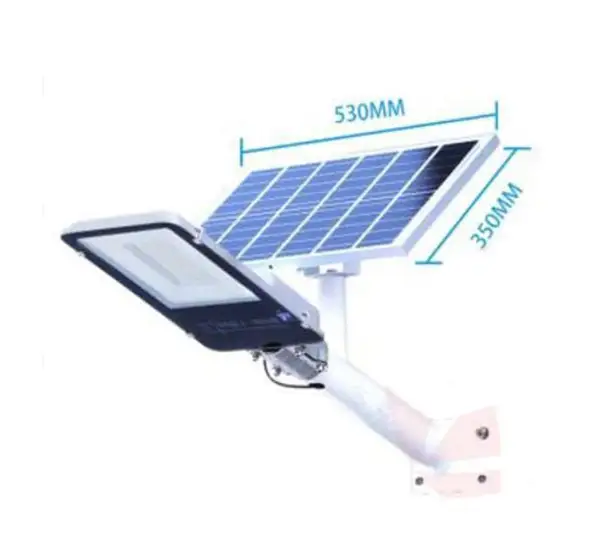
5. Sizing rules: solar module, battery capacity, controller selection
Practical sizing requires local solar data (daily sun hours) and desired nights of autonomy. Here are rules-of-thumb to build a first pass for specification.
Step 1. Decide useful lumen-hours per night
-
For roadway or parking area illumination, plan on the fixture operating at full output for the first 4–6 hours, then dimming to maintain presence for the remainder. If a 150W unit produces 20,000 lm and you require 6 hours at full setpoint, energy draw: 150W × 6h = 900 Wh.
Step 2. Add dimming / control overhead
-
Include a safety margin for battery ageing and cloudy days (multiply by 1.2–1.5).
Step 3. Battery capacity
-
For 2 nights autonomy: Battery Wh = daily consumption × 2 × safety factor. Convert to Ah at battery voltage. Example: 900 Wh × 2 × 1.3 ≈ 2340 Wh. For a 12.8V pack: 2340 / 12.8 ≈ 183 Ah (round up). Many vendors avoid heavy over-discharging and so quote common packs like 90Ah for lower consumption profiles or higher Ah for full-power use.
Step 4. Solar panel sizing
-
Panel Wattage (W) ≈ Daily Wh requirement / equivalent peak sun hours / MPPT efficiency. Example with 5 peak sun hours: 900 Wh / 5h ≈ 180 W, then add margin for inefficiencies and cloudy days (×1.2) ≈ 216 W. Commercial systems often list panels between ~143 W and 300 W for 150W fixtures depending on local insolation and autonomy design choices.
Step 5. Controller selection
-
Use MPPT controllers sized for maximum solar array current and battery chemistry (LiFePO₄). Controllers with programmable curves and remote telemetry are recommended for long-term performance.
Sizing summary example (typical mid-latitude city, 5 peak sun hours):
-
Daily full-power consumption: 150 W × 6 h = 900 Wh
-
Battery: ≈ 2,000–2,500 Wh (12.8V × 160–200 Ah) for 2 nights autonomy (vendor designs vary).
-
Panel: 220–300 W monocrystalline array with MPPT.
Because site variables shift the result, SunplusPro will model each project and provide an optimized panel/battery pairing in proposals.
6. Mounting, pole height and light distribution planning
Pole height, aiming angle, and beam pattern (Type II, III, IV, V) determine uniformity and spacing.
Common guidance
-
Residential paths and sidewalks: 3–6 meters height.
-
Main streets and highways: 8–12 meters or higher (some commercial specs list 30–40 ft for wide arterials).
A commonly used relationship (for uniform coverage) is H ≥ 0.5R where H is pole height and R is the target radius of illuminated area for that pole; use IES files and lighting software to determine final spacing and overlap.
Optics
-
Type II/III distributions are typical for streets. Choose optics that control cut-off to minimize glare while meeting minimum lux requirements.
7. Weatherproofing, IK/IP ratings and material choices
Outdoor fixtures must handle wind, salt, dust and impact.
IP rating
-
IP65 to IP66 is standard; this protects against dust and heavy rain. Check product data for solar junction box and battery enclosure ratings.
IK rating
-
IK07–IK10 for vandal resistance depending on location. For high-vandal zones specify IK09–IK10.
Materials
-
Corrosion-resistant aluminum alloys with powder coating perform well in coastal environments. Ensure stainless hardware and proper sealing of junctions.
8. Energy economics: upfront cost, maintenance, payback
Solar street lights carry higher upfront hardware cost but save on trenching, grid connection, power bills and often maintenance.
Simple payback comparison table (illustrative)
| Item | Solar 150W system (SunplusPro baseline) | Grid-fed 150W LED (driver + AC supply) |
|---|---|---|
| Initial hardware & install | Higher (panel + battery) | Lower (fixture + connection) |
| Annual energy cost | Near zero | Utility bills (150W × hrs × $/kWh) |
| Infrastructure cost | No trenching or cable runs | Trenching, cabling, transformer etc. can be expensive |
| Maintenance | Battery replacement every 5–10 years; periodic cleaning | Driver replacement and wiring repairs; lower battery cost |
| Typical payback | 2–7 years depending on site & incentives | NA (grid ongoing operating cost) |
Because installation conditions (distance to grid, local energy prices, incentives) hugely affect payback, SunplusPro produces project-level TCO models for customers.
9. Customization options SunplusPro offers
SunplusPro can supply factory-direct customization to match project needs:
-
Panel configuration and wattage.
-
Battery chemistry and capacity (specialized LiFePO₄ packs).
-
Driver programming (dimming schedules, motion trigger, remote monitoring).
-
Optic choices (Type II, III, IV, V; narrow, wide, asymmetric).
-
Mounting adaptors and pole-top arrangements.
-
Color temperature choices 3000K / 4000K / 5000K to align with municipal standards.
These customization levers allow balancing initial cost, autonomy and luminous performance.
10. Installation checklist and routine maintenance plan
Pre-installation
-
Confirm site insolation data and orientation for panel mounting.
-
Validate pole foundation load and wind rating.
-
Verify product certificates and warranty terms.
Installation steps
-
Mount pole and luminaire per torque spec.
-
Secure solar panels at specified tilt and azimuth.
-
Connect MPPT controller, battery, and LED driver following wiring diagrams.
-
Commission via remote or onboard interface, set dimming schedule and night-time thresholds.
Maintenance schedule (recommended)
-
Monthly visual check first 3 months, then quarterly: clean PV glass, inspect seals, check fixture tightness.
-
Annually: test battery health and controller logs. Replace battery per manufacturer expectancy (LiFePO₄ often 5–10 years depending on cycles and temperature).
11. Common failure modes and troubleshooting quick fixes
-
Battery underperformance: Check state of charge, temperature compensation, and for parasitic drains. Consider replacing if capacity falls below warranty threshold.
-
Panel soiling: Clean panel if output drops; check mounting angle for shading.
-
Driver faults: Inspect surge protection and wiring; confirm proper heat-sinking. Mean Well and similar drivers include protections that will fault gracefully.
-
Communication loss: Check antenna, SIM (if cellular), or LoRa gateway.
12. Certifications, standards and procurement tips
When specifying for municipal or commercial procurement, require:
-
IEC 60598 for luminaires where applicable.
-
IP/IK ratings on the spec sheet.
-
Battery certifications (UN38.3 for shipping, manufacturer cycle test reports).
-
Manufacturer lab reports for lumen output and LM-79/LM-80 testing if possible.
-
Warranty clarity on panel, battery and LED (commonly 3–5 years for electronics, 5–10 for panels).
Procurement tip: insist on IES files and photometric layouts for the actual model to be supplied, not only generic data.
13. Real-world applications and short case examples
Community street retrofit: Replaced grid-fed 150W fixtures on low-density lanes with SunplusPro 150W solar units to eliminate trenching costs, maintaining target lux while saving operational electricity.
Parking area illumination: A 150W solar luminaire with Type III optics provided adequate uniformity for mid-size parking, with runtime extended through programmable dimming after midnight.
Remote roadways: Deployed in low-infrastructure environments to light last-mile connectors where grid extension was cost-prohibitive.
Each deployment required site-specific modeling for panel orientation, pole spacing and battery sizing.
14. FAQs
Q1: What delivered lumen output should I expect from a 150W solar street light?
A1: Expect roughly 17,000–25,500 lumens based on modern LED efficacies between ~120 and 170 lm/W; always request the actual delivered lumen and IES file from the supplier.
Q2: How large should the solar panel be for a 150W light?
A2: Panel size depends on local peak sun hours and required autonomy. Typical commercial pairings range from ~143 W up to 300 W for single-fixture installations; SunplusPro models system size to meet the customer’s target autonomy and location.
Q3: Which battery chemistry is recommended?
A3: LiFePO₄ is preferred for outdoor solar street lights due to long cycle life, thermal stability and safe performance. Vendors commonly supply 12.8V LiFePO₄ banks at various Ah ratings.
Q4: What pole height is suitable for a 150W unit?
A4: Typical pole heights vary with application; residential paths 3–6 m, main streets 8–12 m or higher for major arterials. Use photometry to confirm spacing and uniformity.
Q5: How many nights of autonomy should I design for?
A5: Two nights is a common baseline for urban installations; choose three to four nights for areas with frequent cloud cover or critical lighting. More autonomy increases battery and panel size and cost.
Q6: Are remote controls and monitoring necessary?
A6: They are not mandatory but strongly recommended for fleets: monitoring enables preventive maintenance, energy trend tracking and remote dimming schedules that extend battery life.
Q7: How long do LEDs and batteries last?
A7: High-quality LEDs often are rated for 50,000–100,000 hours depending on thermal management; LiFePO₄ batteries typically last 5–10 years depending on cycles, depth of discharge and temperature.
Q8: What warranties should I expect from a factory-supplier?
A8: Typical commercial warranties: LED modules 3–7 years, panels 10–25 years (power warranty), batteries 3–8 years depending on chemistry; confirm coverage for system commissioning and labor. Ask SunplusPro for full warranty terms in proposals.
Closing notes and how SunplusPro helps
SunplusPro offers factory-direct pricing with flexible customization and full project engineering: panel/battery matching, photometric layouts and remote monitoring options. For any project we model local insolation, pole geometry and dimming strategy to deliver a cost-optimized and reliable 150W solar street-light solution.