

A well-designed 5 kW off grid solar system will reliably power medium loads such a set of LED solar street lights, household loads for a small cabin, or a mixed lighting and service load when paired with a properly sized battery bank and inverter. For continuous autonomous operation through low insolation days, plan for 10–30 kWh of usable battery capacity, a 48 V inverter slightly above 5 kW rated continuous power with adequate surge capacity, and 12–16 high-efficiency PV modules in the 400–500 W class, dependent on local sunlight. This configuration balances capital cost, expandability, and operation simplicity, and it works well when combined with SunplusPro LED street light fixtures that support DC coupling or AC output depending on installation choice.
1. What is a 5 kW off grid solar system
A 5 kW off grid solar system is an independent power installation sized to deliver up to approximately 5,000 watts of instantaneous DC-to-AC conversion from the inverter for on-site loads without connection to the public utility. Off grid systems include energy storage and control components that enable operation during night and during periods of low sun. They differ from grid-tied systems in that they must store enough energy for intended autonomy days and typically include a backup generator or load-management strategy for extended cloudy periods.

2. Key components and functional roles
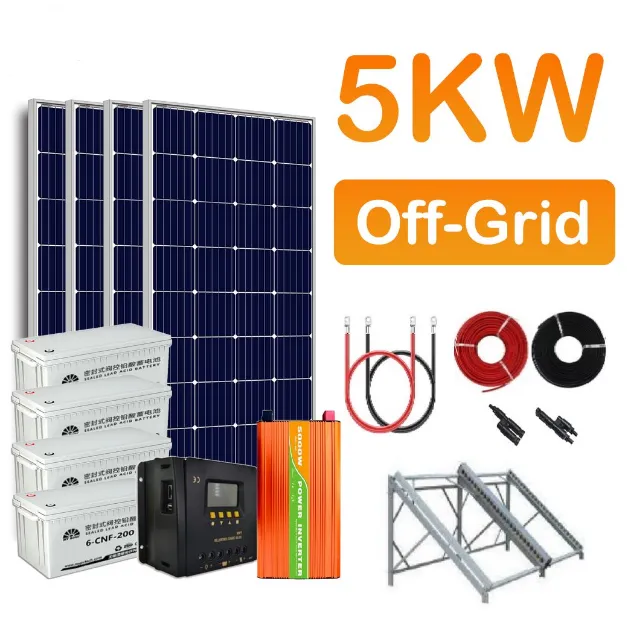
A reliable off grid system contains these functional groups:
-
Solar modules (PV array) that convert sunlight into DC electricity
-
Solar charge controller or hybrid inverter that manages PV input and battery charging
-
Battery bank for energy storage to supply loads at night or in low sun
-
Off grid inverter that produces grid-grade AC if loads need AC power
-
Mounting hardware, wiring, fuses and surge protection for safety and longevity
-
Monitoring, metering and control for system visibility and load management
This component set is standard across vendors and installation types.
3. PV array sizing, expected daily energy and panel count
Design begins from energy demand. For a 5 kW inverter sized system, the PV array that feeds it will usually be dimensioned to produce sufficient energy over a typical day and to charge the battery bank in reasonable sunlight hours.
Typical ballpark outputs for a 5 kW array in many regions:
-
Nominal PV rating: 5,000 W DC
-
Peak-sun hours method: daily energy = PV rating × peak sun hours
-
Example: with 4 peak sun hours the array can produce roughly 20 kWh/day
Solar production varies by latitude, season and module orientation. Many practical design references use 12–15 modern panels in the 400–450 W category to reach 5 kW nominal array size with room for mismatch and future expansion. Real world yield and local losses (temperature, soiling, shading, wiring) should be applied when finalizing panel count.
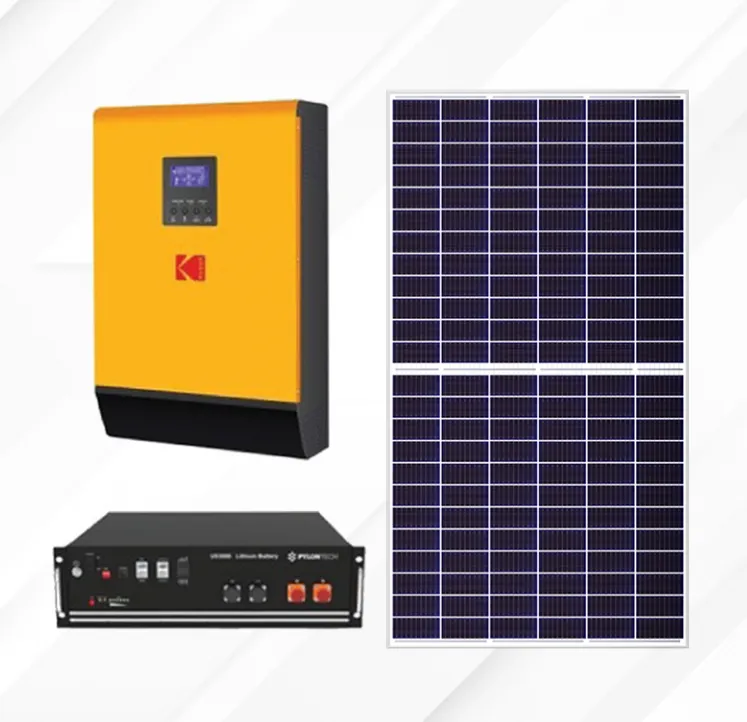
PV array quick reference table (typical modern panels)
| Panel wattage | Panels for ~5 kW DC | Estimated daily output (4 peak sun hrs) |
|---|---|---|
| 350 W | 15 panels | 17.5 kWh |
| 400 W | 13 panels | 20.8 kWh |
| 450 W | 12 panels | 21.6 kWh |
| 500 W | 10 panels | 20.0 kWh |
Notes: use manufacturer STC ratings for panel sizing, then apply a derating factor 0.75–0.85 for real-world losses when calculating battery charge time.
4. Battery bank sizing, chemistries and usable capacity
Battery sizing is the most influential design decision in off grid systems. There is tradeoff between autonomy days, depth of discharge and capital cost. Typical guidance for a 5 kW system depends on the project intent:
-
Backup only for evening lighting and short runs: 10 kWh nominal battery bank (about 5–7 kWh usable depending on chemistry and DOD)
-
Partial off grid with some daytime loads moved to battery: 15–20 kWh nominal (10–16 kWh usable)
-
Full day+night off grid for moderate home loads: 25–30 kWh nominal (20 kWh usable or more)
A conservative design often plans for the month with least sunlight to ensure reliability. Battery type choices include lithium iron phosphate (LiFePO4) for long cycle life and good usable depth, and lead acid flooded or AGM for lower front cost but higher maintenance and lower usable depth. Practical battery bank sizing calculators and step methods are widely used by designers to convert daily watt-hours demand into amp-hours at the chosen system voltage.
Battery chemistry summary table
| Chemistry | Typical usable Depth of Discharge | Cycle life (approx) | Pros | Cons |
|---|---|---|---|---|
| LiFePO4 | 80–90% | 2000–5000 cycles | High usable energy, compact, low maintenance | Higher capital cost per kWh |
| LFP (other lithium) | 70–90% | 1500–4000 cycles | High energy density | Requires BMS and thermal care |
| Flooded lead acid | 30–50% | 300–800 cycles | Lower upfront cost | Needs maintenance and ventilation |
| AGM/gel lead acid | 40–60% | 400–1000 cycles | Sealed, low maintenance | Lower usable capacity, limited temp range |
Practical tip: using a 48 V system voltage reduces charge current and cable losses for a 5 kW inverter and simplifies parallel expansion.
5. Inverter selection: continuous rating and surge capacity
The inverter must meet continuous load rating in addition to surge needs from motors and CFL-style inrush. For a 5 kW nominal project, choose an inverter rated slightly above 5,000 W continuous to provide headroom and avoid throttling under real load. Verify the inverter’s peak surge rating for loads such as pumps or LED drivers that have small startup surges.
Two topologies appear in off grid projects:
-
Pure sine wave off grid inverter integrated with inverter-charger functionality for battery charging from generator and AC bypass
-
Hybrid inverter (multi-mode) that accepts PV input and manages battery and AC loads centrally
When selecting, confirm battery voltage compatibility, charger current capacity, MPPT support, parallel expandability and manufacturer support. Industry vendors publish recommended component matches and wiring diagrams.
6. Balance of system and safety
Balance of System includes MPPT charge controllers if a separate controller is used, fuses, breakers, combiner boxes, DC disconnects, AC distribution panel, surge arrestors and monitoring devices. Proper cable sizing and thermal protections are mandatory. Earthing and lightning protection should reflect local codes. For LED street light installations, include dedicated lighting distribution and photocell controls so that lights are managed independently from general loads.
7. Sample system specifications and three real-world configurations
Below are three sample configurations targeted to common project goals. These are starting points for detailed engineering.
Sample systems table
| Use case | PV array | Battery bank nominal | Inverter | Estimated daily usable energy |
|---|---|---|---|---|
| Street lighting cluster, 20 × 100 W LED (night only) | 5 kW (12 × 420 W) | 10 kWh LiFePO4 | 5.5 kW pure sine | ~15–18 kWh |
| Small cabin with appliances and lighting | 5 kW (13 × 400 W) | 20 kWh LiFePO4 | 6 kW hybrid inverter | ~18–22 kWh |
| Medium off grid home with appliances and HVAC load shedding | 6 kW (15 × 400 W) | 30 kWh LiFePO4 | 8 kW hybrid inverter | ~25–30 kWh |
Designers should size to worst month insolation and include generator backup if uninterrupted full-comfort loads are required.
8. Cost breakdown and simple ROI considerations
System cost varies by region, component brand, shipping and installation complexity. Recent market surveys show a 5 kW residential or small commercial system before incentives commonly lands in a range. For budgeting use these consolidated references:
Typical installed 5 kW system cost range in the US market sits around $10,000–$20,000 before incentives, with battery integrated systems reaching higher.
Cost example table (indicative)
| Item | Low estimate | Mid estimate | High estimate |
|---|---|---|---|
| PV modules (5 kW) | $1,200 | $2,000 | $3,000 |
| Inverter and charge controller | $800 | $2,000 | $4,000 |
| Battery bank (10–30 kWh) | $2,000 | $8,000 | $15,000 |
| Mounting, BOS, wiring | $500 | $1,500 | $3,000 |
| Installation and commissioning | $1,500 | $3,000 | $5,000 |
| Total | $6,000 | $16,500 | $30,000 |
Return on investment depends on avoided fuel or grid cost, incentives, expected lifetime and maintenance. For street lighting projects, payback often improves due to long lamp life of LED fixtures, minimal maintenance with integrated PV arrays, and avoided trenching costs for grid extension.
9. Design notes for LED solar street light projects
When the primary load is LED street lights, system design can be optimized for night demand and long autonomy is often not needed if lights operate on photocell schedules.
Key considerations:
-
Night energy per fixture = rated LED power × hours of operation. Example: 100 W LED for 10 hours uses 1.0 kWh/night.
-
Grouping street lights into lighting circuits with dedicated switches and photocells reduces battery drain during maintenance windows.
-
For direct DC LED operation, some LED drivers accept DC feeding from battery through properly sized MPPT. For AC drivers select inverter with low THD to avoid driver issues. Confirm SunplusPro LED drivers compatibility with DC coupling or AC output.
Design note: a 5 kW PV array paired to a 10 kWh battery bank can comfortably operate multiple LED street fixtures during the night where daily energy per fixture is modest.
10. Installation, permitting and site planning checklist
-
Site solar resource survey and shading analysis
-
Structural assessment for panel mounting (roof or ground)
-
Local electrical permit and inspection requirements review
-
Battery room or enclosure ventilation and fire code compliance
-
Earthing and lightning protection plan
-
Cable routes, combiner boxes and labeling plan
-
Commissioning and monitoring setup for remote alerts
11. Operation, maintenance and troubleshooting tips
-
Monitor battery state of charge and inverter event logs weekly during the first months
-
Clean PV modules seasonally where dust or pollen are present
-
Replace lead acid battery elements per manufacturer schedule; plan longer cycle LiFePO4 replacements at end of life
-
For lighting circuits, verify photocell operation and firmware for dimming schedules
12. Procurement checklist for engineers and buyers
-
Confirm the total daily kWh load and peak instantaneous power requirement
-
Choose system voltage 48 V preferred for medium sized installs
-
Select inverter with continuous rating ≥ required load and surge rating for motors
-
Specify battery chemistry and usable capacity with clear warranty terms
-
Request datasheets for LED street light drivers confirming DC or AC compatibility
-
Confirm BMS and monitoring options with remote telemetry
-
Ask for mechanical drawings for mounting hardware and wind/snow ratings
-
Get a single line electrical diagram and commissioning test plan in the bid
13. Eight Frequently Asked Questions
1. What size battery do I need for a 5 kW off grid system powering LED street lights?
Battery sizing depends on the nightly run time and number of fixtures. For rough sizing convert total nightly watt-hours into kWh and then add reserve for cloud cover. For simple backup lighting only, 10–15 kWh nominal with LiFePO4 chemistry often suffices. For longer autonomy plan 20–30 kWh. Use battery calculators that apply depth of discharge and system voltage to convert to amp-hours.
2. Can I run a 5 kW off grid system with a 24 V battery bank?
Technically possible, but higher system currents at 24 V increase conductor sizes and losses. For 5 kW continuous loads a 48 V battery system reduces DC currents and is industry preferred.
3. Should I use an inverter-charger hybrid or separate inverter and charge controller?
Hybrid inverters reduce wiring complexity and often include MPPT charging capability plus AC generator input. Separate inverter and MPPT charge controllers can allow modular upgrades. Choose based on expandability, vendor support and serviceability.
4. How many panels do I need for a 5 kW system?
With modern 400 W panels, about 12–13 panels produce nominally 4.8–5.2 kW. Adjust panel count upward to cover system losses and to meet desired battery charging time.
5. What maintenance do LiFePO4 batteries require?
Minimal maintenance. Monitor state of charge, avoid sustained overcharge, and ensure BMS functions. Periodic firmware updates and thermal management checks are recommended.
6. How does shading affect system sizing?
Even partial shading on a PV string reduces output dramatically if modules are in series. Use string layouts, microinverters or optimizers if shading is unavoidable.
7. Is a generator needed with a 5 kW off grid solar system?
For long stretches of poor weather or heavy loads it is prudent to include a standby generator able to charge batteries and carry peak loads. Generator sizing depends on inverter charging capacity and battery bank size.
8. How do I choose an LED street light matched to my solar system?
Match the fixture’s average nightly energy to your battery capacity and expected solar production. Prefer fixtures with dimming schedules, low standby losses and drivers rated for the system voltage or compatible with inverter output. SunplusPro offers custom dimming profiles and integrated PV controllers for street lighting projects to optimize autonomy and lifetime.