

2000 lumens produces strong, clearly useful illumination for many home and outdoor needs — roughly equal to about two to three standard 60 W incandescent bulbs combined, and bright enough for a medium-sized room, a high-output task light, or a powerful handheld torch. Perceived brightness depends heavily on beam angle, distance to the surface, reflectivity of that surface, and human eye adaptation. For controlled spotlighting, 2000 lumens can produce hundreds to thousands of lux on a target; when spread into a wide flood it will feel much milder.
1. What lumens measure and why that number matters
Lumens (symbol lm) quantify total visible light output from a source per unit time — technically the luminous flux emitted into all directions. That metric tells how much light leaves the lamp, but not how that light is distributed in a room or onto a work surface. Two lamps with the same lumen rating can look wildly different when one is focused into a tight beam and the other is flooded broadly. For conversions and technical calculations, lumens are distinct from lux and candela; lux measures illuminance on a surface, and candela measures luminous intensity in a particular direction. If a numeric conversion is needed, use a lumen-to-lux calculator or the standard geometric formulas.
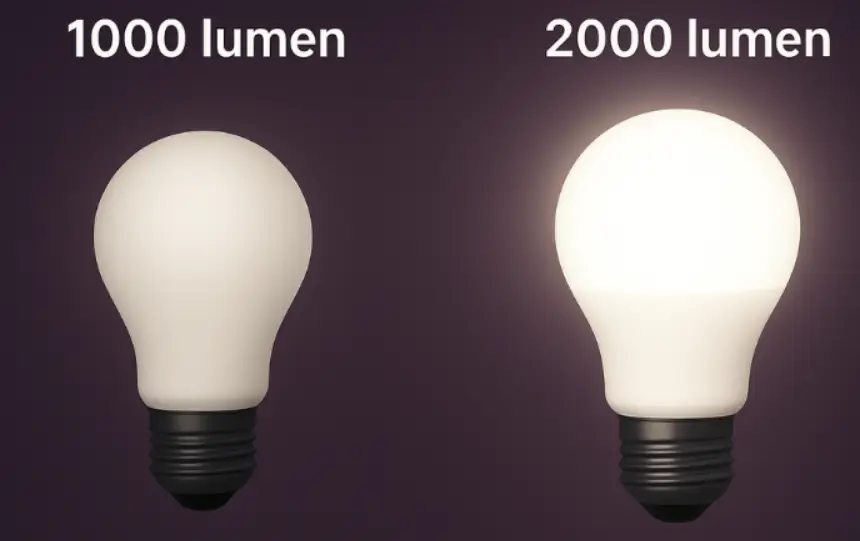
How Bright Is 2000 Lumens? Comparison Of Light Bulb Types.
2. Real-world comparisons that help you picture 2000 lumens
-
A typical 60 W incandescent bulb produces about 800 lumens. By that comparison, 2000 lm is roughly two to three times brighter than one 60 W incandescent. That is a useful quick mental benchmark.
-
Common LED household bulbs labeled 800 to 1600 lumens correspond to everyday uses like table lamps and ceiling fixtures. A 2000-lumen LED lamp provides noticeably more light and is often used in task lighting, kitchens, garages, or outdoor security lights.
-
For portable torches and flashlights, 1000 to 2000 lumens is the mid-to-high range for tactical, search, or rescue lights; 2000 lm feels very bright in a handheld form and can illuminate distant objects if focused into a narrow beam.
3. Beam angle, distance, lux and why perceived brightness changes
Perceived brightness on a surface is best expressed in lux (lx). Lux equals lumens divided by the surface area over which those lumens spread. Practical implications:
-
Narrow beam: same lumens concentrated into a small spot produce very high lux values and strong perceived brightness.
-
Wide flood: same lumens spread over a large area lead to modest lux and softer perception.
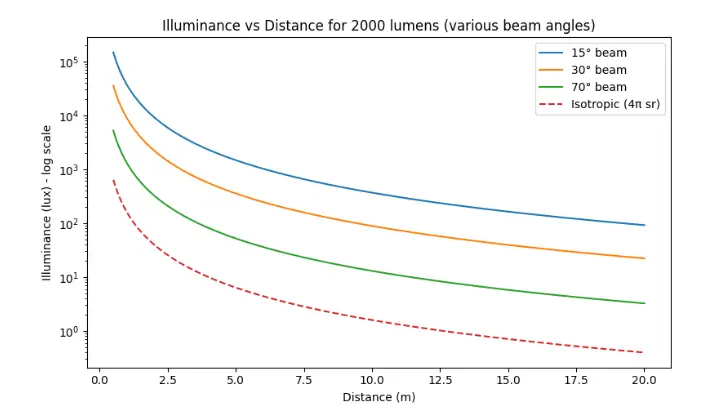
Example measurement from a real torch maker: a 2000-lumen light in a 70° wide flood at 2 meters might give a few hundred lux on the wall, while the identical light focused to a 15° spot at 2 meters yields many thousands of lux on the same patch. This demonstrates why beam control matters more than the raw lumen number for many tasks.
4. Typical uses where 2000 lumens works well
-
Kitchen or workshop task lighting: 2000 lm can light a standard kitchen or workbench effectively when fixtures are correctly positioned. Recommended lumen totals for rooms depend on room size and task; kitchen counters commonly aim for several hundred lux.
-
Garage, basement, or utility area: a few fixtures totaling 2000 lm provide bright, useful illumination.
-
Outdoor security and flood lighting: a 2000-lumen fixture with proper optics delivers sufficient brightness for small-to-medium yards or driveway coverage.
-
Portable searchlights and professional flashlights: 2000-lumen handheld units serve search, emergency response, and outdoor recreation needs, where both intensity and throw matter.
5. Flashlight and portable lighting context: throw, beam, and runtime
When evaluating 2000-lumen flashlights consider three linked specs:
-
Output in lumens: total emitted light.
-
Beam profile and ANSI throw rating: how focused the beam is influences range. A tightly focused 2000 lm beam can spot objects at long range; a wide 2000 lm flood cannot.
-
Runtime and thermal management: higher lumen settings reduce battery life and increase heat; many lights step down after thermal limits or use multiple power modes to balance brightness and endurance. Enthusiast and professional documentation stresses that lumens alone do not predict visible performance.
6. Safety, comfort, glare and recommended illuminance levels
Bright light improves visibility but can also create glare and discomfort. For indoor task lighting, recommended illuminance levels from lighting authorities and industry guidance are:
-
Living areas: about 100 to 300 lux.
-
Kitchen counters and detailed task surfaces: 300 to 750 lux.
-
Workshops and precision tasks: 500 to 1000 lux or higher depending on the work.
Using a 2000-lumen fixture, placement and optics should be designed to reach desired lux on task surfaces rather than producing wasted glare. Follow local codes and IES recommendations for industrial or specialty applications.
7. Converting lumens to lux — practical formulas and tools
Worked example 1: isotropic point assumption
-
If a light truly radiated uniformly into all directions, illuminance at distance r would follow: lux = lumens / (4 × pi × r^2). That provides a lower-bound estimate for distributed light. Use the isotropic formula for quick checks.
Worked example 2: real-world focused beam
-
For a circular spot on a flat surface perpendicular to the beam, approximate the spot radius r_spot = distance × tan(beam_angle/2). Then spot area = pi × r_spot^2. Illuminance (lux) ≈ lumens divided by that area. This calculation is how the charts below were generated. For plug-and-play conversions use online lumen-to-lux calculators.
8. Practical buying advice and a specification checklist for 2000-lumen lights
When the specification lists 2000 lumens, verify these supporting details:
-
Beam angle or optics: determines lux distribution.
-
CCT (correlated color temperature): “warm” vs “cool” light changes perceived brightness and color rendering.
-
CRI (color rendering index): higher CRI means more accurate color rendering under the lamp.
-
Thermal management and sustainment of rated output: some lights advertise peak lumens but cannot sustain them for long. Look for sustained output or thermal step-down information.
-
Power source and runtime: battery capacity, USB charging, mains supply, or integrated battery.
-
Weather and ingress protection rating for outdoor fixtures.
-
Warranty and test standards: look for ANSI FL1 (for portable lights) or manufacturer test conditions.
9. Visual charts and tables
Two charts were produced to clarify the numeric relationships.
-
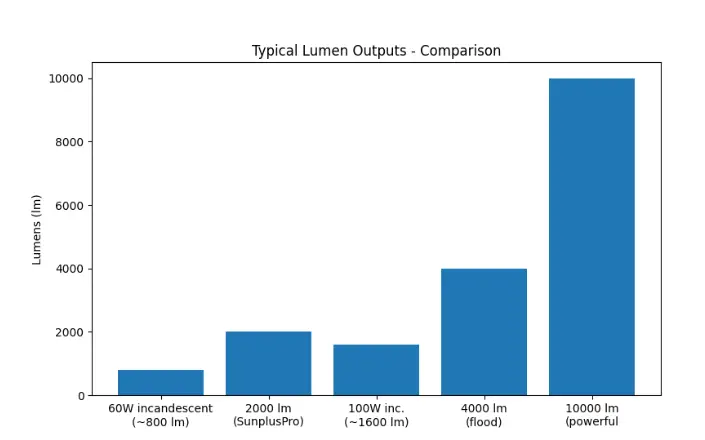
Chart 1 — Typical Lumen Outputs: a simple bar chart comparing 60 W incandescent (~800 lm), 2000 lm (SunplusPro reference), 100 W incandescent (~1600 lm), 4000 lm flood, and 10 000 lm high-power fixture. This helps visualize where 2000 lm sits in common categories.
-
Chart 2 — Illuminance vs Distance for 2000 lumens: curves for 15°, 30°, and 70° beams plus an isotropic approximation. The plot uses a log scale on the vertical axis to show lux dropoff over distance clearly. The chart makes it obvious that focusing the same lumen output into a narrow beam dramatically increases lux on target.
10. Table: Quick reference (lumen → rough use case)
| Lumens (lm) | Typical use case |
|---|---|
| 100 – 400 | small lamps, accent lighting |
| 400 – 800 | standard table lamps, reading lights |
| 800 – 1600 | general home lighting, large bulbs |
| 1600 – 3000 | task lighting, workshops, bright ceiling fixtures |
| 3000 – 8000 | powerful floodlight, large spaces, security lighting |
| 8000+ | stadium, industrial, specialized heavy-output lighting |
2000 lm sits in the 1600–3000 lm band and covers mid to strong task lighting, some outdoor security needs, and serious portable light output.
11. Common pitfalls and how to avoid them
-
Mistaking lumens for perceived brightness: always think about lux on the target surface.
-
Buying by lumen alone: check optics, runtime, and sustained output data.
-
Over-lighting without glare control: too many lumens in the wrong distribution causes discomfort.
-
Confusing equivalence claims: manufacturers sometimes quote peak output; ask for sustain figures and test conditions.
12. FAQs
Q1: Is 2000 lumens too bright for indoor use?
A1: Not necessarily. 2000 lm is appropriate when directed to work surfaces or in rooms that benefit from strong illumination, like kitchens and garages. Proper placement and optics prevent glare and distribute useful light.
Q2: How many 60 W bulbs equal 2000 lumens?
A2: A typical 60 W incandescent gives about 800 lumens. Two 60 W equivalents (1600 lm) are slightly less than 2000 lm, so 2000 lm is roughly equal to two and a half 60 W incandescent bulbs.
Q3: Will a 2000-lumen flashlight hurt my eyes?
A3: Directly shining a high-output flashlight into eyes can cause discomfort and temporary visual impairment. Use care, avoid aiming at people, and use lower modes for nearby work.
Q4: Can 2000 lumens light up a backyard?
A4: Yes, a 2000-lumen flood fixture with suitable optics can illuminate a small to medium backyard or driveway, but layout and mounting height determine coverage uniformity.
Q5: How far will a 2000-lumen spotlight reach?
A5: Range depends on beam focus. A narrow 15-degree beam concentrates lumens into a small spot, giving high lux at longer distances; wide beams deliver bright near-field illumination but limited throw. Check the flashlight’s throw or candela spec for distance estimates.
Q6: How do I convert 2000 lumens to lux on my desk?
A6: Measure or estimate the illuminated spot area on the desk, then compute lux ≈ lumens / area (in square meters). For precise conversions use an online lumen-to-lux calculator or a lux meter.
Q7: Is lumen rating the same across LED brands?
A7: Lumen measurement is standardized, but testing conditions and whether the rating is peak or sustained differ by manufacturer. Look for test methodology or third-party measurements.
Q8: Do warmer bulbs appear dimmer than cooler ones at 2000 lumens?
A8: Color temperature influences perceived brightness and contrast. Cooler white light often appears crisper and can subjectively seem brighter at the same lumen level; however lumen counts remain objective. Consider CRI and CCT when choosing a fixture.