

The best outdoor solar street lights deliver dependable, bright illumination with multi-day autonomy at low operating cost by combining high-efficiency LED modules, LiFePO₄ battery packs, high-grade photovoltaic panels, IP65+ ingress protection, and an appropriate wattage-to-pole-height design. For nearly all municipal, commercial, and large-residential applications in 2025, choose fixtures that use LiFePO₄ batteries, have smart dimming or motion control, and carry a 3 to 5 year warranty to balance lifetime cost and uptime.
1. Why choose solar street lights for outdoor projects
Solar-powered street lights remove the need for trenching and AC wiring, reducing installation complexity and time. In remote locations, new developments, or where utility upgrades are costly, properly specified solar street luminaires provide faster deployment, predictable lifecycle costs, and lower ongoing energy bills. Independent testing bodies and consumer testing panels highlight that the best systems combine durable batteries and tested control logic to satisfy night-time illumination targets with multiple cloudy days of autonomy.
Benefits summary
-
No trenching or AC cable work in most installations.
-
Lower lifetime energy and maintenance costs when correctly sized.
-
Rapid deployment for temporary or phased projects.
-
Reduced grid dependency and lower carbon footprint.
Key caveat: performance depends on correct sizing for local irradiance, expected cloudy days, and the required lumen level on the roadway. A cheap product under-sized for local conditions will fail to meet expectations.

2. How modern solar street lights work
A contemporary integrated solar street light system typically has these parts:
-
Photovoltaic panel (PV): converts daylight to DC electricity.
-
Charge controller / MPPT: extracts maximum power and manages battery charge.
-
Rechargeable battery: stores energy for night operation.
-
LED luminaire (driver + LED array): provides visible illumination using efficient LEDs.
-
Embedded electronics: sensors, dimming logic, motion detection, telemetry modem (optional).
-
Mounting hardware, pole adaptor and seals.
The charge controller and battery chemistry are the heart of reliability. Modern MPPT controllers improve energy harvest from the PV array and extend battery life by using correct charge algorithms. Sources summarizing field-tested systems emphasize battery quality as the single greatest determinant of real-world lifetime.
3. Key performance metrics every purchaser must read
When comparing products, focus on these measurable attributes:
-
Rated lumen output and system efficacy (lumens per watt)
-
LED driver efficiency and thermal management (affects lumen maintenance)
-
Battery type, usable capacity (Wh), depth of discharge limits and cycle life
-
PV panel wattage, efficiency and tilt mounting specifics
-
Days of autonomy (number of nights the light will run without recharging)
-
IP and IK ratings for weather and impact protection
-
Warranty coverage for the luminaire, battery and panel
-
Dimming, motion sensor specs and smart control features
-
Operating temperature range and salt spray / corrosion resistance where needed
These attributes determine field performance and the total cost of ownership. Independent product reviews and lab testers recommend prioritizing battery and controller specifications above listed lumens alone.
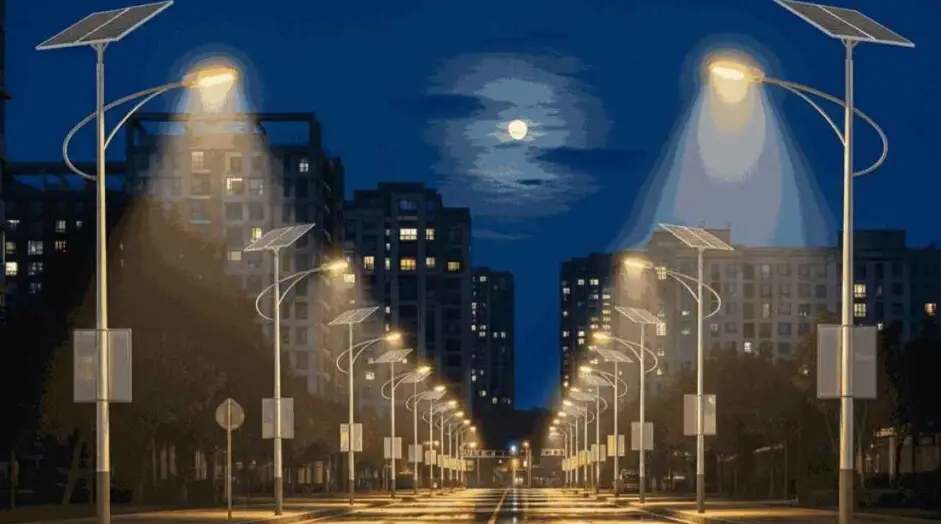
4. Wattage, lumen output, and mounting height: practical sizing tables
Proper selection maps lumen output and beam distribution to pole height and desired illuminance on the roadway. The table below is a practical industry mapping for typical LED solar street luminaires. Use it as a starting point. These figures assume standard Type II/III distributions and modest roadway widths.
| Typical LED Wattage (system) | Approx. Rated Lumens | Recommended Mounting Height | Typical Coverage / Use Case |
|---|---|---|---|
| 30 W | 3,200 to 4,200 lm | 3 to 4 m (10–13 ft) | Pathways, small parking, alleys |
| 60 W | 6,000 to 8,400 lm | 4 to 6 m (13–20 ft) | Small streets, park roads |
| 100 W | 10,000 to 12,500 lm | 6 to 8 m (20–26 ft) | Local streets, small commercial roads. Common “workhorse” size |
| 150 W | 15,000 to 18,000 lm | 8 to 10 m (26–33 ft) | Larger roads, collector streets |
| 200 W + | 20,000+ lm | 10 m and above | Highways, wide boulevards, large parking lots |
Notes
-
Lumens above are system lumens after driver losses.
-
Brightness is only part of the design; uniformity and glare control are equally important.
-
Adjust for local lighting standards and required lux levels. For pedestrian paths 5–10 lux may suffice, while vehicular roadways often require 10–30 lux depending on classification.
Field-tested guides and manufacturer application tables mirror this mapping and recommend the 100 W class as the common baseline for small municipal roads.
5. Batteries compared: LiFePO₄, lithium-ion, sealed lead acid and practical selection rules
Battery chemistry is the decisive reliability factor. Summarized comparison:
| Chemistry | Typical Cycle Life (usable cycles) | Temperature resilience | Energy density | Cost considerations | Practical recommendation |
|---|---|---|---|---|---|
| LiFePO₄ | 2000–5000 cycles | Good; stable thermal profile | Moderate-high | Higher upfront, lower replacement cost | Best balance for street lights: long life and safe thermal behaviour. |
| NMC / ternary Li-ion | 800–2000 cycles | Less tolerant to high temp than LiFePO₄ | Higher energy density | Competitive cost, safety tradeoffs | Use if weight/volume constraints dominate; require robust BMS |
| Sealed Lead Acid (SLA) | 300–800 cycles | Poor in extreme temps | Low | Low upfront, high lifetime replacement | Avoid for long-lived installations; acceptable for very low-cost or temporary projects |
| Recycled/used lithium packs | Highly variable | Unreliable | Unreliable | Cheap but high failure risk | Avoid; many field failures result from reused packs with unknown history. |
Design rules
-
Prefer LiFePO₄ for installations where long life and low maintenance are priorities.
-
Size usable battery Wh based on required night runtime, dimming strategy and days of autonomy.
-
Request manufacturer cycle life at specified Depth of Discharge and temperature.
-
Insist on an integrated Battery Management System (BMS) and cells matching.
Independent technical reviewers repeatedly report that installations using higher-grade LiFePO₄ achieve significantly longer service intervals with fewer replacements.
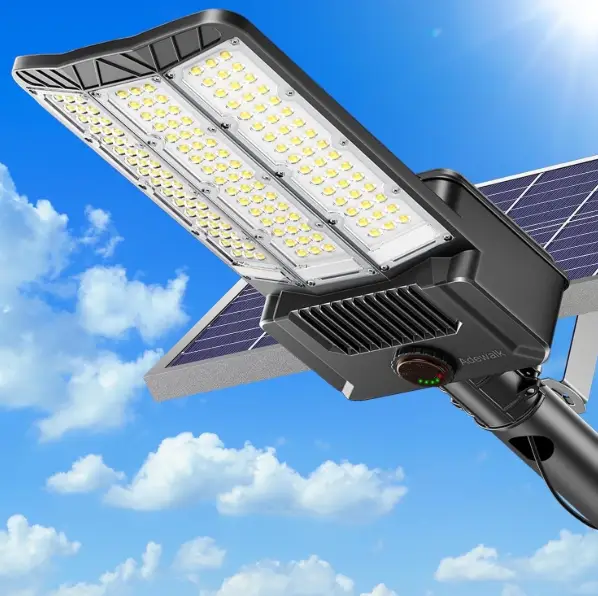
6. Solar panels: types, efficiencies, orientation and derating in real sites
Panel type and mounting determine daily energy harvest. Practical notes:
-
Mono-crystalline panels provide better efficiency per area and are common on contemporary street lights.
-
Real-world energy harvest must account for tilt loss, soiling, shading and temperature derating. Panels mounted flat on the luminaire typically produce 10 to 20 percent less energy than optimally tilted arrays.
-
Use MPPT controllers to reduce losses and improve morning/afternoon harvest.
-
In low-latitude or high-cloud areas, increase panel wattage and battery autonomy.
Sizing tip: calculate daily energy draw (LED power × hours) adjusted for dimming, then size PV capacity with a site-specific insolation figure and desired autonomy days. Practical buying guides provide calculators and rules of thumb; working with measured local irradiance values yields the best results.
7. Controls and smart features: motion sensing, dusk-to-dawn, telemetry, and grid-hybrid options
Controls are a major performance differentiator. Useful features:
-
Dusk-to-dawn with programmable dimming schedules: allows baseline dimming overnight with full brightness during peak hours
-
Motion sensors for spot boost: maintain low-level ambient output and increase to full lumen when motion is detected to save energy
-
Adaptive and weather-aware algorithms: reduce brightness after extended cloudy days to preserve autonomy, or increase battery usage after consecutive sunny days for safety
-
Remote monitoring and OTA updates: telemetry for energy, battery state, fault alerts and remote parameter changes reduce maintenance trips
-
Hybrid AC input options: some systems accept mains charging to extend autonomy in low-irradiance climates
Smart features significantly improve uptime and reduce operating cost when implemented with secure telemetry and robust firmware. Buyers who include remote management see faster fault detection and lower lamp-replacement times than those with dumb fixtures.
8. Mechanical and environmental ratings: IP, IK, temperature, corrosion classes
Essential mechanical specs to request:
-
IP rating: IP65 is common; for heavy rain locations select IP66 or higher.
-
IK rating: IK08 or IK09 for vandal-prone areas.
-
Operating temperature: confirm low/high extremes used in your region. Batteries are especially sensitive to sub-zero or very high temperatures.
-
Salt spray / ISO 9227 corrosion rating: specify for coastal sites.
-
Material finishes: die-cast aluminum housings with powder coat are standard; confirm paint system and surface prep.
High-quality vendors publish tested environmental ratings. Products designed for long service lives use thicker anodization, conformal electronics potting in severe climates, and upgraded gaskets.
9. Return on investment and total cost of ownership (TCO)
A simple TCO model includes purchase, installation, maintenance, energy cost savings and expected replacement parts. Quick formula elements:
-
Capital: fixture, pole and civil works
-
Installation: labour, crane or lift, civil works for poles if required
-
Annual maintenance: cleaning, battery replacement schedule, lamp replacement if any
-
Energy savings: avoided mains kWh cost multiplied by expected years of operation
Rule of thumb: premium systems sized correctly typically pay back within 4 to 8 years versus equivalent mains-powered LED street lights when installation trenching or electricity connection costs are high. Small urban retrofits with existing poles often have longer paybacks because civil works are already done. The ROI depends heavily on local electricity price and duty cycle. Telemetry and remote fault detection reduce maintenance cost, improving TCO.
10. Common failure modes and preventative maintenance checklist
Common field issues
-
Battery degradation due to high temperature or cycling beyond rated DOD.
-
Solar panel soiling and shading reducing harvest.
-
Controller firmware or connector corrosion causing intermittent faults.
-
LED thermal runaway if driver heat sinking fails.
Preventative maintenance checklist (quarterly/annually)
-
Visual inspection for physical damage and water ingress
-
Clean PV panels and remove vegetation shading every 3–12 months depending on site
-
Remote telemetry review weekly if available for early fault detection
-
Battery capacity test annually after first 2 years, then every 1–2 years
-
Confirm firmware updated to latest stable release if remote update supported
Products from reputable suppliers with better testing programs require fewer maintenance visits. Expect to set an initial 1–2 year inspection cadence then move to condition-based maintenance enabled by telemetry.
11. Specification templates and procurement checklist for buyers and engineers
Include these minimum specifications in purchase documents:
-
System lumen output and target maintained lux and uniformity at specified pole height
-
Battery chemistry, usable Wh, required cycle life at specified DOD and temperature
-
Panel wattage, type, and mounting orientation; include local irradiance assumptions used for sizing
-
Controller type and features: MPPT, anti-theft/anti-tamper, overcharge protections and telemetry options
-
Mechanical: IP/IK ratings, housing material and finish, anti-corrosion requirement for coastal areas
-
Warranty: minimum 3-year fixture warranty, minimum 2-year battery warranty with prorated replacement terms
-
Documentation: test reports, salt spray results if applicable, thermal/photometric files (IES / LDT), and manufacturing certificates
Ask vendors for a system energy simulation showing expected monthly state-of-charge across a typical year for the project location. If a vendor cannot provide this, require them to justify sizing.
12. Quick comparison table of typical product tiers and example use cases
| Tier | System features | Example use case | Typical warranty |
|---|---|---|---|
| Economy | SLA or low-grade lithium, minimal controls | Temporary sites, very low budget | 1–2 years |
| Professional | LiFePO₄ 2000+ cycles, MPPT, basic dimming | Local roads, commercial lots | 3 years |
| Premium | LiFePO₄ with BMS, MPPT, motion, telemetry, IP66 | Municipal installations, remote critical sites | 3–5 years+ |
Reputable industry lists and reviewers show that professional and premium tiers dominate recommended lists because of superior lifetime economics.
13. Standards, certifications and testing to request from vendors
Ask for:
-
IES / LM-79 photometric test data for fixture performance
-
IP and IK test certificates
-
IEC 61215 / 61730 or equivalent for PV panels
-
UN 38.3 or IEC 62133 for battery transport and safety if shipping lithium packs
-
Salt spray / corrosion test (ISO 9227) for coastal projects
-
Independent third-party test reports where available
Independent test data and transparent lab reporting are signs of mature suppliers and reduce procurement risk. Consumer testing platforms emphasize the value of independent lab results when comparing products.
14. FAQs about outdoor solar street lights
Q1: How many nights will a solar street light run without sun?
A1: That depends on battery capacity and energy draw. Good designs provide 3 to 7 nights of autonomy at rated power. For safety-critical sites request minimum 3 nights; for remote or high-reliability sites target 5 to 7 nights with LiFePO₄ batteries.
Q2: Are motion sensors necessary?
A2: Motion sensors are highly recommended for energy savings and extended autonomy. Well-implemented motion control reduces average power consumption while maintaining perceived safety by boosting light only when needed.
Q3: How long do batteries last in outdoor solar street lights?
A3: LiFePO₄ batteries typically last 5 to 10 years depending on cycles, temperature, and depth of discharge. Vendors should provide cycle life at specified DOD and temperature points.
Q4: What IP rating is suitable for outdoor fixtures?
A4: IP65 is the baseline for weatherproofing. Use IP66 or higher for very heavy rain or pressurised washdown zones.
Q5: Can solar street lights be used in winter locations with short days?
A5: Yes, but they must be oversized for winter insolation. Increase PV wattage and battery capacity, and allow for reduced sun angles when mounting panels.
Q6: What maintenance is required?
A6: Regular PV panel cleaning, occasional battery checks and telemetry review. A one to two year inspection cadence is typical; telemetry allows condition-based upkeep.
Q7: Can they replace mains street lighting completely?
A7: In many cases yes, especially on new builds, rural roads and where pole replacement is feasible. Urban retrofit often requires hybrid approaches if poles are already wired.
Q8: What is the best battery chemistry?
A8: LiFePO₄ for long life, thermal stability and superior cycle count in street lighting contexts. Avoid recycled packs or unknown chemistry sources.
15. Final recommendations and short specification “starter” for SunplusPro models
If SunplusPro is positioning product SKUs, consider this starter lineup:
-
SunplusPro Urban 100
-
LED: 100 W system, 12,000 lm system output
-
Battery: LiFePO₄ 5.12 kWh usable with 3 nights autonomy at dimmed baseline
-
PV: 300 W mono panel with tilt bracket
-
Controls: MPPT, dusk-to-dawn, motion sensor, optional LTE telemetry
-
Mechanical: IP66, IK08, powder-coated die-cast aluminum
-
Warranty: 5 years fixture, 5 years battery pro-rata
-
-
SunplusPro Path 30
-
LED: 30 W, 4,000 lm system output
-
Battery: LiFePO₄ 1.2 kWh, 3 nights autonomy in moderate climates
-
PV: 80 W integrated module
-
Controls: Dusk-to-dawn and motion sensing
-
-
SunplusPro Heavy Duty 200
-
LED: 200 W, 24,000 lm for wide boulevards
-
Battery: LiFePO₄ 10 kWh usable, 3–5 nights autonomy
-
PV: 600 W split-array with optimized tilt
-
Controls: full telemetry, hybrid AC charge input, advanced dimming profiles
-
Procurement checklist for each model
-
Photometric IES files and predicted maintained lux table for requested pole height
-
Battery cycle life certificate at stated DOD and temp extremes
-
PV certificate (IEC or equivalent) and expected harvest simulation for buyer’s location
-
Firmware and communication protocol documentation for telemetry features
Appendix A: Example sizing quick-calc
-
Determine required total nightly lumen-hours: target lumens × hours at full + hours at dimmed level × dimmed lumens.
-
Convert lumen-hours to Wh using efficacy (use conservative 100 lm/W system for older fixtures, 120–140 lm/W for modern ones).
-
Multiply by autonomy days and add 20 percent margin for aging and losses.
-
Size PV panel using local peak sun hours and derating factors, and choose MPPT controller.
For an example 100 W system with 10,000 lm at 125 lm/W, running 10 hours per night roughly:
-
Average system power ~80 W (accounting dimming) × 10 hr = 800 Wh per night.
-
For 3 nights autonomy → 2,400 Wh usable battery → size LiFePO₄ usable capacity 3,000 Wh to allow margin.
-
PV needed: if local peak sun 4 hrs, daily need = 800 Wh, with derating 0.65 → PV = 800 / (4 × 0.65) ≈ 307 W.
This matches many field sizing calculators and manufacturer application tables. Use local insolation data for accurate results.
Appendix B: Example procurement clause
“The supplier shall provide integrated solar street light systems meeting the following: LiFePO₄ battery with minimum usable capacity of X Wh and minimum cycle life of Y cycles at Z% DOD; MPPT controller; IP66 enclosure; IES photometric file for requested mounting height H; independent test certificates for PV (IEC 61215 / 61730) and battery (UN 38.3 or IEC 62133). Warranty: 5 years for fixture, battery covered under a minimum 3-year pro-rata warranty.”