

For homeowners, facility managers, and resellers who want reliable, low-cost outdoor illumination, waterproof outdoor LED solar lights with sensors from SunplusPro deliver long runtime, responsive presence detection, and true weather resistance at factory pricing with customization options. These products combine robust photovoltaic charging, efficient LED modules, protected battery systems, and motion or light sensors to provide secure, maintenance-light illumination for pathways, yards, building perimeters, and commercial sites.
1. Why choose waterproof outdoor LED solar lights with sensors
Solar fixtures that combine LED illumination with presence or dusk-to-dawn sensing eliminate wiring, reduce ongoing energy costs, and simplify installation. For outdoor use, waterproof construction ensures the electronics remain functional through rain, wind, and humidity, leading to longer service life and lower warranty claims. Motion sensing reduces wasted light, increases security, and extends battery life because full output is used only when needed.
Key market reasons buyers prefer sensor-equipped solar LEDs include simplified installation, reduced electricity bills, reliability in remote sites, and attractive returns on investment compared with running wired lighting. Independent product testing and retailer guidance emphasize the importance of rated weather protection and realistic lumen claims when selecting a model.

2. Core components explained
A high-quality waterproof outdoor solar light with a sensor typically contains five subsystems. Understanding each helps you evaluate specifications and compare models.
Solar module (photovoltaic cell)
-
Monocrystalline cells are common in premium lights because they provide higher efficiency per area than polycrystalline when sunlight is limited. Panel wattage and angle determine charging speed and daily energy budget.
Rechargeable battery
-
Lithium iron phosphate (LiFePO4) or quality Li-ion cells are increasingly common because they hold more cycles and tolerate deeper discharge than older NiMH or lead-acid options. Capacity is given in milliamp-hours or watt-hours; combine this with average nightly use to estimate autonomy.
LED module and optics
-
LEDs are rated by lumen output and efficacy (lumens per watt). Flood-style arrays yield broad, high-lumen output for security; spot modules provide focused beam for signs or accenting. Optics (reflectors, lenses) affect beam spread and perceived brightness.
Sensor(s)
-
Motion and light sensors control when the light operates. Typical sensors:
-
Passive infrared (PIR) for human and vehicle movement.
-
Microwave for fine motion detection with wider coverage in some designs.
-
Photocell for dusk-to-dawn operation inside daylight thresholds.
-
Housing and seals
-
Materials such as UV-stabilized ABS plastic, die-cast aluminum, and tempered glass add durability. Gaskets, silicone seals, and potting compounds protect internal circuits from moisture and insects.
These subsystems interact: a bigger panel plus a higher capacity battery supports higher lumen output and longer runtime; a sensitive sensor allows dim baseline lighting with bright response only when needed.
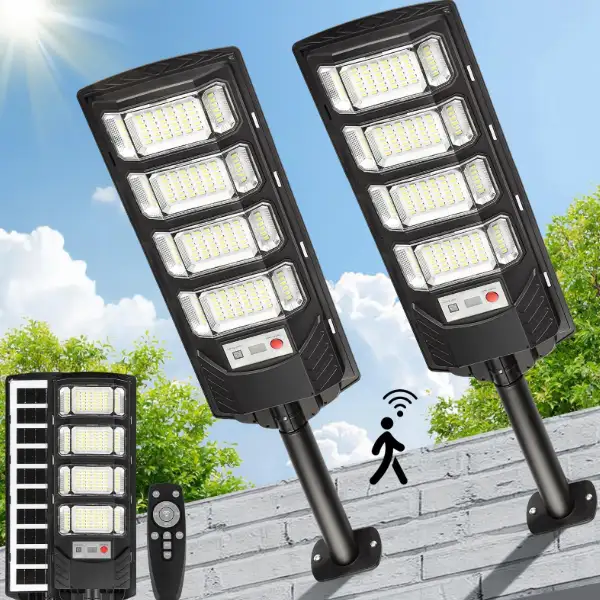
3. Weatherproofing and ingress protection (IP rating) explained
IP (Ingress Protection) ratings communicate how well a product resists solids and liquids. For outdoor solar lights, IP65, IP66, IP67 and IP68 are commonly cited.
| IP rating | Meaning (solids first digit / liquids second digit) | Typical outdoor suitability |
|---|---|---|
| IP44 | Protected against objects >1 mm and splashing water | Light rain, limited exposure; best for sheltered spots |
| IP65 | Dust tight and protected from low-pressure water jets from any direction | Standard for most exposed outdoor fixtures; survives rain and cleaning |
| IP66 | Dust tight; powerful water jets protected | Stronger water jet resistance; good for storm-prone areas |
| IP67 | Dust tight; immersion up to 1 m for 30 minutes | Very robust; survives temporary submersion |
| IP68 | Dust tight; continuous immersion under conditions specified by manufacturer | For permanently wet or submerged installations |
Choose IP65 or higher for fixtures that mount on walls, posts, or eaves subject to direct rain. In coastal zones or flood-prone installations, consider IP67 or IP68 for extra protection. Several expert buyer resources and retailer buying guides recommend IP65 or better for true outdoor durability.
4. Sensor technologies compared
Different sensor types suit different applications. The right choice depends on false-positive tolerance, detection range, and mounting location.
| Sensor type | How it works | Strengths | Limitations |
|---|---|---|---|
| PIR (Passive Infrared) | Detects changes in infrared energy caused by warm bodies moving across the field | Low power, simple, low false alarms indoors, good for doors and paths | Reduced sensitivity in very hot weather or when object temperature approaches ambient |
| Microwave | Emits and listens for Doppler shifts in microwave reflection | Longer range, can detect through some non-metallic obstructions | More prone to false triggers from moving vegetation; uses slightly more power |
| Dual (PIR + Microwave) | Requires both sensors to trigger output or fuses their signals | Reduced false positives, better reliability | Higher component cost and slightly more power draw |
| Photocell (LDR) | Measures ambient light for dusk-to-dawn control | Saves power by disabling daytime operation | Will not detect motion alone; usually paired with motion detection |
PIR sensors remain the most common in consumer solar sensor lights due to their balance of energy use and effectiveness. For expansive yards or high mounting points, microwave or dual systems may give better coverage but must be tuned to avoid frequent false triggers.
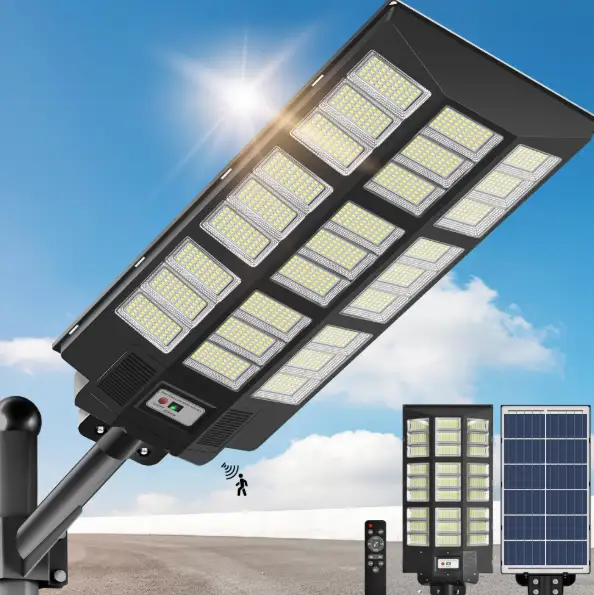
5. Brightness, lumen planning, runtime and battery sizing
Understanding lumens and battery capacity prevents overpaying for underperforming products.
Brightness planning
-
For pathway or decorative lighting, 100 to 300 lumens per fixture is usually sufficient.
-
For security floodlighting or driveways, 800 to 2500 lumens gives visible detail and deterrence.
Retail and review sources show many solar security models range from 300 to 3000 lumens. Match lumen rating to intended use and mounting height.
Runtime estimation (simple method)
-
Convert battery capacity to watt-hours (Wh): Battery voltage times amp-hours.
-
Divide Wh by desired LED power (watts) to get hours of continuous run time.
-
Account for power used by sensors and drivers; use 80 to 90 percent practical efficiency to be conservative.
Example
-
3.7 V nominal battery rated 10,000 mAh equals 37 Wh.
-
If LEDs draw 5 W for full brightness, theoretical continuous runtime = 37 Wh / 5 W = 7.4 hours.
-
Real-world runtime at full brightness may be 6 to 7 hours due to losses.
Charging budget
-
Estimate daily solar energy input by panel wattage times effective sun hours (site dependent; many regions average 3 to 6 peak sun hours daily).
-
For cloudy climates, increase panel area or lower nightly output expectations.
Manufacturers often quote impressive runtimes but may assume dim baseline lighting plus motion-boosted output. Compare claimed run time to battery capacity and panel wattage for realistic assessment.
6. Materials, coatings, and long-term durability
Durability depends on both component selection and protective finishes.
-
Housings: Die-cast aluminum provides heat dissipation and structural rigidity. UV-stabilized plastics reduce fading and cracking. Powder-coated finishes resist corrosion.
-
Lens: Tempered glass withstands impact and retains clarity. Polycarbonate lenses are lighter and impact resistant but may yellow over time if not UV stabilized.
-
Seals: Silicone gaskets and potting around electronics slow moisture ingress. Watch for vents that lack proper filtering; insects and dust often enter there.
-
Fasteners: Stainless steel hardware reduces rust-related loosening and staining.
Retailers and lighting specialists recommend checking vendor details about materials and warranties; products with robust housings and replaceable batteries usually last longer and provide better total cost of ownership.
7. Installation and placement best practices
Correct placement maximizes performance.
-
Panel orientation: Point solar panels toward the equator (south in northern hemisphere) and tilt at local latitude for year-round performance.
-
Avoid shade: Keep panels clear of tree canopy, gutters, and walls for unobstructed sunlight. Partial shading drastically reduces charging.
-
Mounting height: For motion sensors, typical mounting height is 6 to 10 feet to balance range and false triggers. Higher mounts increase required lumen output.
-
Aim and beam spread: Floodlight optics should illuminate desired area without directing light into neighbors’ windows to comply with local nuisance rules. Use adjustable heads to shape coverage.
-
Secure mounting: Use anchors appropriate for substrate. Vibration or loose mounts can stress seals and wiring.
Retail product pages and installation instructions often highlight these points; check manufacturer guidance for model-specific limitations.
8. Customization, procurement, and factory advantages from SunplusPro
SunplusPro’s factory model allows cost control and product tailoring for distributors and OEM customers.
Common customization options
-
Logo printing and private labeling.
-
Battery chemistry and capacity upgrades for longer autonomy.
-
Higher-efficiency PV panels or larger panel area.
-
Different sensor settings preprogrammed (sensitivity, hold time, night threshold).
-
Packaging and manuals tailored to markets and languages.
-
Mounting brackets and accessory sets for poles, fences, or soffits.
Why factory pricing matters for resellers
Buying direct from the manufacturer reduces middleman margins, enables tighter quality control, and allows minimum order quantities to be set to fit business models. SunplusPro can support product testing, certification management, and sample runs before mass orders, lowering time to market for private label lines.
For large projects, OEM partners can specify lifetime targets, corrosion-resistance levels, and warranty terms that match commercial procurement standards.
9. Energy savings and environmental impact (simple case)
Switching to sensor solar LED lighting reduces grid electricity consumption and carbon emissions.
Sample calculation per fixture annually
-
Wired halogen flood: 150 W, runs 4 hours nightly on average = 150 W × 4 h × 365 ≈ 219 kWh/year.
-
Solar LED alternative: grid energy use near zero; embodied energy and manufacturing exist, but operational electricity consumption is eliminated.
Assuming local grid emissions of 0.4 kg CO2 per kWh, the wired fixture emits ≈ 88 kg CO2/year. Replacing ten wired fixtures yields a near-term operational saving of nearly 880 kg CO2 annually.
Offer buyers lifecycle comparisons and warranty-backed durability figures to make procurement decisions based on total cost of ownership rather than upfront purchase price.
10. Common failure modes, maintenance and troubleshooting
Even well-built units need occasional care.
Typical issues and fixes
-
Reduced runtime: Check battery health; replace if cycle capacity drops. Verify solar panel is clean and unobstructed.
-
Intermittent operation: Inspect wiring and connectors; corroded contacts cause intermittent behavior. Confirm sensor is not blocked by film or cobwebs.
-
False triggers: Reposition to avoid moving vegetation; adjust sensitivity or use a model with adjustable time and detection zones.
-
Panel or battery failure: Replace modules through authorized channels; design for replaceable batteries extends fixture life.
Regularly clean panels with soft cloth and mild detergent, inspect seals annually, and tighten mount hardware to prevent stress leaks.
11. Buying checklist and product comparison matrix
Use this checklist before purchase or listing on an e-commerce page.
Essential checklist
-
IP rating (IP65 or higher recommended).
-
Battery type and capacity with expected cycle life.
-
Solar panel type and wattage.
-
Lumen output at full brightness and modes available.
-
Sensor type, detection angle, range, and adjustability.
-
Warranty length and what it covers (battery often excluded).
-
Replaceability of batteries and availability of spare parts.
-
Mounting accessories included.
-
Certifications required in your market (CE, RoHS, FCC, etc.)
Simplified product comparison table (example)
| Feature | Entry model | Mid tier | Pro security |
|---|---|---|---|
| Typical lumen | 300 | 1200 | 2500 |
| Battery | NiMH 6000 mAh | Li-ion 10000 mAh | LiFePO4 15000 mAh |
| Panel | 2.5 W poly | 6 W mono | 12 W mono |
| Sensor | Basic PIR | PIR adjustable | Dual PIR + microwave |
| IP rating | IP44 | IP65 | IP67 |
| Suggested use | Path | Yard/porch | Driveway/lot |
SunplusPro can produce variants across these buckets at factory pricing and provide technical data sheets for reseller listings.
12. FAQs
Below are eight frequently asked questions with concise, actionable answers optimized for snippet potential.
Q1: What IP rating should I choose for fully exposed outdoor solar lights?
A1: Choose IP65 as the minimum for exposed walls and posts. For coastal, flood-prone, or occasionally submerged locations, choose IP67 or IP68 for extra protection.
Q2: How many lumens do I need for a driveway or security area?
A2: Aim for 800 to 2500 lumens for clear illumination of driveways and large perimeters; for smaller paths, 100 to 300 lumens may suffice.
Q3: Which sensor type minimizes false triggers from trees and small animals?
A3: A PIR sensor tuned to human-size thermal signatures, or a dual-sensor arrangement that requires both PIR and microwave validation, reduces false positives.
Q4: What battery chemistry should I prefer for longevity?
A4: LiFePO4 and quality Li-ion batteries provide higher cycle life and safer thermal behavior than NiMH; verify cycle rating in the spec sheet.
Q5: How long will a solar light run through the night on average?
A5: Runtime depends on battery capacity and usage. A common result is 6 to 10 hours at moderate output for fixtures with 10,000 mAh Li-ion batteries, but verify with stated watt-hour numbers.
Q6: Can I replace the battery in a solar light?
A6: Many models have replaceable batteries; choose designs that offer user-replacement or buy spare battery kits from the manufacturer.
Q7: Will a solar motion light work on cloudy days?
A7: It will charge less efficiently. To maintain desired runtime in cloudy climates, choose larger panels, higher capacity batteries, or models rated for low-light performance.
Q8: What warranty and certifications should I require from a supplier?
A8: Ask for at least a one-year product warranty, and certifications such as CE, RoHS, and any local safety approvals needed for your market. For commercial projects, negotiate extended warranty and service terms.