

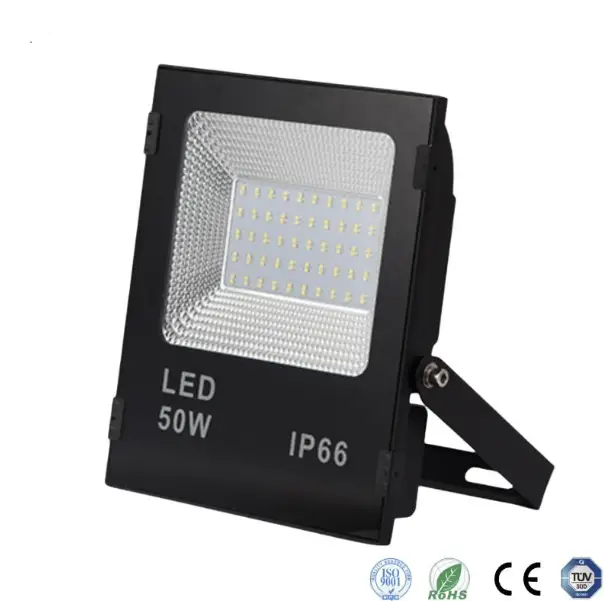
For most outdoor lighting needs, a 50 watt dimmable LED flood light delivers the best balance between brightness, energy use, and durability: expect roughly 6,000 to 7,500 lumens, an efficacy between 120 and 145 lumens per watt, weatherproof housings rated IP65 or IP66, long rated life near 50,000 hours, and common dimming options such as 1-10V or 0-10V for smooth dim control. Choosing a quality fixture with certified drivers and good thermal design yields reliable outdoor performance and the lowest total cost over time.
1. What a 50W dimmable LED flood light is, and why buyers choose it
A 50 watt LED flood light is a compact high-output fixture designed to illuminate broad outdoor surfaces such as building facades, parking areas, playgrounds, yards, and signage. This wattage commonly replaces traditional 150W to 300W metal halide or halogen fittings, producing comparable light with far lower energy consumption and heat. Dimmability allows integration with lighting controls for energy optimization, security lighting schedules, and night-time scene-setting.
Business buyers prefer 50W models when they need bright coverage without oversized fixtures, and when retrofit or new-install budgets favor fewer fixtures with good lumen-per-watt performance. Consumer buyers value the balance between brightness and cost. Many commercial-grade 50W units meet UL or DLC listings permitting commercial projects and incentive programs.

2. Typical performance numbers you must check before buying
Key performance indicators to compare:
-
Lumen output: typical range 6,000 to 7,500 lm for modern 50W modules. Verify manufacturer lumen maintenance data.
-
Efficacy: expect roughly 120 to 145 lm/W depending on LED binning and driver design. Higher efficacy lowers operating cost.
-
Color temperature (CCT): common options 3000K, 4000K, 5000K; pick warmer tones for hospitality, cooler tones for security and task lighting.
-
Color rendering (CRI): spec-grade fixtures provide CRI 70, 80, or 90; choose 80+ for accurate color near facades and retail displays.
-
Lifespan: rated life often 50,000 hours with proper thermal design. Confirm LM70 or LM80 reports when possible.
-
Beam angle: flood distribution typically between 90° and 150°; narrower beams concentrate light, wider beams give even wash.
-
IP rating: IP65 or IP66 for outdoor resistance to dust and water jets. Higher protection suits harsher coastal or industrial sites.
Always verify measured photometric data and not just broad claims.
3. Weatherproofing and ingress protection explained
IP ratings are shorthand for enclosure protection. For outdoor flood lights these are common:
| Abbreviation | Meaning |
|---|---|
| IP65 | Dust tight plus protection from low-pressure water jets from any direction. Appropriate for most outdoor wall and ground mounts. |
| IP66 | Dust tight plus protection from powerful water jets. Recommended for exposed locations or pressure washing zones. |
| IP67 | Temporary immersion protection. Good for flood-prone installations though less common in flood fixtures. |
Corrosion-resistant coatings, stainless steel fasteners, and high-quality gaskets improve longevity in coastal environments. For permanent commercial installs choose models with robust powder-coated aluminum housings and replaceable sealing gaskets.
4. Dimming methods and control compatibility
Dimming capability influences control strategy and integration with building automation. Popular methods for 50W flood fixtures:
-
1-10V or 0-10V analog: widely used in commercial controls for smooth continuous dimming. Many industrial 50W floods ship with 1-10V drivers for compatibility with dimmers and sensors.
-
TRIAC / leading-edge: common for residential retrofits. Compatibility varies and requires a TRIAC-ready driver.
-
PWM digital dimming: used internally by drivers; external compatibility varies.
-
DALI: digital addressable lighting interface for advanced control, scene-setting, and two-way monitoring.
-
Remote control or RF: consumer-oriented units sometimes include RF remotes or smartphone apps.
When specifying, confirm dimmer type supported, minimum load, and whether flicker meets project requirements.
5. Optical design: lumens, beam angle, CCT, CRI and glare control
Flood lighting requires proper optics to avoid hot spots and glare:
-
Lens and reflector: polycarbonate lenses or tempered glass plus precision reflectors shape the beam. Look for photometric files (IES/LM) for predicted distribution.
-
Beam choice: use narrow beam for signage or tall wall washing; wide beam for landscape and yard illumination. Beam data must match mounting height to avoid wasted light.
-
CCT selection: 3000K warm white for hospitality; 4000K neutral for mixed-use; 5000K cool white for security.
-
CRI effects: 80+ CRI renders colors with acceptable fidelity; retail and façade up-lighting may benefit from CRI 90.
-
Glare control: baffles, louvers, or angled mounting reduce discomfort. Photometric cutoff options help meet light trespass rules.
Manufacturers provide measured lumens and distribution files—use them for layout modeling.
6. Electrical compatibility and driver technology
A robust driver determines dimming smoothness and lifetime:
-
Universal input: 100V to 277V or 100V to 347V options cover common commercial voltages.
-
Power factor and THD: PF >0.9 preferred for utility compliance. Lower total harmonic distortion ensures cleaner grid behavior.
-
Surge protection: built-in surge suppression (e.g., 4 kV or greater) helps reliability in locations prone to voltage spikes.
-
Driver type: constant-current drivers paired to LED modules regulate output and protect LEDs from thermal runaway. Replaceable drivers simplify maintenance.
-
Certifications: UL, DLC, CE, RoHS help ensure compliance with incentives and regional standards.
7. Materials, thermal management and mechanical mounts
Longevity depends on mechanical design:
-
Housing: die-cast aluminum offers structural strength and good heat conduction. Powder coating adds corrosion resistance.
-
Heat sink design: fins and mass area remove heat from LEDs and drivers; poor thermal design reduces useful life.
-
Seals and gaskets: quality silicone gaskets maintain IP ratings over thermal cycles.
-
Mounting options: knuckle mount, yoke mount, trunnion bracket, and pole mounts each suit different angles and heights. Adjustable knuckles improve aiming.
-
Lens material: tempered glass resists impact; polycarbonate handles impact but may scratch over time.
Choose fixtures that explain thermal path, driver location, and include mounting hardware.
8. Efficiency, lifetime, warranties and certification
Operating cost and maintenance depend on these guarantees:
-
Efficiency: top models reach 130 lm/W or higher. Verify manufacturer LM/W claims and test method.
-
Lumen maintenance: look for LM70 or LM80 data showing lumen depreciation over time.
-
Rated life: many units carry 50,000 hours or more rating, which translates to years of service depending on hourly operation.
-
Warranty: commercial-grade fixtures typically offer 3 to 7 year warranties. Longer warranties indicate manufacturer confidence.
-
Listings: UL for safety, DLC for energy program eligibility, and CE for European markets. These listings ease rebate claims and help specifiers.
9. Installation best practices and mounting options
Correct installation maximizes performance:
-
Mounting height: plan height to match beam angle; higher mounts need narrower beams for distance illumination.
-
Aiming: adjust knuckle or trunnion before final tightening to control glare and light spread.
-
Electrical feed: use weatherproof junction boxes and ensure cord entry seals maintain IP rating.
-
Grounding and surge: proper grounding and optional surge suppression protect electronics.
-
Photocell and sensor integration: phototube or motion sensor may be added for automated control; verify compatibility with driver dimming method.
Follow local electrical code and have qualified electricians perform wiring.
10. Use cases and application scenarios
Some common installations:
-
Security lighting for commercial yards: 50W floods give crisp task illumination with dimming schedules for night economy.
-
Architectural façade washing: multiple fixtures with careful aiming create even washes on building faces.
-
Parking lot accent and perimeter lighting: combine with taller poles for broad coverage.
-
Landscape and sports court lighting: paired with glare control to avoid spectator discomfort.
-
Sign and billboard illumination: narrow beam spreads with high mounting concentrate light on signage.
Each application requires matching beam, CCT, and mounting.
11. Comparison tables
Table 1. Typical spec comparison of representative 50W units
| Feature | Entry-level consumer | Mid-range commercial | Premium commercial |
|---|---|---|---|
| Typical lumen output | 5,500 lm | 6,500 lm | 7,100 lm |
| Efficacy (lm/W) | 110 | 130 | 142 |
| IP rating | IP65 | IP65 or IP66 | IP66 |
| Dimming | Basic, remote | 1-10V | 0-10V / DALI / 1-10V |
| Driver replaceable | No | Sometimes | Usually |
| Warranty | 2 years | 3 to 5 years | 5 to 7 years |
| Typical use | small yard | commercial facade | industrial/security |
| Sources: manufacturer specs and product pages |
Table 2. Lumen-to-application quick guide
| Mount height | Beam angle recommended | Typical application |
|---|---|---|
| 2 to 4 m | 90°–150° | Garden, patio, retail signage |
| 4 to 8 m | 60°–120° | Parking area, façade lighting |
| 8 m + | 30°–90° | Large perimeter, warehouse yards |
12. Customization options SunplusPro provides
SunplusPro offers factory direct customization to tailor fixtures to project needs:
-
CCT selection: 3000K, 4000K, 5000K and color selectable options.
-
Dimming drivers: specify 1-10V, 0-10V, DALI or non-dimmable versions.
-
Mounts: knuckle, yoke, trunnion, pole adapters.
-
Lens / beam: selectable optics for narrow, medium or wide distributions.
-
Finish: custom powder coats and corrosion-resistant treatments.
-
Certifications: targeted UL or DLC testing for large orders to support rebate programs.
Factory customization reduces lead time and lowers unit cost through production-scale adjustments.
13. Maintenance, troubleshooting and integration
Keep fixtures reliable with planned maintenance:
-
Cleaning: periodically remove dust from lens and heat sink to preserve output.
-
Thermal checks: ensure fins are clear and driver vents unobstructed.
-
Driver replacement: choose models with accessible driver compartments where possible.
-
Flicker or dimming issues: check driver-dimmer compatibility and minimum load requirements.
-
Network integration: for DALI or smart fixtures, confirm addressing and mapping before final commissioning.
Document fixture serials, installation date, and warranty start to simplify future claims.
14. Buying checklist for specifiers
Before purchase confirm:
-
Verified lumens and photometric IES files.
-
IP rating appropriate for environment.
-
Dimming protocol compatibility with building controls.
-
LM80 / LM70 or lumen maintenance data.
-
Driver surge protection rating and PF/THD numbers.
-
Warranty duration and spare part policy.
-
Mounting hardware and aiming range.
-
Certifications for rebates or code compliance.
Request sample units for photometric verification in critical projects.
15. Technical deep dive and design notes for engineers
-
Thermal path: LED junction temperature drives lumen maintenance. Prioritize fixtures specifying Tc point temperatures and thermal resistance.
-
Optical modeling: use manufacturer IES files in lighting design software to predict illuminance and uniformity.
-
Harmonics: check driver THD if multiple fixtures connect to sensitive equipment.
-
Environmental testing: consider fixtures with salt-spray and UV-stability testing in coastal or high-UV climates.
-
Electromagnetic compatibility: check for conducted emissions compliance in installations near communication equipment.
16. Procurement and lifecycle cost estimate
Calculate total cost of ownership by combining:
-
Initial purchase price per unit.
-
Installation labor per fixture.
-
Energy consumption: e.g., a 50W fixture at 4,000 operating hours consumes 200 kWh annually. Multiply by local electricity cost to get yearly running cost.
-
Maintenance and expected replacement schedule driven by lumen depreciation.
-
Available rebates for DLC/UL listed fixtures reduce payback time. Confirm current utility program rules before ordering.
17. Example specification snippet (for tender documents)
-
Fixture: 50 watt LED flood light, delivered lumens 7,000 ±5%, driver 100–277V, PF >0.9, THD <20%, dimming 1-10V, IP66, housing die-cast aluminum, lens tempered glass, LM80-tested LED, rated life 50,000 hours, warranty 5 years, comply with UL1598. Provide IES files and surge protection rating.
18. FAQs
Q1: Will a 50W LED flood replace my 200W metal halide?
A1: Yes in many cases. Modern 50W LEDs commonly emit 6,000 to 7,500 lumens while metal halide 200W typically produced less usable lumens and had higher losses. Real-world replacement requires comparing lumens and beam shape. For similar task lighting compare measured lux at the working plane using photometrics.
Q2: Which IP rating do I need for an outdoor flood mounted on a building wall?
A2: IP65 meets most exterior wall installations. Choose IP66 for very exposed sites, strong jet wash, or coastal locations where protection from driven spray provides added durability.
Q3: What dimming type should I specify for a commercial site?
A3: 1-10V remains a common, reliable analog choice. For advanced control and two-way monitoring pick DALI. Confirm driver compatibility with your control panels before ordering.
Q4: How many lumens should I expect from a quality 50W flood?
A4: Typical manufacturer ranges are 6,000 to 7,500 lumens depending on binning and optics. Higher lumen numbers indicate better efficacy but verify tested photometric data.
Q5: How long do these lights last in outdoor installations?
A5: Many are rated for 50,000 hours under specified ambient conditions. Actual life depends on thermal environment and duty cycle. Seek LM80/LM70 data to assess lumen maintenance.
Q6: Can I get a color-selectable 50W flood that toggles between 3000K and 5000K?
A6: Yes; some manufacturers offer CCT selectable modules or switchable options at product level. This feature helps finalize color tone in-situ before final commissioning.
Q7: Do these fixtures come with surge protection?
A7: Industrial and premium models often include surge protection rated several kilovolts. Check product spec sheet for surge rating and consider external SPD for critical sites.
Q8: Why do some 50W floods cost significantly more than others?
A8: Higher cost often reflects superior LEDs, better thermal design, higher efficacy, replaceable drivers, stronger warranties, and verified test data. For long-term projects, higher initial spend can reduce lifecycle cost.
Final recommendations and SunplusPro offering
If you need a reliable 50 watt dimmable LED flood light for outdoor, pick models with published IES files, IP65/IP66 housings, LM80-tested LEDs, and dimming drivers that match your control infrastructure. SunplusPro provides factory-direct pricing with volume discounts, customizable optics, driver options and color temperatures. For spec projects we supply sample photometric files, warranty terms and can assist with UL or DLC testing arrangements for bulk orders.