

A floodlight provides broad, washed illumination for safety or area coverage while a spotlight concentrates light into a narrow, long-throw beam for emphasis or distant visibility; choose floodlights when you need uniform coverage and deterrence, choose spotlights when you need focused accenting or long-range illumination, and combine both in layered lighting schemes for the best result.
1. What are Floodlight and Spotlight means?
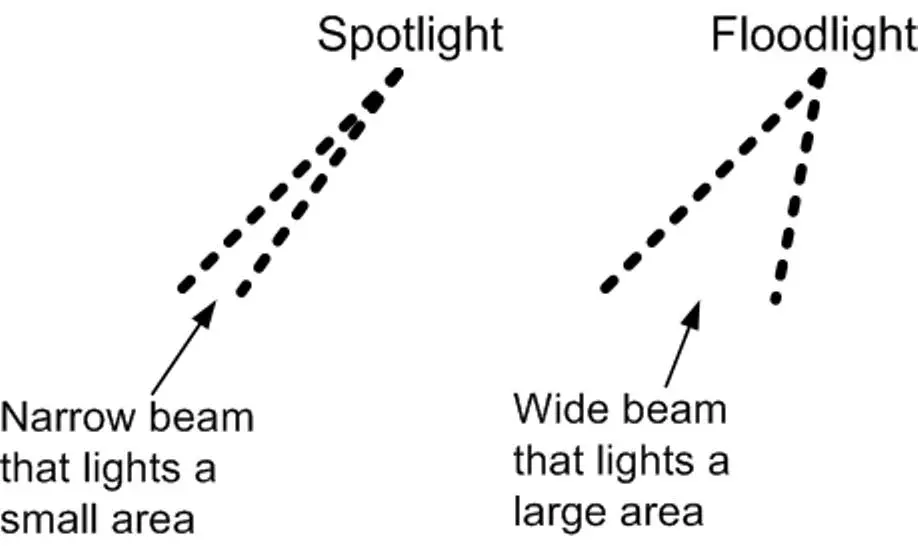
A floodlight is a fixture designed to wash an area with light, creating broad, relatively even illumination across walls, yards, parking lots, or sports fields. Its beam angle is wide and light spreads quickly across the scene. A spotlight is designed to concentrate light into a narrower cone to highlight objects, create dramatic accents, or reach farther distances with concentrated intensity. These labels may refer to beam pattern, fixture shape, or both, and manufacturers sometimes use the terms loosely, so check the technical spec sheet when in doubt.

2. Technical differences: beam angle, lumen distribution, candela, and effective distance
Beam angle
Beam angle is the angular width of the light cone at which intensity falls to 50 percent of the center value. Floodlights typically have beam angles from about 45 degrees up to 120 degrees or more, creating a “wash” of light. Spotlights usually have beam angles between about 5 and 45 degrees, concentrating luminous flux into a smaller solid angle for greater reach.
Lumen distribution and candela
Lumens measure the total visible output. Candela measures luminous intensity in a particular direction, which matters more for spotlights because the light is concentrated. For the same lumen rating, a spotlight will have higher candela and greater distance than a floodlight because its beam is narrower. Floodlights spread lumens across a wide area so the lux at any given point is lower unless the total lumens are much higher.
Beam distance
Because of the narrow beam, spotlights can illuminate targets at longer distances. Floodlights trade throw for width; they illuminate closer and wider spaces effectively. For this reason, spotlights are used for long-distance accenting and floodlights for short-to-medium range area coverage.
3. Typical fixtures and design features
-
Floodlight fixtures: often rectangular or multi-chip arrays, with robust housings for weather resistance, adjustable yokes for aiming, and reflectors or diffusers to soften edges. They may include motion sensors, photocells, or cameras for security applications.
-
Spotlight fixtures: often round or cylinder shaped, with optical lenses or reflectors that create a tight beam; used in landscape uplighting, facade highlighting, and architectural accent lighting. Low-voltage landscape spotlights are common for garden and path accenting.
4. Practical use cases and placement examples
Below are common scenarios and the recommended solution.
| Scenario | Recommended type | Why it fits |
|---|---|---|
| Building facade illumination for security and visibility | Floodlight | Wide coverage reveals large areas and reduces dark zones. |
| Highlighting a statue, tree, or architectural detail | Spotlight | Concentrated beam draws attention and creates modeling with contrast. |
| Parking lot, driveway, or yard safety | Floodlight or multi-head arrays | Uniform light across walking and driving surfaces reduces hazard. |
| Long-range search, marine or offroad use | High-output spotlight | Narrow beam delivers usable illumination to much greater distances |
| Layered landscape lighting | Mix of both | Floods provide base layer, spotlights add drama and focal points. |
5. Performance and measurement table: numbers to compare before purchase
This concise table shows typical ranges you will see on spec sheets. Real products vary, check the spec sheet.
| Metric | Typical floodlight | Typical spotlight | What to check on datasheet |
|---|---|---|---|
| Beam angle | 45° to 120°+ | 5° to 45° | Beam angle, beam shape (elliptical or round) |
| Typical lumen range | 1000 to 50,000 lm (small to stadium) | 300 to 50,000 lm (small to high-power search) | Lumens and candela |
| Candela | Lower for same lumens | Much higher for same lumens | Candela values help estimate throw |
| Useful throw distance | Short to medium | Medium to very long | Use photometric files for accurate ranges |
| Typical applications | Area lighting, security, sports | Accent, long-range, signaling | Environmental rating, glare control |
| Optical control | Diffusers, wide reflectors | Lenses, TIR optics, parabolic reflectors | Beam uniformity and spill |
Key takeaway, check both lumens and candela plus a photometric (IES) file when available. Photometrics tell you lux at distance and are the most accurate method to size lighting for a space.
6. Power, efficiency, and light quality considerations
LED vs HID and other sources
Most modern floodlights and spotlights are LED. LEDs offer higher energy efficiency, longer life, and smaller form factors that provide flexible optics. Some older systems still use metal halide or halogen for color rendering or cost reasons, but LED has become dominant for both flood and spot applications due to efficiency and control.
Color temperature and CRI
Color temperature affects mood and visibility. For security and exterior work, 4000K neutral white balances visibility with color accuracy. For accenting landscapes or warm facades, 2700K to 3000K produces a warm tone. CRI (color rendering index) above 80 is recommended for accurate color rendition when color matters, such as architectural finishes or signage.
Control and dimming
Spotlights often benefit from dimming or beam-angle control to tune drama and balance. Floodlights with motion sensors and photocells reduce energy consumption and increase utility for security applications. Smart control compatibility is common in contemporary fixtures.
7. Installation, mounting, and wiring differences
-
Floodlights: frequently mounted on poles, building walls, or high yokes. Because they cover large areas, mounting height is important to reduce glare and improve uniformity. Floodlight wiring often needs conduit and may require higher power circuits for large arrays.
-
Spotlights: often installed closer to the ground for landscape uplighting, or on brackets pointing to an object. Low voltage spotlights use transformers and simpler wiring for retrofit projects. When aiming, consider beam cutoffs to avoid light trespass.
Installation checklist
-
Confirm fixture IP rating for weather.
-
Verify mounting height and aim for desired coverage.
-
Review power requirements and circuit protection.
-
Obtain photometric files and simulate coverage if available.
-
Arrange glare shields and cutoffs near neighboring properties.
8. Safety, security, and compliance considerations
Light pollution and glare are important. Floodlights, if poorly aimed, cause nuisance light and intrude into neighbors windows. Many municipalities require cutoff optics or limit lumen output for exterior fixtures. Security lighting can deter intruders but flashing or excessively bright lights can create unsafe glare for drivers or pedestrians. Use motion sensors, timers, and directional optics to reduce negative impacts.
9. Cost comparison and lifecycle economics
Up-front cost depends on LED power, housing quality, optics, and control features. A single LED floodlight with integrated driver may cost more initially than a simple halogen spotlight, but energy savings and reduced maintenance for LED generally produce lower total cost of ownership over 3 to 7 years. For large installations like sports fields, photometric planning can reduce the number of fixtures needed and lower long-term costs. Consider warranty terms and IP/IK ratings for outdoor durability.
10. How to choose for your application, quick decision flow
-
Define objective: area coverage, accent, long-range visibility, or security.
-
Determine mounting height and available power.
-
Check photometric needs: lux targets for tasks or safety.
-
If you need uniform illumination, pick floodlights and specify beam angle and lumen output.
-
If you need emphasis or throw, choose spotlights and check candela and beam spread.
-
Combine both for layered lighting: flood for base, spot for accents.
-
Add controls like motion sensors or dimming to optimize runtime.
11. Recommended product types and specification templates for suppliers
When requesting quotes or writing a product page, include:
-
Intended use and target lux level
-
Mounting type and height
-
Required beam angle (degrees) or beam type (narrow, medium, wide)
-
Lumen output and required candela or photometric file
-
Color temperature and CRI
-
IP rating and warranty
-
Control options: motion sensor, photocell, NEMA socket, DMX, DALI, or wireless
This helps suppliers deliver accurate fixtures rather than relying on ambiguous terms. Many manufacturers use “spot” or “flood” interchangeably, so demand numeric specs rather than marketing names.
12. FAQs
Q1: Are floodlights brighter than spotlights
A: Brightness depends on lumens and how those lumens are focused. For equal lumens, a spotlight will look brighter on the target because the beam is concentrated, while a floodlight spreads light across a wider area. Check lumen, candela, and photometric data to compare.
Q2: Can one fixture act as both a flood and a spotlight
A: Some modern fixtures offer interchangeable optics or adjustable beam angles that let you change between narrow and wide beams, creating variable flood or spot effects. Always verify with the manufacturer whether the fixture supports that flexibility.
Q3: Which is better for home security, floodlight or spotlight
A: Floodlights provide broad coverage and reduce hiding spots, which is useful for security. Spotlights can be used to highlight entry points or to provide long-range detection. Often a combination yields the best result: flood for area coverage and spot for camera-backlighting or signage.
Q4: What beam angle should I choose for garden uplights
A: Use narrow beams (10° to 25°) for strong accents and wider beams (30° to 45°) for softer washes on trees and shrubs. Consider multiple fixtures at different distances to sculpt the scene.
Q5: How many lumens do I need for a typical yard floodlight
A: Small yards often work well with 1000 to 3000 lumens per fixture, depending on mounting height and desired brightness. Larger areas or higher mounting heights need correspondingly higher lumen outputs or multiple fixtures. Use photometric calculations for precise sizing.
Q6: Do floodlights cause light pollution
A: Poorly aimed floodlights can cause sky glow and trespass. Use full cutoff optics, proper aiming, and motion lighting to reduce light pollution while maintaining functionality. Check local lighting ordinances for compliance.
Q7: Are LED floodlights and spotlights dimmable
A: Many LED fixtures are dimmable, but you must confirm compatibility with dimmer type and driver. Professional installations often use wired control protocols like DALI or DMX for precise dimming.
Q8: What maintenance should I expect for outdoor flood and spot fixtures
A: Inspect seals and gaskets annually, clean lenses to keep output high, check for corrosion on mounts, and replace drivers or modules according to warranty intervals. LEDs reduce lamp changes but drivers and optics require occasional service.
Appendix A: Quick comparison summary table
| Factor | Floodlight | Spotlight | Best when |
|---|---|---|---|
| Coverage | Wide wash | Narrow beam | Need uniform area light vs focal highlighting |
| Throw | Short to medium | Medium to long | Close area vs distant target |
| Glare control | Requires shielding | Requires careful aiming | Reduce neighbor impact vs avoid blinding drivers |
| Typical uses | Security, parking, sports | Accent, facade, long-range | Safety and uniformity vs emphasis and distance |
| Specification to inspect | Beam angle, total lumens, IP, photometric file | Beam angle, candela, lens type, photometric file | Compare numbers, not names |