

Properly designed solar LED lighting provides safe, uniform visibility for outdoor horse arenas while cutting ongoing power costs and simplifying installation. For most private or commercial arenas, aim for an engineered photometric layout that delivers 100 to 300 lux across the riding surface, color temperature near 4000 K, low glare and a max/min uniformity ratio under 3.0; these targets balance equine comfort, rider visual performance, and energy efficiency, and they form the baseline for a reliable solar lighting solution.
1. Why correct arena lighting matters
Good arena lighting is not cosmetic. It reduces the chance of accidents, helps horses judge obstacles correctly, supports judges and trainers who must read subtle cues, and extends usable hours for training or events. Poorly distributed light creates deep shadows, sudden contrast shifts, or glare that spooks animals and fatigues riders. LED fixtures with controlled optics reduce glare and concentrate light where it is needed, while solar systems remove dependence on distant grid connections that raise installation complexity and cost.

2. Key technical metrics every buyer should know
Illuminance (lux / footcandles)
-
Training and general use (recreational riding): typically 100 to 150 lux (about 9 to 14 fc).
-
Higher-level training, light jumping: 150 to 300 lux.
-
Competition levels may require 300 lux or more depending on discipline and broadcast needs.
These ranges come from lighting industry practice for equestrian venues; final targets should follow a photometric study tailored to arena size and discipline.
Uniformity
Uniformity ratio (average-to-minimum or max-to-min) should be kept low so riders and horses do not cross sharp light/dark boundaries. A max/min of 3.0 or lower is commonly recommended for arenas.
Color temperature and color rendering
Neutral white color around 4000 K to 5000 K gives natural contrast and accurate color perception without appearing too cool. Aim for CRI 70 or higher for general use; higher CRI (80+) benefits judging and photography.
Glare and shielding
Optical control, beam angles and proper aiming minimize direct glare. Choose fixtures with Type II/III asymmetric optics for long, narrow arenas, and Type IV/V for larger round or open areas.
Pole height, lumen output and beam selection
Fixture wattage and lumen output must match pole height. Typical small-to-medium arenas use poles 6 to 18 meters high, with flood fixtures in the 150 W to 500 W LED range depending on layout. Final selection depends on beam angle and desired lux level.
3. Solar versus grid: feasibility, advantages and limits
Solar-powered arena lights are practical when grid access is costly or slow. Solar works well in rural equestrian centers, remote training fields, or any site that prefers low infrastructure disruption. Advantages include near-zero night energy bills, simpler permitting in some regions, and modular deployment. Limitations include the need for adequate daytime insolation, battery sizing for multi-night autonomy if required, and larger upfront equipment cost compared with a basic grid-run system. Case histories show many successful solar arena installs when system design used professional photometry and oversizing of storage to cover cloudy periods.
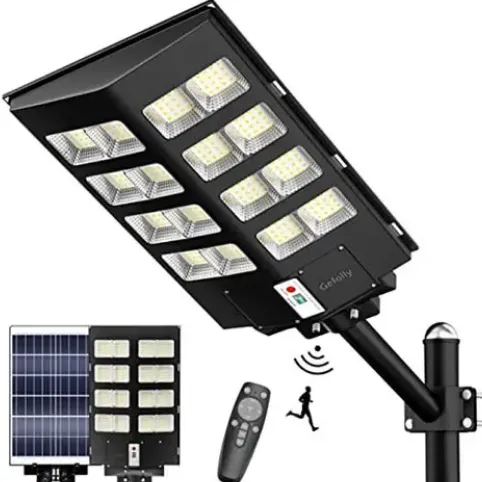
4. System components and how they interact
A reliable solar arena lighting system includes four main parts:
-
LED fixtures: high-efficiency LEDs with selectable optics, dimming and good thermal design.
-
Solar panels: PV array sized for daily energy yield plus system losses.
-
Energy storage: lithium-ion or advanced AGM battery bank sized by required nights of autonomy.
-
Intelligent controller and inverter: MPPT charge controllers and an inverter (if fixtures require AC) or DC drivers for direct-DC fixtures. Controllers handle dusk/dawn switching, dimming schedules and load management.
Correct integration requires a balance: fixture power × hours per night = required battery energy; panel array must recharge battery each sunny period plus reserve for cloudy days. Use derating factors (panel 0.75–0.85, battery round-trip efficiency 0.85–0.95) when calculating. Vendor data sheets and a site irradiance map produce final sizing.
5. Sizing principles with practical examples
Quick rules of thumb
-
Estimate required average lux for the discipline (100–300 lux).
-
Calculate arena surface area (length × width).
-
Required lumens = target lux × area × factor for fixture-to-surface efficiency and uniformity losses (typically 1.3–1.6).
-
Solar daily energy = total lumens-to-watts conversion × fixture hours per night × system loss multiplier.
-
Add battery reserve for desired autonomy nights.
Example table: sample arena types and starting points
| Arena size | Typical target lux | Suggested pole height | Typical fixture power per pole (LED) | Typical number of poles |
|---|---|---|---|---|
| 20 m × 40 m (small) | 100 | 6–10 m | 4 × 150 W | 4–6 |
| 25 m × 60 m (private training) | 150 | 10–15 m | 6 × 200–250 W | 6–8 |
| 40 m × 80 m (competition) | 250–300 | 12–18 m | 8–12 × 300–500 W | 8–12 |
Numbers above are starting points. A certified photometric study refines fixture counts, aiming, and beam selection.
Battery and panel quick-sizing example (simplified)
Assume: 6 fixtures × 200 W = 1200 W running, 4 hours/night = 4.8 kWh/night. Factor losses and inefficiencies, multiply by 1.4 → 6.72 kWh required from battery per night. For two nights autonomy, battery capacity ≈ 13.5 kWh (include depth-of-discharge margin). Panel daily yield (site dependent) of 4.5 kWh/kW; for 6.72 kWh/day need ≈1.5 kW of panels before derating; after derate multiply by 1.3 → ~2.0 kW array. Actual engineering uses local solar insolation data.
6. Photometric planning, mounting and aiming best practices
-
Commission a photometric study. It defines fixture placement, aiming, and beam requirements so uniformity and lux targets are met. Providers can simulate lux maps that reveal hotspots and shadows.
-
Use asymmetric optics for long narrow arenas to push light into the riding surface while reducing spill.
-
Avoid fixture heights that produce excessive glare toward rider eye level. Place lights outside the immediate sightline where practical, and use shields/visors to control direct view into lamp sources.
-
Consider dimming schedules and motion-sensing for low-use hours to protect battery reserves. For events, use full output.
-
Account for seasonal sun angle when placing panels to ensure year-round recharge. Panels often mount on separate ground racks or on mid-height pole arms with tilt fixed to local latitude.
7. Lifecycle costs, maintenance and reliability
Solar options have higher initial equipment cost but lower operational expense. Key lifecycle considerations:
-
LED fixtures often have 50,000–100,000 hour lifespans with minimal lumen depreciation.
-
Batteries have replacement intervals that depend on chemistry and depth of discharge; lithium batteries typically last 5–12 years under proper management.
-
PV arrays usually have 25+ years of productive life with gradual performance decline.
-
Routine tasks: clean panels seasonally, check pole mounts, verify controller logs, and schedule fixture lens cleaning.
A total cost of ownership model comparing grid-run LED plus trenching costs to solar CAPEX often shows payback in rural installs where trenching and transformer costs are high. Use local pricing and an energy model for precise ROI.
8. Environmental, safety and regulatory factors
Follow responsible lighting principles to limit light pollution and disruption to neighbors. International lighting organizations recommend targeted illumination, low upward light spill, and controls that shut down or dim fixtures during late hours. Check local ordinances regarding glare and hours of operation. The Illuminating Engineering Society provides principles that balance outdoor lighting benefits with environmental stewardship.
9. How to specify a custom solution from SunplusPro
When you request a bespoke quote from SunplusPro provide:
-
Arena dimensions and surface type
-
Primary use (training, competition, riding school, multiuse)
-
Desired illuminance (lux target) and any event or broadcast requirements
-
Preferred autonomy nights for solar (e.g., 1 night, 2 nights)
-
Local latitude and average site insolation or nearest city/zip code
-
Any access or aesthetic constraints (pole locations, existing poles)
We produce a photometric layout, panel and battery sizing, full BOM, installation instructions and a warranty package at factory pricing with customization options for mounting finishes and control systems.
10. Technical tables and sample specification sheets
Table A. LED fixture specification examples
| Item | Typical spec |
|---|---|
| Model type | Narrow-asymmetric LED flood with adjustable tilt |
| Rated power | 150 W, 200 W, 300 W, 500 W options |
| Lumen output (manufacturer) | 18,000 lm (150 W) to 70,000 lm (500 W) |
| Optics | Type II/III/IV selectable, cut-off trim to reduce glare |
| CCT | 4000 K standard; 3000 K or 5000 K optional |
| CRI | ≥70 standard; ≥80 optional |
| IP rating | IP66 or better |
| Dimming | 0–10 V or DALI optional |
| Warranty | 5-year standard, extended to 7–10 years optional |
Table B. Battery chemistry comparison
| Chemistry | Cycle life | Typical depth of discharge | Maintenance | Typical use case |
|---|---|---|---|---|
| Lithium-ion (LiFePO4) | 2000–5000 cycles | 80–90% | Low | Best for frequent cycling and long life |
| AGM / sealed lead acid | 300–800 cycles | 40–50% | Moderate | Lower CAPEX, shorter life |
| Gel | 500–1200 cycles | 50% | Moderate | Cold-tolerant options |
Sample project worksheet (condensed)
-
Arena: 40 m × 80 m = 3200 m²
-
Target lux: 200 (training/competition mix) → required lumens ≈ 640,000 lm (after efficiency multiplier)
-
Proposed fixtures: 10 × 300 W high-efficiency LEDs (approx. 28,000 lm each) with asymmetric optics → photometric study required to confirm count and aiming.
-
Night usage: 4 hours typical, peak event nights 6 hours.
-
Battery: ~25–30 kWh LiFePO4 for one-night autonomy, add per-night reserve for cloudy periods.
-
PV array: dependent on local irradiation; example estimate 6 kW before derate.
Final engineering will refine all numbers using site solar data and precise fixture photometry.
11. Installation tips and quality checkpoints
-
Use concrete foundations sized to pole manufacturer instructions with anti-vibration measures.
-
Provide surge protection for fixtures and controllers.
-
Use lockable enclosures for battery and controller cabinets and ventilate appropriately.
-
Pre-wire and test controllers off-site when possible to reduce on-site commissioning.
-
Keep records: photometric report, as-built pole locations, cable routes and warranty paperwork.
12. Frequently asked questions
Q1: Can solar LED lights provide consistent brightness every night?
A1: Yes when designed with adequate panel capacity and battery reserve. Systems may include multiple nights of autonomy to cover cloudy stretches. A professional energy model uses local insolation data to set panel size and storage capacity.
Q2: Will LED lighting spook horses?
A2: Properly aimed, uniform LED lighting reduces sudden contrasts that can startle animals. Avoid direct line-of-sight glare into the horse’s eye level and use gradual dimming where late-night use is low.
Q3: What color temperature should I choose?
A3: Neutral white near 4000 K offers natural color rendering and depth perception. Higher CRI fixtures improve color fidelity for judging and photos.
Q4: How many poles do I need for a 25 m × 60 m arena?
A4: Typical layouts use 6 to 8 poles with mid-range fixtures, but exact counts depend on pole height, beam angle and target lux. Obtain a photometric layout for a definitive figure.
Q5: Can I mix solar and grid power?
A5: Hybrid systems combine grid with PV plus battery for redundancy and lower battery sizing. They offer great resilience for event venues. System architecture should be designed by a qualified integrator.
Q6: What maintenance does a solar arena light require?
A6: Clean panels seasonally, inspect pole hardware annually, check battery health via BMS logs, and replace worn components per warranty schedules. Batteries typically require the most attention.
Q7: How do I limit light spill into neighbors’ properties?
A7: Use optics with tight cutoff angles, lower mounting heights where practical, shields, and dimming schedules. Photometric reports show predicted spill and help mitigate complaints.
Q8: Will LED fixtures work in cold climates?
A8: Yes. LEDs perform well in cold weather and battery selection should favor chemistries tolerant of low temperatures or include thermal management. Battery capacity adjustments account for reduced cold-weather performance.
Closing recommendations and SunplusPro value proposition
For best outcomes, request from SunplusPro a full photometric study, a BOM that shows PV, battery, controller and fixture specifications, and a total installed price that highlights factory direct savings. Our team can produce layouts for private riding arenas through large public competition grounds, optimize for low glare and energy independence, and tailor warranties and maintenance plans relevant to equestrian uses. SunplusPro supports customization, quick factory turnaround and technical documentation to satisfy event organizers, judges and local authorities.