

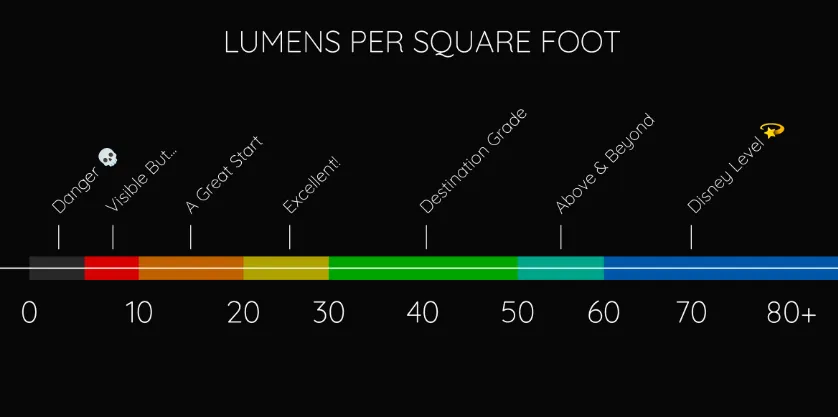
For most residential garages deliver about 50 lumens per square foot for general lighting; if the space is used for mechanical work, fine-detail projects, or professional shop tasks, plan for 100 to 300 lumens per square foot in task areas. Use footcandles for design precision because one footcandle equals one lumen per square foot, then convert required lumens to fixture counts using fixture lumen output and a realistic room coefficient.
1. Why lumens per square foot matters for a garage
Lighting determines how effectively you can perform tasks, how safe the area feels, and how well you see subtle colors and details. A garage used only for parking needs far less delivered light than one used for woodworking, car repair, or photography. Designing to an appropriate lumen-per-square-foot target ensures even coverage, reduces glare and shadows, and prevents energy waste by specifying the right fixtures and layout.

2. Key terms explained simply
-
Lumen: total light output of a lamp or fixture. Use this to compare sources.
-
Footcandle (fc): illuminance on a surface. 1 fc = 1 lumen per square foot. Many designers prefer this for rooms because it describes delivered light.
-
Lux: metric equivalent. 1 fc ≈ 10.76 lux.
-
Efficacy: lumens produced per watt. Higher efficacy reduces energy use.
-
CCT (correlated color temperature): warm to cool appearance in Kelvin. Garages commonly use 4000 K to 5000 K for neutral to cool task lighting.
-
CRI (color rendering index): how accurately colors are rendered. For tasks, CRI 80+ is baseline; CRI 90+ is preferred where true color identification matters.
3. Recommended lumen and footcandle ranges
Below are practical ranges distilled from professional sources and standard recommendations.
-
Parking and general storage: 10 to 20 lumens per square foot (10 to 20 fc).
-
Typical residential garage general illumination: around 50 lumens per square foot (50 fc) is commonly recommended for consistent visibility.
-
Task areas, workbenches, automotive service bays: 100 to 300 lumens per square foot depending on detail level. Automotive service and body work call for the higher end of that range.
-
Safety corridors and aisles in larger shops: 10 to 30 fc for navigation, more where tasks occur.
These ranges map back to footcandle guidelines published by lighting professionals and industry bodies. Use the 50 lm/sqft baseline for most homeowners, and raise that value where precision or safety tasks exist.
4. How to calculate total lumens for your garage — step by step
Follow this approach to translate a lumen-per-square-foot target into fixture counts.
-
Measure area: length × width = square feet.
-
Set target fc (lumens per square foot) depending on use. Example: 50 lm/sqft for general.
-
Total lumens required = area × target fc.
-
Select fixture lumen output: use manufacturer-rated lumens per fixture (not watts).
-
Apply a room surface coefficient (also called light loss factors): reflectance of walls/ceiling and fixture distribution reduce delivered light. Typical working coefficient is 0.7 to 0.9 for residential garages; use 0.7 for darker finishes or obstructed fixtures.
-
Adjusted fixture lumens = fixture lumen rating × coefficient.
-
Fixture count = total lumens required ÷ adjusted fixture lumens. Round up and plan layout to avoid dark spots.
Example (table)
| Garage size | Target (lm/sqft) | Total lumens required | Fixture type | Fixture output (lm) | Coefficient | Adjusted lm per fixture | Fixtures needed |
|---|---|---|---|---|---|---|---|
| 2-car (20×20 = 400 sqft) | 50 | 20,000 | 4-lamp LED shop light | 4,000 | 0.8 | 3,200 | 7 (20,000 ÷ 3,200 = 6.25 → 7) |
This example shows that seven 4,000-lumen fixtures (well distributed) will meet a 50 lm/sqft target when accounting for realistic losses. Use similar math with your selected fixtures.
5. How ceiling height, reflectance and layout affect delivered light
-
Ceiling height: as height increases, fixture beam spreads more before reaching surfaces, reducing footcandles. For ceilings above 10 feet, raise fixture lumen output or use narrow-beam fixtures placed closer to work areas. Many layout calculators change recommended lumen-per-square-foot upward when height increases.
-
Surface reflectance: bright ceilings and light-colored walls reflect light and cut required initial lumens. Dark walls can increase fixture counts by 10 to 30 percent.
-
Obstructions: shelving, vehicles, or machinery create shadows; add task lights near workbenches.
-
Spacing and symmetry: aim for uniform spacing so illuminance variation across the floor is small. A ratio of spacing to mounting height near 1.0 to 1.5 usually yields even coverage for linear fixtures.
6. Choosing fixtures for garages
Match fixture family to ceiling height, budget, and use.
Common fixture types
-
LED linear shop lights: inexpensive, good for 8 to 12 foot ceilings, distribute wide light. Use multiple evenly spaced fixtures for uniform coverage.
-
LED panels/troffers: good for finished garages with drywall ceilings, provide even, soft light.
-
High bay or low bay LED fixtures: for ceilings above 12 feet, use high or low bay with appropriate beam angle.
-
Strip and task lights: under-cabinet or under-shelf LEDs for workbenches. Provide high localized footcandles.
-
Adjustable flood or directional fixtures: for highlighting a specific work area or car lift.
Fixture selection table
| Use case | Typical fixture | Lumen range per fixture | Typical mounting |
|---|---|---|---|
| General parking storage | 4-lamp LED linear shop lights | 3,000 to 6,000 lm | Ceiling surface mount |
| Workbench / mechanical | LED task light / shop light with diffuser | 2,000 to 5,000 lm | Direct above bench, 2 to 4 ft above surface |
| High-ceiling garage | LED high bay | 10,000 to 40,000 lm | Suspended / chain mount |
| Accent and inspection | Directional LED flood | 1,000 to 5,000 lm | Wall or adjustable track |
When selecting, prefer fixtures with photometric data and an IES file so you can model layout precisely, especially in larger or high-value projects.
Lumens for Garage (Per Square Foot) Calculator
7. Energy efficiency, driver quality and dimming
-
Efficacy matters: choose LEDs with high lm/W ratings to reduce electricity consumption. Modern LEDs range from 100 to 170 lm/W.
-
Dimming: if variable lighting is desired, confirm fixture drivers support the dimming method (0–10V, TRIAC, ELV). Dimming saves energy and extends lamp life.
-
Power factor and THD: for commercial installations, choose drivers with high power factor and low total harmonic distortion.
-
Controls: motion sensors and timers in garages often save energy because the space is intermittent-use. Combine occupancy sensors with manual overrides near workbenches.
8. Practical layout examples and fixtures counts
Below are rapid examples to help convert target lumens to practical fixtures. Assume coefficient 0.8 unless noted.
Layout table for 50 lm/sqft target
| Garage (sqft) | Total lumens needed | Example fixture | Fixture lm | Coef | Fixtures needed |
|---|---|---|---|---|---|
| 200 (1-car) | 10,000 | 4-lamp LED shop light | 4,000 | 0.8 | 4 (10,000 ÷ 3,200 = 3.125 → 4) |
| 400 (2-car) | 20,000 | 4-lamp LED shop light | 4,000 | 0.8 | 7 |
| 600 (attached workshop) | 30,000 | LED high bay / long linear | 6,000 | 0.8 | 6 (30,000 ÷ 4,800 = 6.25 → 7) |
Task-area supplement example
If a 2-car garage uses 7 general fixtures, add two 2,000-lumen task fixtures over the bench to raise local illuminance to 150 lm/sqft at the bench surface.
9. Safety, local code, and IES references
The Illuminating Engineering Society publishes recommended illuminance levels and design practices. For commercial and professional spaces consult the IES handbook or a licensed lighting designer. Residential guidance often uses the same unit conversions but can be adjusted for preference. For regulatory compliance or warranty conditions, follow local electrical codes and the IES guidance.
10. Maintenance, lumen depreciation, and warranty notes
-
Lumen maintenance: LEDs gradually lose output. Use manufacturer L70 or L90 ratings to estimate when lumen output reaches 70 percent or 90 percent of initial output. Factor this depreciation into initial fixture count for long life between replacements.
-
Cleaning: dust on lenses cuts delivered light. Schedule periodic cleaning in dusty workshops.
-
Warranty: prefer fixtures with at least a five year driver and LED warranty for high-use workshops.
11. Quick reference tables
Table A: Lumen targets by activity
| Activity | Recommended lumens per square foot | Notes |
|---|---|---|
| Entry and parking | 10 to 20 | Navigation, storage |
| General residential garage | ~50 | Balanced visibility for most uses. |
| Hobby workbench | 75 to 125 | Better for painting, carpentry |
| Mechanical and inspections | 150 to 300 | High detail and color accuracy required. |
Table B. Conversion reminders
| Unit | Equivalent |
|---|---|
| 1 footcandle | 1 lumen per square foot |
| 1 footcandle | ≈ 10.76 lux |
| Room lumens required | area (sqft) × target fc |
Table C — Choosing CCT and CRI
| Purpose | CCT (K) | CRI |
|---|---|---|
| General storage | 3000 to 4000 | 80+ |
| Workshop / auto work | 4000 to 5000 | 80 to 90+ recommended |
| Color-critical finishing | 5000 | 90+ |
12. How to structure a specification for procurement
When buying fixtures write a short spec including:
-
Required lumen output per fixture and IES data file included
-
Beam angle and mounting method
-
CCT and CRI required
-
Dimming compatibility and control protocol
-
IP rating if dust or moisture is a concern
-
Warranty and lumen maintenance (L70/L90) requirements
This ensures fixtures meet both visual and operational needs and enables accurate photometric layouts.
13. Common mistakes and how to avoid them
-
Underestimating task needs: Relying only on general lighting without task supplements results in poor work visibility. Always add task fixtures for benches.
-
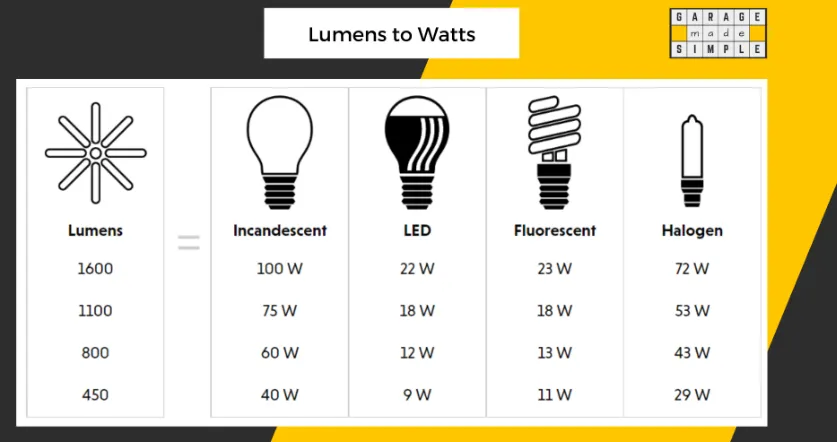
Counting watts instead of lumens: watts measure power, not light. Always specify lumens.
-
Poor spacing: clustering fixtures can create hot spots and shadows. Use even spacing or aim fixtures to overlap coverage.
-
Ignoring ceiling height: mounting height reduces delivered illuminance. Recalculate for taller spaces.
14. Sources and practical further reading
This article synthesizes industry guidance and practical manufacturer advice. For technical standard references consult the Illuminating Engineering Society publications and fixture photometric files when designing larger or commercial installations. For simple residential projects use manufacturer lumen calculators and layout tools to verify uniformity and counts.
15. FAQs
Q1: How many lumens do I need for a two-car garage?
A1: For general use target about 50 lumens per square foot. For a 2-car 20×20 garage (400 sqft) that equals about 20,000 lumens. Add focused task lights where you work.
Q2: Is lumens per square foot the same as footcandles?
A2: Yes. One footcandle equals one lumen per square foot. Designers often use footcandles to express illuminance on surfaces.
Q3: What fixtures give the best value for garage lighting?
A3: High-efficacy LED linear shop lights provide good value for 8 to 12 foot ceilings. For higher ceilings use LED bay fixtures. Prioritize fixtures with published photometrics, a high lm/W rating, and a reliable warranty.
Q4: Should I use warm or cool color temperature?
A4: For tasks use neutral to cool color temperatures 4000 K to 5000 K for clearer detail and truer color perception. For a cozier look use 3000 K where fine detail is not required.
Q5: How do I handle a garage with a vehicle and built-in storage?
A5: Use a general layout for baseline lighting and add adjustable task fixtures over benches and inside storage areas. Consider motion-sensing controls for the vehicle path to save energy.
Q6: Do I need to hire a lighting designer?
A6: For standard residential garages the calculation method described here suffices. For commercial, multiple-bay, or high-ceiling garages, hire a lighting professional to model illuminance, glare, and energy compliance.
Q7: How often do I need to replace LED garage fixtures?
A7: LEDs last many years. Expect 50,000 hours or more depending on driver and operating conditions. Replace earlier if lumen depreciation or driver failure reduces deliverable light below required levels.
Q8: Can I use motion sensors to reduce power?
A8: Yes. Motion sensors are effective for intermittent spaces like garages. Pair them with a minimal baseline light level if safety is a concern, or use instant-on LEDs with sensors for full brightness when needed.
Closing notes tailored to SunplusPro customers
As SunplusPro offers factory-direct pricing and customization, specify the exact lumen output, mounting options, CCT, CRI and control interfaces in your purchase order. Provide your garage dimensions and preferred target lumens per square foot to get a photometric layout and fixture count tailored to your project.