

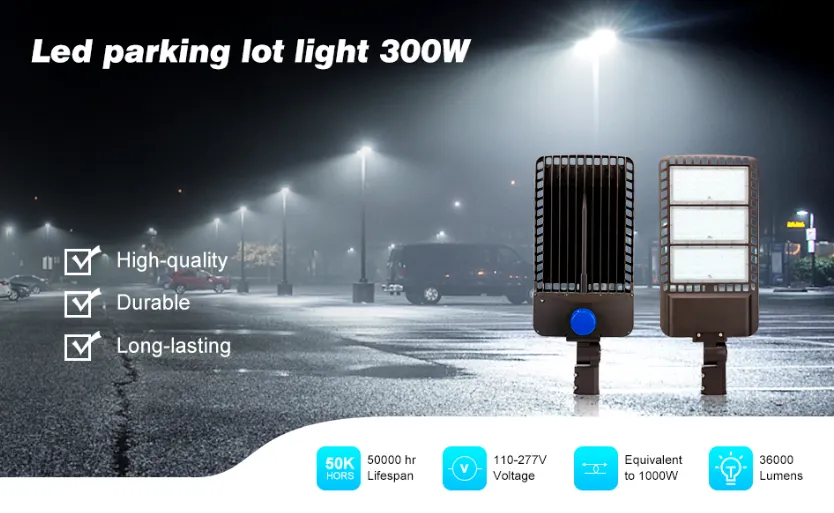
SunplusPro’s 300W LED parking lot fixture rated at roughly 36,000 lumens is a practical solution for medium-to-large parking areas and roadway poles between 25 and 40 feet: it replaces large HID installations while cutting energy use, lowering maintenance, and improving uniformity and color rendering when specified with the right optics, thermal design, and certified testing (LM-79/LM-80 and DLC/ETL where required). For procurement, require third-party photometric test reports, a reputable driver (high PF, low THD), surge protection, an IES file, and a clear warranty — these items protect performance and rebate eligibility and reduce lifecycle risk.
1. Key takeaways
-
36,000 lm at 300W implies an average system efficacy target of ~100–130 lm/W in quality fixtures; verify with LM-79.
-
Prefer fixtures with IES files and LM-79/LM-80 reports to validate claimed lumen and lumen-maintenance.
-
Choose optical distributions (Type III, IV or V) to match pole spacing and target uniformity.
-
Require driver specs: PF ≥ 0.95, THD ≤ 20%, surge protection ≥ 10kV, 0-10V or DALI dimming optional.
-
Look for DLC or utility rebate eligibility and an explicit warranty (5–10 years) to protect long-term value.
2. Technical profile: what “300W / 36,000 lm” really means
When a vendor lists a 300W LED fixture with 36,000 lumens, they are making three distinct claims that buyers must confirm:
-
Input power: nominal system consumption under rated conditions (300W). Measure at nominal voltage and typical driver conditions.
-
Delivered lumens (initial lumens, L0): total luminous flux emitted by the fixture measured in LM-79 photometric tests. Claims on retail pages often use LED chip lumens multiplied by chip count — only an LM-79 report proves fixture output.
-
System efficacy (lm/W): L0 divided by input watts. For 36,000 lm at 300W efficacy = 120 lm/W — high but achievable with modern chips and efficient optics in top designs. Many commodity fixtures report optimistic values; therefore require independent testing.
Practical implication: a 36,000 lm, 300W LED fixture often replaces a 1000W HPS/MH lamp in large, high-mount applications because LEDs deliver directional light and improved effective illuminance on the task surface. Expect the LED replacement to require different optics and different pole spacing to achieve the same uniformity.
3. Optical design: beam patterns, photometry, and uniformity
Optics determine how lumens translate into useful illuminance on the pavement. For parking lots and roadways the common distributions:
-
Type III: lateral spread good for general perimeter rows and long rectangles.
-
Type IV: asymmetric distribution, ideal near walls and boundaries.
-
Type V (square or circular): centralized uniformity for large, evenly spaced poles.
Request the vendor’s IES (LM-63) files and rendered isolux/isoilluminance plots for your proposed pole spacing and mounting height; these files are essential for lighting calculations and permit submittals. High quality fixtures feature refractor/polycarbonate or precision aluminum reflectors and lens optics matched to the chip array; this minimizes uplight and glare while maximizing usable lumens.
Practical checks:
-
Verify Glare Rating (UGR or IES glare info) when installing near pedestrian zones.
-
Confirm color temperature options — typical 3000K, 4000K and 5000K; 4000K is commonly preferred for parking lots (balance of visibility and color appearance).
-
CRI: aim for CRI ≥ 70; CRI ≥ 80 if color rendering is important (adjacent retail façades, cameras).
Also read: Solar Parking Lot LED Lights.
4. Electrical and driver requirements
Reliable electrical design is fundamental to lifetime and performance:
-
Power factor (PF): require ≥ 0.95 to avoid distribution penalties and to ensure efficient use of the circuit.
-
Total harmonic distortion (THD): specify ≤ 20% (lower is better for grid quality and compatibility).
-
Dimming control: 0-10V is common; DALI allows addressable control. Dimming can dramatically reduce energy and extend lifetime.
-
Surge protection: at least 10kV/10kA is advised for outdoor fixtures in exposed locations; higher levels recommended in industrial or coastal sites.
-
Ingress protection: IP65 or higher for wet locations, IP66 recommended in harsh environments.
-
Electrical certifications: UL/ETL listing for North America; CE and RoHS in other jurisdictions.
These requirements influence rebates and insurance acceptance and should be written into procurement documents.
5. Thermal management, lumen maintenance and expected lifetime
LED junction temperature drives lumen depreciation. Design elements to inspect:
-
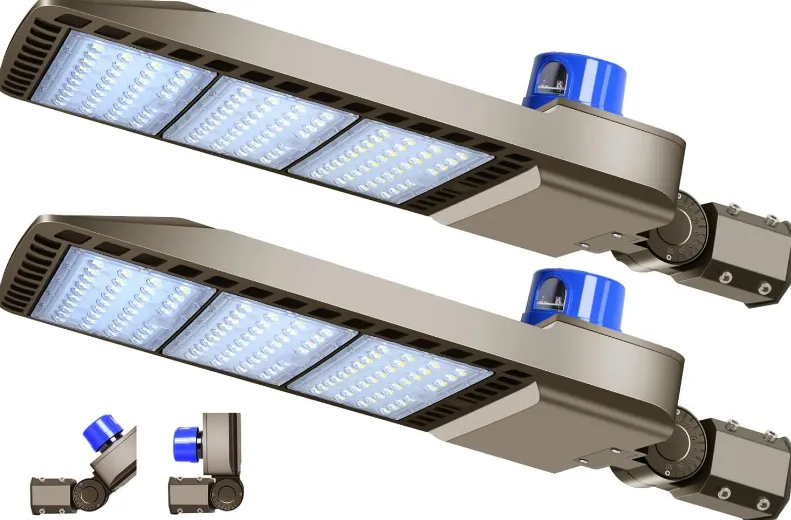
Heat sink design: extruded aluminum fins with conduction path from LED PCB to housing.
-
Driver ventilation: sealed driver compartments with thermal path; avoid designs that trap heat around diodes.
-
LM-80 reports and TM-21 projections: use LM-80 data for the LEDs and TM-21 calculations to project lumen maintenance (L70 at 50,000–100,000 hours is typical for quality fixtures). Always request the vendor’s LM-79/LM-80/TM-21 documentation.
Real world: a fixture claiming 100,000 hour life (L70) but without LM-80/TM-21 documentation is higher risk. Junction temp and ambient conditions (e.g., hot southern climates) reduce life — specify lumen maintenance at site ambient conditions if possible.
6. Mounting, pole height, spacing and recommended layouts
Recommended mounting heights and suggested coverage
| Mounting height (ft) | Typical use case | Typical pole spacing (ft) | Lighting distribution |
|---|---|---|---|
| 15–20 | Small lots, low poles | 40–55 | Type III or IV |
| 20–25 | Medium lots | 55–70 | Type III or V |
| 25–30 | Large lots, retail | 70–90 | Type IV or V |
| 30–40 | Stadiums, campus or high poles | 90–140 | Type V (wide) |
(Values above reflect common industry practice and vendor recommendations for 300W fixtures; confirm with IES files specific to the model.)
Pole spacing strategy:
-
Use pole spacing:height ratio (S/H). For Type III aim for S/H 2.0–3.0; for Type V you can extend S/H to 3.0–4.0 depending on required uniformity.
-
Prioritize uniformity (min/avg) and peak/min ratios for safety and perception; a single very bright pole with large dark areas is undesirable.
7. Energy savings, rebates and ROI
LED replacements typically save 60–75% energy against HID equivalents because of higher efficacy and control options. Utilities often tie rebates to fixture efficacy and DLC listing.
Example ROI table (illustrative)
| Parameter | Existing HPS 1000W | New LED 300W (36,000 lm) |
|---|---|---|
| Fixture wattage (system) | 1000 W | 300 W |
| Annual operating hours | 4,000 | 4,000 |
| Annual energy (kWh) per fixture | 4,000 kWh | 1,200 kWh |
| Electricity $/kWh | $0.12 | $0.12 |
| Annual energy cost | $480 | $144 |
| Annual savings | — | $336 |
| Payback from energy savings (no rebate) | — | depends on installed cost; with typical commercial price differential payback often 2–4 years |
Add rebates and maintenance savings (lamp replacements, ballast work, cleaning) to shorten payback. Always calculate with local utility rates and rebate schedules; require DLC qualification to maximize rebate eligibility.
8. Compliance, testing, and documentation to require in an RFP
Ask vendors to supply:
-
LM-79 photometric report (fixture-level performance).
-
LM-80 (LED package) test report and TM-21 lumen maintenance projection.
-
IES (LM-63) files for lighting layout software.
-
DLC or ENERGY STAR listing if you depend on rebates.
-
UL/ETL listing / CE marking as applicable.
-
Surge protection and driver specs: PF, THD, dimming protocol.
-
Photographs of thermal tests and ambient operating temperature (Ta) derating curves.
-
Warranty statement with coverage (lumens, driver, labor) and a clear RMA/contact process.
Including these deliverables in the RFP protects stakeholders and ensures the fixture performs as promised.
9. Procurement checklist and sample specification (table)
| Requirement | Minimum specification | Why it matters |
|---|---|---|
| Rated power | 300W ±5% | For circuit design and rebates |
| Initial lumens | ≥ 36,000 lm (LM-79 verified) | Confirms vendor claim |
| Efficacy | ≥ 100 lm/W (LM-79) | Energy performance |
| LM-79/LM-80/TM-21 | Required | Photometric & lumen maintenance proof. |
| IP rating | IP65 minimum; IP66 preferred | Weather resistance |
| Surge protection | 10kV/10kA min | Protects electronics |
| Driver | PF ≥ 0.95, THD ≤ 20%, 0-10V dim | Electrical quality & controls |
| Certifications | DLC/UL/ETL as applicable | Rebates, safety |
| Warranty | 5 years minimum; 10 ideal | Lower lifecycle risk |
10. Typical failure modes & maintenance planning
Failure modes include driver failures, LED module lumen depreciation, lens yellowing, and corrosion at mounting interfaces. Mitigations:
-
Use replaceable driver modules and modular LED boards.
-
Choose silicone or high-quality PMMA lenses to resist UV yellowing.
-
Apply corrosion-resistant hardware and powder coating to housings for coastal sites.
Planned preventive maintenance: scheduled cleaning (remove bird droppings, dirt), torque checks on mounting bolts, inspection of seals and gaskets, and replacement of surge protectors after major storms.
11. Competitive gaps and product differentiators (how SunplusPro stands out)
From the top-ranked product pages most suppliers advertise 36,000 lm and 120 lm/W using SMD3030 chips — but customers often lack supporting documentation on LM-79/LM-80 and utility listings. High-value differentiators for SunplusPro:
-
Complete test bundle: provide LM-79, LM-80 and TM-21 with the product listing to build trust.
-
Rebate toolkit: include DLC listing support and utility rebate paperwork for the buyer.
-
Options for controls: photocell, programmable dimming, motion + dim profiles to maximize savings.
-
Robust surge protection and sealed driver compartments to extend useful life in harsh conditions.
-
Custom optics to match local pole spacing and regulatory glare limits.
These items close the practical gaps buyers experience with commodity fixtures that only advertise luminous claims without test data. Retail product pages often claim 36,000 lm; professional buyers need test evidence and installation guidance.
12. Frequently asked questions
Q1: Does 36,000 lm at 300W mean every fixture delivers 120 lm/W in the field?
A1: Not automatically. The 120 lm/W number is initial lab efficacy (L0/W). Field efficacy is influenced by lens, driver losses, and ambient temperature. Require LM-79 fixture test results to verify claim and note that real-world efficacy will be slightly lower.
Q2: What mounting height should I use for a 300W 36,000 lm fixture?
A2: Typical heights are 25–40 ft for large lots and higher poles. Use IES layout files to confirm spacing for uniformity; Type V lenses allow wider spacing than Type III.
Q3: Will 300W LED replace a 1000W HID?
A3: In most high-mount parking applications yes — because LEDs deliver directional light and efficient lumens on the pavement. Confirm with photometric comparison to ensure required peak/min ratios and vertical illuminance for safety.
Q4: What documents do I need to get utility rebates?
A4: DLC qualification (or local program listing), LM-79 reports, and a distributor/installer invoice are common requirements. Check local utility rules.
Q5: What color temperature is best for parking lots?
A5: 4000K (neutral white) is a common balance between visibility and comfort. 3000K reduces glare and sky glow; 5000K increases apparent brightness but may raise glare. Provide options.
Q6: How long until the fixture’s lumen output falls to 70% (L70)?
A6: Quality fixtures with LM-80-tested LEDs and good thermal design often project L70 at 50,000–100,000 hours via TM-21 projections. Require LM-80/TM-21 in procurement.
Q7: What warranty should I expect?
A7: Minimum 5 years; many premium suppliers offer 7–10 year warranties covering driver and LED modules. Ensure the warranty includes lumen maintenance commitments and clear RMA procedures.
Q8: Do I need a photocell or motion sensor?
A8: Photocells for dusk/dawn operation are standard; motion sensors or dimming profiles significantly increase energy savings in low-traffic periods and extend driver life.
13. Appendix: quick spec comparison table
| Item | Commodity 300W listing (typical) | Spec-grade 300W (recommended) |
|---|---|---|
| Claimed lumens | 36,000 lm (vendor page) | 36,000 lm (LM-79 verified) |
| Efficacy | 120 lm/W (claimed) | ≥100 lm/W (LM-79) |
| Certification | often none | DLC, UL/ETL, LM-79/LM-80 |
| IP rating | IP65 | IP66 |
| Warranty | 3 years | 5–10 years |
| Controls | photocell | photocell + 0-10V/DALI + optional motion |
Closing recommendations for engineers and procurement teams
-
Require test documents up front — LM-79, LM-80, TM-21 and IES files. These protect performance claims and rebate eligibility.
-
Specify electrical quality — PF ≥ 0.95, THD ≤ 20%, surge ≥ 10kV.
-
Confirm optical distribution with IES files for your pole layout; do not rely on a single lumen number.
-
Factor in controls (dimming, occupancy) to boost energy savings and reduce payback.
-
Ask for an installation and maintenance plan and include a warranty that covers labor or replacement for critical failures.