

For projects where continuous, high-output lighting and predictable uptime matter, grid-powered LED fixtures remain the best technical choice; for locations with limited grid access, high energy cost sensitivity, long-term operating-cost targets, or sustainability mandates, integrated LED solar lighting usually delivers lower total cost of ownership and greater deployment flexibility.
1. Quick definitions: what each term means
-
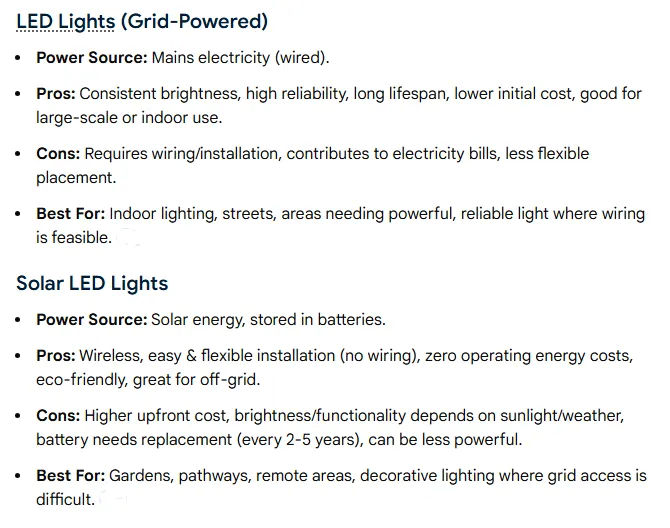
LED light refers to a lighting fixture that uses light-emitting diodes and is powered by a stationary electrical supply, typically the utility grid or a local generator. The fixture includes LED module, driver, housing, and mounting hardware.
-
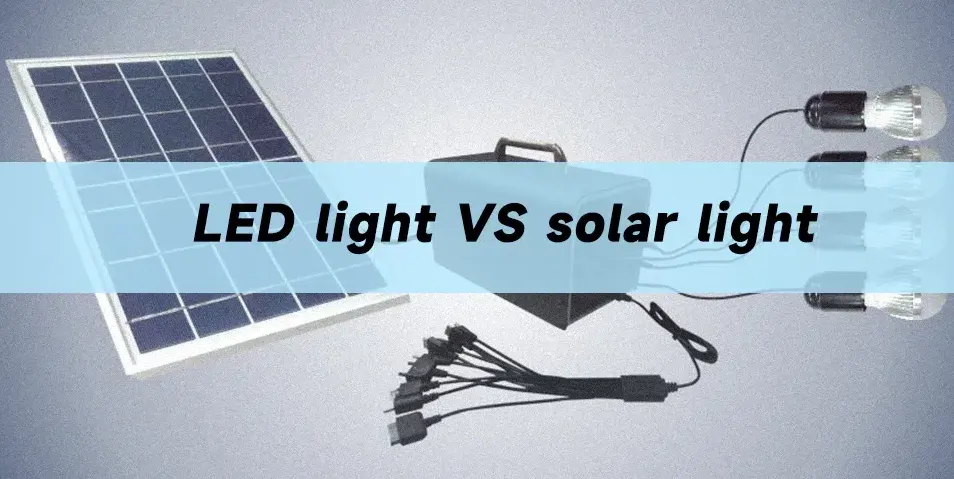
LED solar light (often called solar LED or solar street light) is an integrated system: photovoltaic (PV) panel, battery pack, charge controller/MPPT, LED fixture, and sometimes a smart controller in one solution. The LED emitter technology is the same family, but the power source and balance-of-system components differ.
2. High-level difference summary
Key contrasts:
-
Power source: grid vs on-site solar energy. That changes procurement, civil work, and operations.
-
Upfront cost: solar systems typically cost more upfront due to PV, batteries, and control electronics.
-
Operating cost: solar avoids utility energy bills and cabling trenching costs, often lowering operating costs over multi-year horizons.
-
Maintenance profile: solar adds battery and panel upkeep; grid systems add network cabling and centralized power failures.
-
Lifetimes: LED modules often rate to tens of thousands of hours; PV panels typically last multiple decades while batteries require periodic replacement.
3. Core system components and how they change outcomes
Breakdown and procurement relevance:
Grid LED fixture
-
LED module (SMD/COB chips), optical lens, thermal path
-
Constant current LED driver (dimming optional)
-
Pole, wiring, fuse/protection, junction boxes
LED solar light (integrated)
-
PV panel (mono or polycrystalline)
-
Battery (LiFePO4, Li-ion, sealed lead acid in low-cost units)
-
Charge controller / MPPT and system controller (scheduling, dimming, remote telemetry)
-
LED module and optics
-
Mounting hardware that must meet load/wind specs
Implication: procurement spec must include not only fixture lumen output but battery chemistry, depth-of-discharge limits, PV wattage and tilt, MPPT efficiency, and expected autonomy days for off-sun operation.
4. Performance: luminous efficacy, lumen maintenance, color quality
-
Efficacy (lm/W): modern LED modules commonly achieve 120–200 lm/W at the component level; final fixture numbers depend on optics and thermal management.
-
Lumen maintenance: LEDs typically maintain useful output for many thousands of hours; L70 ratings around 50,000 hours are common in quality outdoor fixtures. This is an important baseline for both grid and solar systems because LED lifetime drives replacement frequency.
-
Color rendering and CCT: both systems can deliver high CRI and a range of correlated color temperatures (2700K–6500K); choose based on safety, visual comfort, and application.
Note: solar systems must balance brightness profile with available energy per night. For strictly equivalent lumen output all night, solar designs will need larger PV and battery capacity and therefore higher upfront cost.
5. Installation, civil work, and site planning tradeoffs
-
Grid LED: requires trenching, conduit, poles with underground or overhead cabling, and possibly transformers. When multiple lights are clustered, cabling cost per fixture reduces but initial civil work can be expensive.
-
Solar LED: eliminates trenching and reduces utility permitting, enabling rapid deployment in remote sites, islands, temporary works, or constrained urban settings. For some projects, lack of trenching yields major savings and much faster timelines. Several industry comparisons show solar solutions often reduce installation complexity and cost in distributed deployments.
Site planning notes for solar:
-
PV orientation and tilt must match local latitude to meet winter insolation needs.
-
Obstructions, shading, soiling, and vandalism risk must be evaluated up front. Dirty panels or prolonged cloudy periods impact available energy. Cleaner panels and tilt help maintain winter output.
6. Cost comparison and typical total cost of ownership (TCO)
Upfront vs operational costs vary by scenario. The sample table below models three illustrative use cases (values are demonstrative; treat as a structured method, not a quote).
Table A. Example CAPEX and 5-year TCO (per single streetlight, illustrative)
| Item | Grid LED (single pole) | LED Solar (integrated) |
|---|---|---|
| Fixture CAPEX (LED luminaire only) | $450 | $650 (LED + system electronics) |
| PV & battery & controller CAPEX | n/a | $900 |
| Civil & trenching (per pole share) | $1,200 | $200 |
| Installation labor | $300 | $250 |
| Energy cost over 5 years | $150 | $0 |
| Maintenance & spare parts (5 yrs) | $200 | $300 (battery replacements prorated) |
| Estimated 5-year TCO | $2,300 | $2,300 |
Explanation: when trenching costs are high and grid connection is distant, integrated solar can match or beat grid TCO over a 5-year window. Specific projects show solar TCO advantages when trenching is required or utility rates are high.
Table B. Primary drivers that shift TCO in solar’s favor
| Driver | Moves outcome toward solar |
|---|---|
| High local electricity price | yes |
| Expensive trenching/permitting | yes |
| Remote or temporary installation | yes |
| Strict carbon reduction goals | yes |
| Low maintenance budget for central crews | mixed |
Caveat: battery replacement every 3–7 years (depending on chemistry and duty) is the single largest recurring cost for solar systems. Industry guidance commonly cites battery life around 5–7 years for common chemistries in many products; older sealed lead acid units often fail sooner.
7. Reliability, lifetime, and replacement cadence (component lifespans table)
Understanding which parts wear matters for procurement and spare-parts planning.
Table C. Typical component lifetimes (industry ranges)
| Component | Typical rated life | Procurement note |
|---|---|---|
| LED module (L70) | ~50,000 hours (about 7–17 years depending on daily usage) | Specify TM-21/L70 rating in RFP. |
| LED driver | 8–15 years | Choose drivers with thermal protection and high MTBF. |
| Photovoltaic panel | 20–25+ years | PV warranties often 20–25 years; output degrades slowly. |
| Battery (LiFePO4) | 4–10 years (chemistry dependent) | Plan scheduled replacement; LiFePO4 preferred for cycle life. |
| Charge controller / electronics | 5–12 years | Choose controllers with remote telemetry for easy diagnostics. |
Important reliability point: solar lighting can be affected by extended cloudy periods and panel soiling, which reduces available energy and, in turn, reduces night-time output if autonomy is insufficient. Grid power does not have that vulnerability; however, grid outages and cable faults are different risk vectors.
8. Sizing methodology for LED solar systems
Engineers must size PV and battery based on required nightly lumen-hours, local insolation, autonomy days, and system losses.
Step-by-step outline
-
Define lighting requirement: required lux or lumen output × hours per night. Example: a street is specified to need 30 lux for 12 hours (use local standard). Convert to total lumen-hours per pole.
-
Select LED system efficacy: assume fixture delivers 120 lm/W and driver efficiency 90%. Calculate electrical watt-hours required per night.
-
Define autonomy: number of cloudy days to sustain (common choices: 2–5 days).
-
Local insolation: use site PV production (kWh/m2/day) — reference meteorological data. Multiply by panel efficiency and sizing factor to get daily energy production.
-
Battery sizing: battery capacity (Wh) = nightly consumption × autonomy × depth-of-discharge factor / inverter/roundtrip losses.
-
Add margins: add 20–30% for system losses and aging.
Worked numeric example (rounded)
-
Nightly lighting energy need: 40 Wh (LED power) × 12 h = 480 Wh
-
Autonomy: 3 days → battery must supply 480 × 3 = 1,440 Wh
-
Battery chemistry DoD allowed 80% → required battery capacity ≈ 1,800 Wh
-
Daily sun (site) average winter worst-case: 3 kWh/m2/day. With panel and system losses, use 300 W panel sized to generate ~900 Wh/day in winter — adjust for tilt and shading. For conservative designs increase panel size.
This example shows why winter/low-insolation conditions force larger PV and battery sizing, increasing CAPEX. For sensitive projects, perform full local solar resource modeling.
9. Maintenance, serviceability, and spare-parts planning
Grid LED maintenance
-
Replace LED modules/drivers based on L70 predictions
-
Repair or replace underground cable faults and poles
-
Centralized maintenance crews often more efficient for many fixtures
LED solar maintenance
-
Periodic battery replacement and end-of-life disposal plan
-
Panel cleaning schedule in dusty/industrial environments to avoid production loss
-
Controller firmware updates and telemetry diagnostics can reduce site visits
Industry reporting highlights battery replacement and panel soiling as the major variable costs for solar lighting; plan a life-cycle maintenance budget and remote monitoring to reduce truck rolls.
10. Environmental, regulatory, and procurement considerations
-
Carbon and sustainability: solar lighting can support municipal GHG reduction targets and corporate sustainability reporting.
-
Permits and utility interactions: grid connections can require complex permitting and trenching approvals; solar often needs fewer permits but must meet structural and electrical safety codes.
-
Recycling and end-of-life: specify battery recycling, PV recycling or reuse, and LED component disposal.
-
Standards and certifications: demand IP65/67 ingress protection, IK impact ratings, LM-79 photometric reports, TM-21/L70 predictions, and PV IEC certifications. These are central to EEAT-style procurement and to winning enterprise contracts.
11. Buyer checklist for engineers and purchasing managers
Use this in RFP or purchase order language.
Minimum technical checklist
-
Fixture lumen output at nominal drive current (lm) and driver efficiency.
-
Lumen maintenance (TM-21 report; L70 hours).
-
Photometric files (IES/LOM).
-
PV panel watt rating, temperature coefficients, and warranty (≥20 years).
-
Battery chemistry, cycle life, DoD, warranty, and recommended replacement schedule.
-
Controller features: MPPT, dimming schedules, telemetry, anti-theft.
-
Mechanical specs: pole load, wind rating, ingress protection, salt-spray where coastal.
-
Service SLA and spare-parts list (batteries, drivers, PV panels).
-
Warranty terms, MTTR (mean time to repair), and on-site support.
Commercial checklist
-
Factory direct price confirmation (SunplusPro: 100% factory price, customizable).
-
MOQ, lead times, packaging, and shipping options.
-
References and case studies for similar deployments.
12. Typical application match: when to choose which option
Prefer grid LED when
-
Continuous, guaranteed power and high lumen output required for safety-critical urban arterials
-
Dense urban environment with existing distribution network and low marginal trenching cost
-
Simple replacements to existing centralized systems and minimal on-site maintenance capabilities
Prefer LED solar when
-
Remote, off-grid, temporary, or rapid-deployment sites
-
Projects with expensive trenching, or where trenching is impossible
-
When sustainability targets or zero-operating-cost goals are prioritized
-
Low- to moderate-lumen needs where autonomy days and battery replacement can be engineered economically
13. Comparative quick-reference tables
Table D. Feature-by-feature snapshot
| Feature | Grid LED | LED Solar |
|---|---|---|
| Upfront CAPEX | Lower for luminaire; may be higher when trenching needed | Higher (PV + battery) |
| Ongoing energy bill | Yes | No (self-generated) |
| Civil cost (trenching) | Often required | Usually not required |
| Vulnerable components | Cabling faults, centralized power | Batteries, panels, vandalism, soiling |
| Deployment speed | Slower when civil work required | Faster for distributed/remote sites |
| CO2 emissions (operational) | Linked to grid mix | Low (zero operational emissions) |
14. Procurement sample specification language (short)
-
“Provide LED luminaire rated 40,000+ lumen-hours per year, LM-79 photometrics attached, L70≥50,000 hours. For solar units, provide PV modules IEC 61215 certified with 20-year performance warranty and LiFePO4 battery with ≥3,000 cycles @80% DoD and minimum 5-year warranty.”
15. Typical case scenarios and short examples
-
Rural village lighting: solar systems reduce trenching and energy cost and usually fastest ROI.
-
Large urban retrofit: if trenching by roadworks required, grid LED upgrades may be preferred due to centralized maintenance and traffic control during works.
-
Temporary construction sites: solar offers rapid, permit-light deployment.
16. Eight practical procurement tips
-
Insist on LM-79/LM-80 test reports and TM-21 extrapolation for LED lifetime.
-
Specify battery chemistry and cycle life rather than only capacity.
-
Require MPPT controllers and remote telemetry for solar.
-
Use tilt/angle optimized PV mounting for seasonal worst-case.
-
Include anti-theft and anti-corrosion options for high-risk areas.
-
Plan scheduled battery replacements in budget forecasts.
-
Demand supplier references for similar climate zones.
-
Put long-term performance clauses in contracts tied to lumen maintenance and system uptime.
17. FAQs
1. How long do LED solar lights last before major component replacement?
High-quality LED modules commonly exceed 50,000 hours of useful light, PV panels are typically warranted for 20 years or more, while batteries often require replacement every 4–8 years depending on chemistry and duty cycle. This battery lifecycle is the principal recurring expense.
2. Do solar lights work on cloudy or winter days?
Yes, if designed with adequate PV capacity and battery autonomy. Engineers must size for worst-case winter insolation and include several autonomy days in battery sizing. Extended clouds or heavy soiling reduce available energy and require larger system margins.
3. Which battery chemistry should I specify?
For outdoor lighting, LiFePO4 offers a strong balance of cycle life, thermal stability, and lifespan. Sealed lead acid is lower cost but shorter life and higher maintenance. Insist on cycle-life data and DoD limits in your RFP.
4. Is a solar LED always cheaper over 5 years?
Not always. In many remote or trenching-expensive projects, solar often shows TCO advantages over 3–7 years. Where grid connection is inexpensive and energy rates are low, the payback can be longer. Assess site-specific trenching, energy costs, and maintenance.
5. How does soiling affect solar LED performance?
Panel soiling can reduce energy harvest substantially in dusty or pollen-heavy environments. A cleaning schedule and tilt optimization reduce the impact.
6. Can I mix grid and solar in a hybrid design?
Yes. Hybrid systems allow grid charging of batteries for extended autonomy, offering reliability benefits and lower battery sizing. Hybrid design increases system complexity and requires a clear control strategy.
7. What warranties and certificates should I demand?
Request LM-79/LM-80 reports, TM-21 lumen projections, IEC PV certifications for panels, battery cycle life certificates, IP/IK ratings, and a minimum 5-year fixture warranty plus longer PV warranty where possible.
8. What data should vendors provide for bid evaluation?
Provide photometric files, thermal derating curves, full BOM (battery brand & spec, PV brand & spec), maintenance schedule, MTTR, remote monitoring options, and references for comparable installs.
Closing: how SunplusPro helps procurement teams
SunplusPro supplies LED solar street lighting with factory-direct pricing, tailored PV/battery sizing, and optional remote monitoring and maintenance packages. For engineering procurement, SunplusPro can provide detailed LM-79/LM-80 photometric reports, battery cycle data, and local climate-based PV sizing to support RFP evaluation and lifecycle costing.