

For almost all residential and light-commercial walkways, choose solar pathway fixtures rated IP65 or higher, sized to deliver roughly 100–200 lumens per fixture, powered by long-life lithium batteries (LiFePO4 preferred for high reliability) and paired with a 2.5–6 W monocrystalline solar panel for dependable dusk-to-dawn operation; this balance gives safe visibility, weather durability, and low total cost of ownership.
1. How walkway lighting differs from area or security lighting
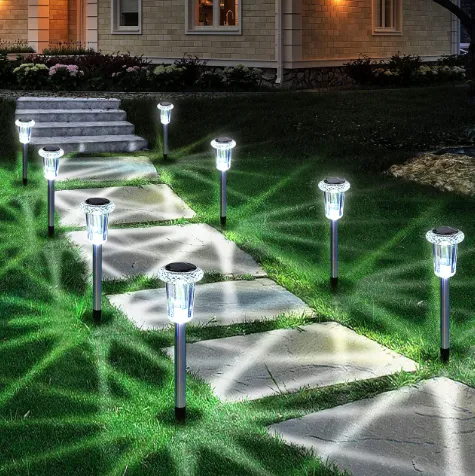
Walkway lighting primarily supports safe footing, route definition, and low-glare aesthetics. Unlike security floodlighting, walkway fixtures should provide even low-angle illumination that reduces trip hazards while avoiding glare into eyes or adjacent windows. In procurement terms this means specifying lumen output, beam spread, color temperature, and luminance thresholds instead of only peak candela numbers. Independent tests and editorial reviews show that pathway fixtures that aim for a steady 100–200 lumens per fixture typically meet the needs of both visibility and ambiance when placed correctly.

2. Key technical criteria to specify for waterproof solar walkway lights
When you prepare specs for vendors or internal purchasing you should include measurable parameters. Below are the fields you must include in any RFQ or spec sheet.
Essential fields (must have)
-
IP rating (minimum IP65 for most outdoor walkway installations)
-
Nominal lumen output (e.g., 100 lm steady, or multi-mode with high/eco)
-
Correlated color temperature (CCT) in Kelvin; typical: 2700K, 3000K or 4000K
-
Color rendering index (CRI) — request CRI ≥ 70, CRI ≥ 80 for higher quality color rendering
-
Battery chemistry, nominal voltage and usable capacity (mAh or Wh)
-
Solar panel type, rated power (W) and panel conversion type (monocrystalline preferred)
-
Expected run time (hours at full rated output and hours at dim/night mode)
-
Charging time to full under defined irradiance (e.g., 6 hours at 1000 W/m²)
-
Operating temperature range and storage temperature
-
Impact resistance rating (IK rating), especially in public areas
-
Materials and finish: marine-grade stainless steel or die-cast aluminum preferred for coastal sites
-
Warranty, cycle life (battery cycles) and mean time between failures (MTBF) if available
Nice-to-have fields (distinguish commercial from consumer lines)
-
LiFePO4 battery chemistry with cycle life estimate (preferred)
-
Replaceable battery modules and replacement part numbers
-
Light distribution type and photometric files (IES or LDT)
-
Integrated motion sensor and dimming profile specs
-
Tamper screws, anti-theft anchors and mounting accessories
-
Certifications: CE, RoHS, IEC 60598 or IEC 62471 if required by project
Including these fields prevents ambiguous proposals and avoids costly rework during installation.
3. Recommended performance bands and a sample specification table
Below are practical target bands you can use when writing tender documents or product comparison tables.
Practical bands
-
Low-ambient decorative paths: 30–80 lumens per fixture, 2700–3000 K, spacing 1.2–2 m
-
Standard residential walkway: 100–200 lumens per fixture, 3000 K, spacing 1.5–3 m
-
Commercial campus or security-adjacent paths: 200–400 lumens, 3000–4000 K, motion sensing, spacing 2–4 m
Sample single-fixture spec table (for RFQ)
| Attribute | Target value (example) |
|---|---|
| Lumen output (nominal) | 150 lm (steady), 300 lm (motion boost) |
| Beam angle | 100° wide flood or diffused lens |
| CCT | 3000 K |
| CRI | ≥ 80 |
| Battery | LiFePO4, 3.2 V nominal, 5.2 Ah (≈16.6 Wh) |
| Solar panel | Monocrystalline 4.5 W, 5.5 V open circuit |
| Runtime (typical) | 10–12 hours on eco mode; 3–6 hours at full brightness |
| Charge time | 6–8 hours full sun |
| IP rating | IP65 minimum |
| Impact rating | IK07 or higher for public sites |
| Materials | Die-cast aluminum housing, powder coat finish |
| Warranty | 3 years (battery prorated) |
Use this table to compare vendor quotes line by line.
4. Weatherproofing and IP ratings explained for pathway fixtures
IP ratings matter because walkway fixtures sit at ground level and face direct exposure to rain, spray from sprinklers, dust, and sometimes temporary puddling. The first digit of the IP code measures solid ingress protection, while the second digit measures liquid ingress. For pathway lights you should require a first digit of 5 or 6 and a second digit of 5 or higher. IP65 is dust tight with low-pressure water jets protection and is acceptable for most landscaped walkways. If the installation is at grade in flood-prone areas or in heavy-pressure washing locations choose IP66 or IP67; IP67 adds temporary immersion resistance. Clear manufacturer guidance on how ratings were tested should be part of the technical submission.
5. Battery technology, lifecycle and maintenance implications
Batteries determine lifecycle cost more than LEDs do. Older consumer solar lights frequently shipped with NiMH or even NiCd cells; modern commercial products use lithium chemistries. Lithium iron phosphate (LiFePO4) has become a preferred choice for commercial outdoor fixtures because it combines safety, thermal stability, wide temperature operation, and very high cycle life (often thousands of cycles). LiFePO4 reduces replacement frequency and total cost of ownership despite a higher upfront price. If your site is in cold climates, LiFePO4 retains usable capacity better than many Li-ion variants and often performs better than NiMH in real-world outdoor conditions. Require manufacturers to state cycle life (e.g., 2,000 cycles at 80% DoD) and provide a replacement battery part.
6. Solar panel sizing, charging and runtime calculation (practical method)
To estimate sizing for a walkway light follow this simple approach.
-
Decide target nightly energy use: Wattage × hours at that power. Example: 1.5 W LED at 150 lm with driver losses ~1.8 W; 10 hours = 18 Wh per night.
-
Choose autonomy: number of cloudy days to tolerate without full sun; typical commercial spec uses 3 days autonomy. So storage = 18 Wh × 3 = 54 Wh. Add 20% safety margin = ~65 Wh.
-
Choose battery capacity and chemistry to meet usable depth of discharge. For LiFePO4 use 80% usable DoD. Required battery energy = 65 Wh / 0.8 ≈ 81 Wh. That’s ~25 Ah at 3.2 V nominal. This is a simplified calculation; vendors commonly provide recommended battery sizes and you should request their charge-discharge curves.
-
Solar panel sizing: Use the worst-case peak sun hours for your location. If you have 4 peak sun hours, and you need to harvest 18 Wh per night plus system losses (~1.3 factor), required panel power = (18 Wh × 1.3) / 4 h ≈ 5.85 W. For multi-mode fixtures with motion sensor daytime harvest or energy harvesting inefficiencies choose slightly higher panels (6–8 W).
Request vendor test data showing run time under defined irradiance conditions and include the peak sun hours value in RFQs so proposals are comparable.
7. Materials, finish, and mechanical design
For long life use corrosion-resistant materials and secure mounting.
-
Housing: die-cast aluminum with powder coat or marine-grade 316 stainless for coastal salt-air sites.
-
Lens: tempered glass or UV-stabilized PC; glass resists scratching and UV discoloration but can break under impact.
-
Seals: silicone gaskets sized to rated IP level; specify replaceable gasket parts in RFQ.
-
Fasteners: stainless steel tamper screws and lock features for public installations.
-
Theft and vandal protection: locking anchor plates, recessed mounting, or steel post options.
-
Thermal design: LEDs and batteries are temperature sensitive; include vents for heat conduction while maintaining IP seal integrity.
Specify IK impact rating if fixtures are in high-risk areas; IK07 or higher is common for pathway installations in parks or transit zones.
8. Installation layout, spacing, and photometry basics
When you design layout keep visual comfort foremost.
-
Height: low-profile pathway lights usually sit 6–18 inches above grade. Higher fixtures (bollards) are 24–42 inches.
-
Spacing: for 100–150 lm fixtures with 100° beam use spacing roughly 1.5–3 meters to ensure overlapping pools of light without dark gaps. For 150–300 lm fixtures spacing can increase to 3–4 meters.
-
Overlap and uniformity: aim for an average to minimum illuminance ratio (avg/min) no greater than 3:1 on the walking surface. Ask vendors for an IES file so you can run a simple photometric layout in your lighting software.
-
Color: 2700–3000 K gives warm ambiance; 3500–4000 K improves task visibility but can feel cooler. For historical settings prefer ≤3000 K.
-
Motion sensors and dimming: configure a low-level night mode and motion-triggered boost to extend battery life while providing security illumination only when needed.
9. Procurement checklist and RFQ template fields
Use the following checklist when soliciting bids.
Vendor must supply
-
Full datasheet with electrical, mechanical, thermal data and test reports
-
IES / LDT photometry files and measurement method used for lumen claims
-
Battery datasheet showing chemistry, cycle life and replacement part number
-
IP and IK test reports or certified test lab references
-
Details on expected lifetime and maintenance intervals; replaceable parts list
-
Production lead times, MOQ, sample policy and factory capabilities (for OEM)
-
Warranty terms and battery warranty specifics
-
Packaging and shipping weights for freight calculation
Include acceptance tests on delivery such as random sample function test for charge/discharge, IP spray test, and mechanical inspection.
10. Quick comparison: common consumer features versus commercial expectations
| Feature | Typical consumer pack | Commercial grade (spec) |
|---|---|---|
| Battery | NiMH or basic Li-ion | LiFePO4 with specified cycles |
| IP rating | IP44–IP65 | IP65+, IP66/IP67 for exposed sites |
| Warranty | 1 year | 3 years or more |
| Replaceable parts | Rare | Designed for in-field battery replacement |
| Photometry | General claims | IES files and measured lumen maintenance |
| Tamper protection | No | Tamper screws & anchor kits |
Consumer models can be cost effective for residential installs but for municipal or commercial projects insist on commercial grade specs.
11. What tests and certifications to request
Ask for:
-
IP test report showing the test method (IEC 60529) and lab name
-
Battery safety and transport classification (UN38.3 if lithium)
-
EMC/EMI if integrated electronics or wireless control present
-
Test reports for lumen maintenance (LM-80 / TM-21) for the LED engine if high accuracy is required
-
Salt spray test for coastal installations (ASTM B117) if needed
These documents avoid surprises on site and are commonly supplied by reputable vendors.
12. Market signals and review summaries
Independent testing outlets and year-end reviews continue to show wide performance variance between inexpensive multi-packs and commercial fixtures. Consumer Reports and several trade reviews highlight the importance of panel area, battery chemistry and realistic runtime testing rather than marketing lumens alone. When evaluating vendor claims, prioritize lab reports, user runtime tests, and warranty terms over product images or pack counts.
13. Pricing and total cost of ownership guidance
Cheaper consumer products may cost 10–50 USD per light in low quantities; commercial fixtures with LiFePO4, higher IP/IK, and replaceable batteries typically cost more but reduce the need for frequent replacement. When you calculate TCO, include battery replacement intervals, maintenance visits, and downtime costs. For bidding it is reasonable to ask vendors to provide 5-year TCO models based on their recommended replacement schedule.
14. Sample RFQ language
Supply and deliver solar pathway fixtures meeting the following minimum requirements: nominal 150 lumen output, CCT 3000 K, CRI ≥ 80, LiFePO4 battery 80% usable DoD with documented cycle life ≥ 1,500 cycles, monocrystalline solar panel ≥ 5 W, IP65 minimum, IK07, IES files included, three-year parts warranty. Provide unit price FOB China plus MOQ and lead time.
Use this text as a starting point and adapt quantities, warranty, and delivery Incoterms as your procurement rules require.