

A 5,000-lumen outdoor light produces very strong illumination suitable for large yards, driveways, security lighting, and small work sites; in many outdoor layouts it will comfortably illuminate between roughly 250 and 500 square feet to useful task-level brightness, though final performance depends on beam spread, mounting height, color temperature, and surface reflectance.
1. What lumens measure, and why that matters for outdoor lighting
Lumens quantify the total amount of visible light emitted by a source. This is the number manufacturers place on packaging to indicate overall brightness. Lumens do not reveal how light concentrates on a surface, nor do they state how comfortable the light will feel to human eyes. For surface-level illumination, the correct metric is lux, which equals lumens per square meter; planning outdoor lighting requires using both total output and distribution data.
Quick distinction
-
Lumens: total light output from the fixture.
-
Lux: how much of that light hits a surface, measured per square meter.
-
Candela: intensity in a particular direction, useful when the beam must be focused.

2. How bright 5,000 lumens feels in real situations (comparisons)
Putting 5,000 lumens in context helps buyers choose the right product.
-
Typical living room general lighting often ranges from 1,000 to 2,000 lumens. Therefore, 5,000 lumens is far greater than usual indoor general lighting, and would be overwhelming in many indoor rooms.
-
Security floodlights intended to light driveways, yards, or building fronts commonly start around 1,000 to 3,000 lumens for small to medium spaces; 5,000 lumens sits at the high end for residential security and is often used where broad, bright coverage is required.
-
A pair of car headlight beams combined is commonly estimated in the low thousands of lumens; 5,000 lumens will therefore be noticeably brighter than a single vehicle headlight system, and will produce significant scene visibility at night.
Practical example: a single high-efficiency 5,000-lumen LED flood mounted at 10 feet with a wide beam can provide comfortable visibility for a 250 to 500 square foot area for security or task lighting, depending on beam control and reflectivity of nearby surfaces.
3. Area planning: rules to estimate coverage and target lux levels
When planning outdoor lighting, start from the desired lux level for the task, then work backward to required lumens.
Typical target lux values for exterior tasks
-
Security lighting for visual monitoring, path identification: 20 to 50 lux.
-
General driveway and patio activity: 50 to 100 lux for comfortable visibility.
-
Task lighting for work surfaces or detailed tasks: 200 lux or higher.
Basic calculation flow (simplified)
-
Choose target lux (L).
-
Estimate area in square meters (A).
-
Required lumens ≈ L × A ÷ fixture efficiency factor. Efficiency factor accounts for beam loss and mounting (use 0.6–0.8 for broad flood fixtures).
Example: For a 25 m² patio (roughly 270 ft²) targeting 50 lux, required lumens ≈ 50 × 25 ÷ 0.7 ≈ 1,786 lumens. That suggests a single 5,000-lumen fixture would be more than sufficient, offering higher lux or the option to mount higher or use narrower beams. Lux computation principles summarized here help explain why one 5,000-lumen light can be too much or perfectly right, depending on layout.
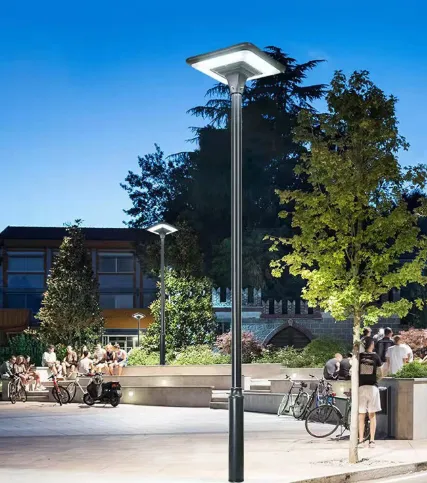
Outdoor IP65 Waterproof Super Bright 5000 Lumens 50W LED Solar Garden Light for Park
4. Beam angle, mounting height, and light distribution: why 5,000 lumens can behave very differently
A fixture’s beam angle and optical design control how lumens convert into useful light on surfaces.
-
Narrow beam (10–30 degrees): light concentrates into a smaller area, producing high lux and long throw. One 5,000-lumen unit may light a distant facade effectively.
-
Wide beam (60–120 degrees): light spreads, lowering lux but providing uniform coverage nearby. One 5,000-lumen unit with a 120-degree beam will cover a wide yard but produce lower lux at any single spot.
-
Mounting height: double the mounting height roughly quadruples the illuminated area, while lux falls by about a quarter for the same lumens because light spreads over a larger surface.
For design, pick beam angle and mounting height to match the intended application: concentrated beams for architectural accent or camera lighting, wide beams for general security or area coverage. Manufacturer photometric data (IES files) should be consulted for precise planning.
5. Energy use and lumens-to-watts estimates
Modern LED fixtures offer a wide range of luminous efficacy (lumens per watt). Efficiency determines the wattage required to produce 5,000 lumens.
Typical lumen-per-watt ranges (approximate, by technology)
-
Older halogen/incandescent: 10–20 lm/W (very inefficient).
-
Fluorescent and older HID: 50–90 lm/W.
-
Standard contemporary LEDs: 100–160 lm/W or more for high-performance commercial arrays.
Practical wattage estimates for 5,000 lumens
-
If fixture yields 100 lm/W, wattage ≈ 50 W.
-
If fixture yields 125 lm/W, wattage ≈ 40 W.
-
If older or lower-efficiency tech yields 70 lm/W, wattage ≈ 71 W.
Selecting a quality LED driver and high-efficacy LEDs reduces operating cost and heat stress, improving longevity. Product listings from major retailers show common 50 W LED flood fixtures claiming 5,000 lumens, matching the 100 lm/W band typical for many commercial outdoor lights.
6. Color temperature, CRI, glare, and night-time comfort
Brightness is not only lumens; the spectral character of light alters perception.
-
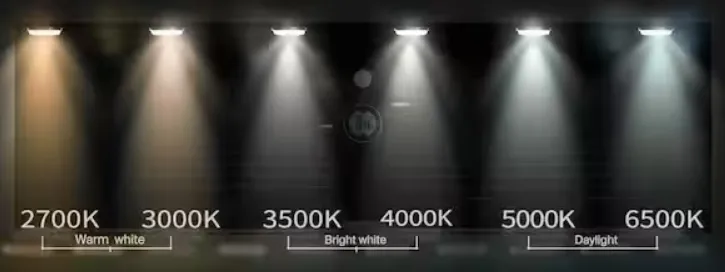
Color temperature (Kelvin) influences perceived crispness. 2,700–3,000 K feels warm and welcoming for patios. 4,000–5,000 K looks whiter and can improve perceived visibility for security, though it can also increase glare and attract more insects.
-
CRI (Color Rendering Index) indicates fidelity of color under the light. For outdoor security, CRI 70+ may suffice. For camera-optimized lighting or work tasks, CRI 80+ yields better color detail.
-
Glare control matters more with high-lumen fixtures. Use baffles, shields, or proper aiming to prevent direct view of the LED plane, which reduces discomfort and light trespass.
Design tip: choose the lowest acceptable color temperature that still meets visibility goals, and combine optics plus shielding to deliver lumens where needed without producing blinding hotspots.
7. Best use cases for 5,000-lumen fixtures and when it is overkill
Appropriate applications
-
Security lighting for medium to large yards, warehouses, parking areas, and building facades.
-
Outdoor work areas and small construction sites where task-level illumination is required.
-
Sports practice courts or large driveways where high uniformity and bright coverage help safety.
When to avoid 5,000 lumens
-
Small decorative garden fixtures or intimate patios, where 200–1,000 lumens is usually sufficient.
-
Locations next to neighbors where light trespass or nuisance could create complaints. In such situations, lower-lumen fixtures with targeted optics are better.
Market context: many mainstream retailers and manufacturers offer 5,000-lumen flood options labeled for security or industrial use. That confirms 5,000-lumen products are common for high-visibility exterior needs.
8. Product specification checklist for buying (weather rating, driver, warranties)
When choosing a 5,000-lumen fixture, verify these items:
-
IP rating for weather: IP65 or higher for splashing water and dust resistance; IP66/IP67 for harsher exposures.
-
Lumen maintenance: L70 at a specified hours value (for example L70 > 50,000 hours means output stays above 70% for that lifespan).
-
Driver quality: constant-current driver with surge protection and thermal foldback increases reliability.
-
Photometrics: look for IES files or candela distribution charts to plan spacing and uniformity.
-
Mounting options: adjustable yoke, slipfitter, or wall mount for flexible aiming.
-
Dimming and controls: support for dimming protocols or photocell/occupancy sensors if needed.
-
Warranty: manufacturer warranty of 3 to 7 years suggests confidence in product quality.
-
Certifications: DLC listing or equivalent efficiency/quality programs matter for commercial projects and rebate eligibility.
9. Installation and placement tips to get even illumination and reduce light trespass
-
Aim fixtures downwards where possible to reduce upward spill and skyglow.
-
Use multiple lower-lumen fixtures spaced evenly for uniformity rather than a single oversized unit in sensitive areas.
-
Employ cutoff shields or barn doors to direct light.
-
Match color temperature across nearby lights to maintain consistent visual appearance.
-
Avoid pointing lights directly at neighbor windows or street-facing cameras.
When installing a single 5,000-lumen fixture, test at lower mounting heights and consider adding dimming control so the light can be adjusted after observing real-world effects.
10. Maintenance, lifespan, and operating cost
LED fixtures shift maintenance from frequent lamp replacement to occasional driver or lens cleaning tasks.
-
If a 5,000-lumen LED fixture uses 50 W and operates 10 hours daily, annual energy use ≈ 50 W × 10 h × 365 ≈ 18.25 kWh per year; that seems off — compute correctly: 50 W × 10 h/day = 0.05 kW × 10 h = 0.5 kWh/day; annual ≈ 0.5 × 365 = 182.5 kWh/year. Multiply by local electricity rate for cost.
-
Typical high-quality LEDs maintain usable output for tens of thousands of hours; manufacturers often quote L70 > 50,000 hours, which equates to 13+ years at 10 hours daily. Longevity depends on thermal management and driver quality.
Always compare specified lumen maintenance and warranty rather than relying only on initial lumens.
11. Comparison tables (quick reference)
Table 1. Typical applications by lumen band
| Lumen band | Typical residential application | Typical commercial application |
|---|---|---|
| 200–1,000 lm | Garden accents, pathway lights | Accent lighting, small entryways |
| 1,000–2,500 lm | Porch, small patio, pathway with higher visibility | Small parking spots, sign lighting |
| 2,500–5,000 lm | Large patio, driveway, strong security light | Loading bay lights, medium parking lots |
| 5,000–10,000+ lm | High-security area, construction site, sports practice | Stadium practice, large storage yards |
Table 2. Estimated watts for 5,000 lumens by efficiency (rounded)
| Lumen efficacy (lm/W) | Estimated wattage for 5,000 lm |
|---|---|
| 70 lm/W | 72 W |
| 100 lm/W | 50 W |
| 125 lm/W | 40 W |
| 150 lm/W | 33 W |
(Values above illustrate that modern LED fixtures in the 100–150 lm/W range commonly provide 5,000 lumens using roughly 33–50 W. Manufacturer specs should be checked.)
Table 3. Example coverage estimates (very approximate)
| Mount height | Beam angle | Approx uniform area lit (sq ft) for 50 lux target |
|---|---|---|
| 8 ft | 90° | 250–350 |
| 12 ft | 90° | 350–500 |
| 20 ft | 40° | 400–700 |
Note: these are rough planning values; use photometric files for precise layout.
12. Buying scenario checklist for SunplusPro customers
If SunplusPro is selling a 5,000-lumen model, highlight:
-
Real-world lux at given heights (screenshot of a photometric file recommended).
-
Lumen maintenance (L70 hours).
-
Measured lm/W and actual power draw.
-
IP rating and operating temperature range.
-
Warranty and factory direct customization options (mounts, color temp, lens accessories).
-
Offer an installation layout calculator or sample IES file so installers can plan spacing.
Providing downloadable specification sheets and example layouts improves trust and helps ranking for technical queries.
13. Quick buying tips to avoid common mistakes
-
Don’t buy based solely on lumens. Verify optics and photometrics.
-
If neighbor sensitivity is a concern, choose lower color temperature and shielded optics.
-
For camera-integrated security, prefer fixtures with higher CRI and neutral color temperature near 4,000 K.
-
Look for surge protection and a robust driver when fixtures are exposed to full weather cycles.
14. FAQs
1. Is 5,000 lumens too bright for a backyard?
Not necessarily. For a medium to large backyard used for security or sports, 5,000 lumens is appropriate. For intimate patios or seating areas, choose lower lumens or use dimming to avoid harsh light.
2. How many watts does a 5,000-lumen LED fixture use?
Wattage depends on efficiency. High-efficiency LEDs at about 100–150 lm/W will draw roughly 33–50 watts. Always confirm the fixture’s lm/W rating on the data sheet.
3. Will a 5,000-lumen floodlight light up my driveway?
Yes, in most cases a single properly aimed 5,000-lumen floodlight will illuminate a typical driveway, particularly when mounted at the correct height with suitable beam control. Use photometrics for exact placement.
4. What color temperature should I choose for security lighting?
Between 4,000 K and 5,000 K gives crisp white light that improves visual clarity. Choose lower temperatures to reduce perceived harshness and to lessen insect attraction.
5. How far does a 5,000-lumen light reach?
Reach depends on beam angle and mounting height. With a narrow beam and high mount, the light can reach farther but will cover a smaller area. Use manufacturer candela data for throw calculations.
6. Can a 5,000-lumen light be dimmed?
Many modern LED fixtures support dimming. Verify compatibility with dimmer types and confirm that drivers permit reduction to desired levels without flicker.
7. Are there energy rebates for 5,000-lumen LED fixtures?
Rebates depend on efficiency ratings and local programs. Choosing DLC-listed fixtures often increases eligibility. Check local utility programs for commercial or residential incentives.
8. How do I avoid blinding neighbors with a 5,000-lumen light?
Aim fixtures downward, use shields, select narrower beams when required, and consider motion-triggered operation or dimming during low-need periods.
15. Summary and recommended approach for buyers
A 5,000-lumen outdoor light is a robust option for many security, commercial, and heavy-duty residential uses. For best results, match beam control, mounting height, and color temperature to the intended task, and rely upon manufacturer photometrics to plan spacing and uniformity. If a SunplusPro model is offered, providing clear specification sheets, IES files, and customization options (mounts, Kelvin choices, dimming/controls) will help professionals choose the right configuration and improve purchase confidence.
16. Sources referenced for key technical points
Key concepts in this article drew on manufacturer and lighting-education resources that explain lumens, lux, and practical installations for outdoor spaces. Representative pages include lighting guides and product pages showing 5,000-lumen fixtures on major retail sites and technical discussions about lumens-to-watts conversion. For specific data and photometric planning, consult fixture IES files provided by the manufacturer.