

For heavy-duty outdoor installations that require high lumen output, strong weather protection, and theft or tamper resistance, an IP66-rated 300W LED flood light fitted with a robust tamper-proof mounting bracket typically gives the best balance of long-term performance, lower operating cost, and lower maintenance demands. Select a unit with proven lumen maintenance (L70 data), FK-rated optics and surge protection, and tamper hardware to meet both engineering and procurement needs.
1. How to buy IP66 300W LED Flood Light
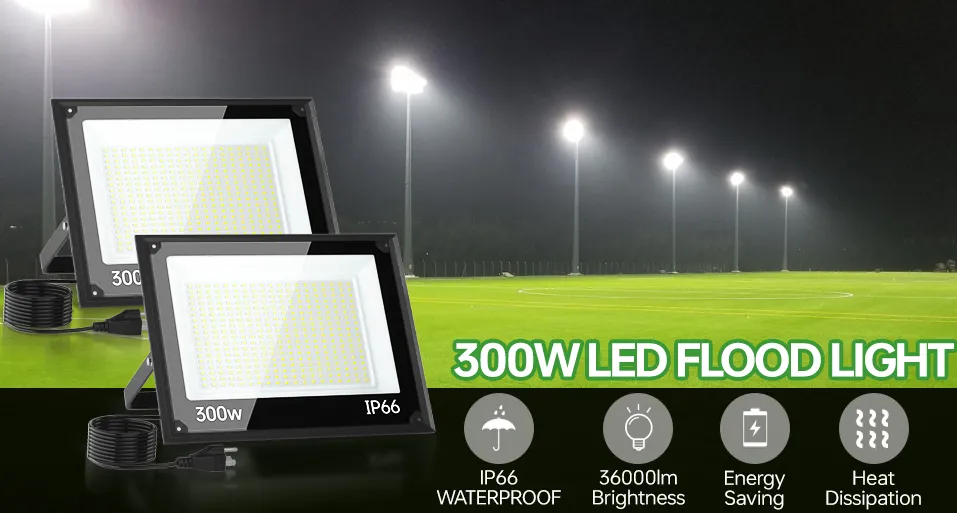
A 300W LED flood fixture rated IP66 is engineered for dusty environments and for exposure to strong water jets. In typical commercial units the delivered light ranges from roughly 27,000 to 54,000 lumens depending on LED efficacy and optics, and reputable products report L70 lumen-maintenance life from 50,000 up to 200,000 hours depending on LED binning, thermal management, and driver choice. Select the fixture that pairs a verified L70 number with an appropriate surge protection, IK impact rating, and tamper-resistant fasteners for secure public installations.

2. Technical specification checklist
| Parameter | Minimum for robust industrial use | Why it matters |
|---|---|---|
| Power | 300W nominal | Standardized power point for comparing lumens per watt |
| IP rating | IP66 | Dust-tight and protected from strong water jets. Use where hose-down or heavy rain occurs. |
| Typical lumen output | 27,000 — 54,000 lm (market range) | Determines spacing and number of fixtures. |
| Efficacy | ≥120 lm/W (industrial baseline); premium 140–175 lm/W | Better efficacy lowers energy and HVAC load |
| Lumen maintenance | L70 reported (50k–200k hours) | Longer L70 reduces replacement frequency. Verify LM-80 and TM-21 data. |
| IK rating | IK07 or IK08 suggested | Resistance to impact and vandalism |
| Tamper hardware | Tamper-proof screws or security bolts plus captive fasteners | Prevents theft or unauthorized access |
| Bracket | Adjustable U-yoke or extension bracket with 180° rotation | Allows aiming and reduces installation complexity. |
| Surge protection | ≥6kV-10kV LM line-line standard; optional 10kV+ line-earth | Protects driver and LED strings from transients |
| Warranty | 5 years minimum; premium 7–10 years | Reflects manufacturer confidence and expected life |
3. What IP66 means for flood lights and why it matters
IP codes come from IEC 60529 and specify protection against solids and liquids for electrical enclosures. IP66 indicates the highest solid ingress category (6, dust-tight) and resistance to powerful water jets from any direction. For an outdoor flood luminaire, this rating means the housing and seals are specified to stop dust entry and to survive sustained heavy spray exposure typical in external washdown, coastal spray or high-rainfall installations. Verify that the supplier documents the IP test method or certificate.
Practical implications
-
IP66 does not equal submersion protection. It is not a substitute for IP67/IP68 where immersion is possible.
-
Seals and cable glands are critical. Pay attention to cable-entry design and torque specification to maintain IP66 in the field.
-
Regular maintenance inspections of gasket condition greatly reduce ingress risk over decades.
4. Optical performance: lumens, correlated color temperature, CRI and beam shapes
Lumens and efficacy
300W LED flood lamps use either high-power COB modules or arrays of SMD LED chips. Market products list lumen outputs from about 27,000 lm up to 54,000 lm and sometimes higher depending on binning and optics. Higher lumens at good efficacy (≥120 lm/W) reduce fixture count but increase initial cost.
Correlated color temperature (CCT) and CRI
Offerings typically include 3000K, 4000K, 5000K–5700K. For security and sports lighting choose neutral to high CCT (4000K–5700K) for visual acuity. Specify CRI ≥70 for general outdoor use; CRI ≥80 when color rendering matters for retail or architectural applications.
Beam control
Available distributions include narrow spots (10–30°), medium flood (60–120°) and asymmetric Type III/Type V optics for roadway or area control. Choose lens/reflector options to control glare and avoid light trespass.
5. Thermal design, drivers, L70 lifetime and reliability testing
Thermal path matters
Heat is the primary driver of lumen depreciation. Effective fixtures move junction heat into the ambient via an aluminum housing or fins and maintain LED junction temperatures within recommended ranges. Look for measured case temperatures and thermal simulation data.
Drivers and dimming
Select drivers with high power factor (>0.9), low THD, and proven over-temperature protection. Dimmable drivers (0-10V or DALI) allow control but add complexity; match control strategy to site needs.
Lumen maintenance
L70 denotes the hours until lumen output drops to 70% of initial. Industry practice: manufacturers publish L70 derived from LM-80 data and TM-21 extrapolation. Expect L70 claims between 50,000 and 200,000 hours based on product class; verify the test basis and raw LM-80/TM-21 reports when procurement risk is low.
6. Tamper-proof features and vandal resistance (hardware, IK)
Tamper-resistant fasteners and captive hardware
Tamper resistance usually combines special screw heads or security nuts (Torx with pin, tri-groove, one-way screws) with captive brackets that keep lens and electronics inaccessible without the matched tool. For high-risk areas request a tamper hardware kit or specify tamper bolts in the PO.
Vandal-resistant housing and lens materials
Options include reinforced die-cast aluminum housings and polycarbonate or tempered glass lenses. An IK07–IK10 rating resists impacts from thrown objects and reduces service calls in public spaces. Vendors often bundle tamper hardware with vandal-resistance lines for transit, correctional and school installations.
Locking and theft prevention
For pole-mounted units specify locking brackets, security nuts and locked junction boxes. On wall-mounted applications require tamper screws and recessed mounting so fastener access is limited.
7. Mounting bracket types, installation notes, torque and anchoring
Common bracket types
| Bracket name | Description | Use case |
|---|---|---|
| U-yoke (adjustable) | U-shaped yoke that bolts to sides; allows tilt and pan | General area and wall mounts. |
| Extension/arm bracket | Extension bracket that offsets the body from mounting plane; often 180° rotation | Ceiling, soffit and high wall installations. |
| Slip-fit or pole mount | Adapter for round poles, often specified in mm/inch diameters | Parking lot and roadway poles |
| Trunnion with locking plate | Heavy-duty trunnion with lock-down hardware | Stadium and sports lighting |
Installation best practices
-
Use stainless steel fasteners for coastal sites.
-
Follow manufacturer torque specs to avoid crushing or stretching gaskets; over-torque may compromise IP66.
-
Use thread-lock compound on non-security fasteners where vibration is possible.
-
Anchor foundations for pole loads using engineered calculations for wind and seismic loads.
8. Surge protection, electrical options and controls
Transient protection reduces premature driver failure. Typical spec: 6kV to 10kV surge protection for line-line and higher for line-earth recommended in regions with heavy lightning activity. Modern fixtures may offer built-in surge modules; otherwise supply external SPD devices.
Controls:
-
Photocells for dusk-to-dawn operation reduce unnecessary runtime.
-
Timer or networked controls (NEMA or DALI) enable scheduled dimming.
-
For critical security installations prefer redundant controls and remote monitoring.
9. Materials, corrosion protection and finish options
Aluminum alloys with powder coat finish are standard. For marine or chemical environments specify high-grade aluminum, epoxy primer plus polyester topcoat, or 316 stainless fixtures. Check salt spray testing (ASTM B117) or supplier corrosion data sheets when corrosion is a concern.
10. Typical applications and siting recommendations
-
Sports fields and warehouses: choose wide optics with high lumen output and good thermal management.
-
Parking lots and perimeter security: aim for uniform lux with Type III/Type V optics; tamper hardware recommended.
-
Ports and coastal installations: pick marine-grade materials and extra surge protection.
-
Industrial yards: IP66 protects against dust and jet-wash cleaning.
11. Commercial comparison table: typical market specs and tradeoffs
| Feature | Cost-focused 300W unit | Mid-range commercial | Premium industrial |
|---|---|---|---|
| Typical price per unit (bulk) | Low | Moderate | High |
| Efficacy | 110–125 lm/W | 125–150 lm/W | 140–175 lm/W |
| L70 claim | 50k hours | 100k hours | 150k–200k hours (documented LM-80/TM-21) |
| Surge protection | Optional | Built-in small SPD | Multi-stage SPD |
| Tamper hardware | No | Optional kit | Integrated tamper-proof system |
| Warranty | 2–3 years | 5 years | 7–10 years |
12. Procurement checklist and specification template
Short tech spec for purchase order
-
Product model: IP66 300W LED floodlight with tamper-proof mounting bracket.
-
Power: 300W ±5% at 220–240 VAC (or specify 100–277 VAC / 277–480 VAC option).
-
Lumen output: ___ lm at 5000K, CRI ≥70. State measured lumens and LM-79 test report required.
-
Efficacy: ≥120 lm/W.
-
Lumen maintenance: L70 ≥ 100,000 hours with LM-80 and TM-21 data attached.
-
IP rating: IP66 certified, supply test certificate.
-
IK rating: IK07 or better.
-
Surge protection: ≥10kV line-line and ≥20kV line-earth or equivalent; specify SPD standard.
-
Tamper features: Tamper-proof screws (Torx pin or tri-groove), captive fasteners, and locking bracket included. Provide photos and hardware key details.
-
Bracket: Adjustable U-yoke or extension bracket, stainless steel, anti-corrosion finish; specify allowable tilt range.
-
Warranty: Minimum 5 years full replacement; extended warranty optional.
-
Documentation: LM-79 report, LM-80 data for LEDs, TM-21 calculations, IP test certificate, material spec sheet.
13. FAQs
Q1: Is IP66 enough for coastal or washdown applications?
IP66 resists dust and strong water jets but not prolonged submersion. For coastal sites also specify marine-grade coatings and stainless fasteners; for equipment that may be submerged choose IP67 or IP68 depending on depth.
Q2: What does tamper-proof mean in practice?
Tamper-proof commonly means security fasteners (e.g., Torx pin, tri-groove, one-way screws), captive fasteners and housing designs that prevent easy removal. It reduces theft and unauthorized access but is not theft-proof against determined attackers; combine with locked junction boxes for stronger protection.
Q3: How do I verify L70 claims?
Request manufacturer LM-80 raw data and the TM-21 extrapolation method used. Prefer suppliers that provide third-party lab reports or LM-79 photometric test reports.
Q4: Should I buy COB or SMD models?
COB modules provide compact, high-output sources with simpler optics; SMD arrays offer more flexible thermal distribution and multiple CCT options. Choose based on optics needed and available heatsinking. Test reports matter more than the LED packaging style.
Q5: What bracket gives the best anti-tamper performance?
A bracket that uses captive hardware and limits fastener access (e.g., recessed fasteners or locking plate) combined with security nuts yields the best on-site resistance. Specify stainless security nuts and a matched security key.
Q6: Do surge protectors need maintenance?
Yes; SPDs degrade with events. Include inspection in maintenance cycles and consult manufacturer for replacement intervals after major storms.
Q7: Can I retrofit these into existing poles?
Often yes. Confirm slip-fit adapter diameter and wind-load calculations. Ensure pole wiring capacity and thermal considerations are met.
Q8: What ambient temperature range should I expect these to work in?
Most commercial fixtures rate from roughly -40°C to +55°C. For extreme heat check driver high-temperature derating specs.
14. Short vendor negotiation and warranty tips
-
Require LM-79 and LM-80/TM-21 documentation in the contract.
-
Request IP66 and IK test certificates.
-
Ask for spare tamper hardware and a keyed tool kit with bulk orders.
-
Negotiate an extended warranty or parts replacement window tied to verified L70 performance.