

For outdoor basketball courts, high-quality LED systems that deliver the correct illuminance for the intended level of play, paired with careful optical selection and aiming, deliver superior player visibility, safer play, lower operating cost, and simpler maintenance than legacy systems. A properly designed LED installation should target horizontal illuminance between 200 and 1,000 lux depending on recreational or competition level, maintain even distribution with uniformity ratios typically at or above 0.5, use fixtures with good glare control, and specify CRI and color temperature that support ball tracking and broadcasting when needed. When buyers pick fixtures with proven photometric data and confirm pole height, aiming, and control systems at design stage, energy savings and user satisfaction follow quickly.
1. Why LED technology is the preferred choice for outdoor basketball courts
LED fixtures bring several concrete advantages over older technologies. They provide higher lumen efficacy, directional light that reduces spill, instant on/off and dimming, and much longer rated lifetime which reduces maintenance costs. Because LED optics can be tailored precisely, designers achieve improved uniformity across the playing surface and controlled glare that preserves player comfort and spectator viewing. Modern LED systems also integrate easily with smart controls for scheduling, dimming and remote diagnostics which further reduces energy use and operating complexity. Many municipal and private facilities report payback in a few years when switching from metal halide to LED.

2. Key standards and recommended illuminance levels
Two reference documents commonly used by lighting professionals are the European standard EN 12193 and the North American IES RP-6 recommended practice for sports lighting. These documents classify levels of play and provide target horizontal illuminance (lux), vertical illuminance for broadcasting, uniformity ratios, color rendering and glare limitations. For basketball courts the typical guidance can be summarized like this:
| Level of play | Typical horizontal illuminance (lux) | Typical vertical illuminance for broadcasting (lux) | Typical uniformity (min avg/min) |
|---|---|---|---|
| Backyard / recreational | 150–300 | not required | 0.4–0.6 |
| Community / training | 300–500 | 300–500 | 0.5 or better |
| Club / local competition | 500–800 | 500–800 | 0.6 or better |
| Professional / televised | 800–1,500+ | 1,000–2,000 | 0.7 or better |
These ranges reflect common practice and the published tables in EN 12193 and IES documents. Local governing bodies or broadcasters may require higher vertical illuminance and tighter flicker/frequency tolerances for high-speed video recording. Always confirm final targets with the user of the court before design begins.
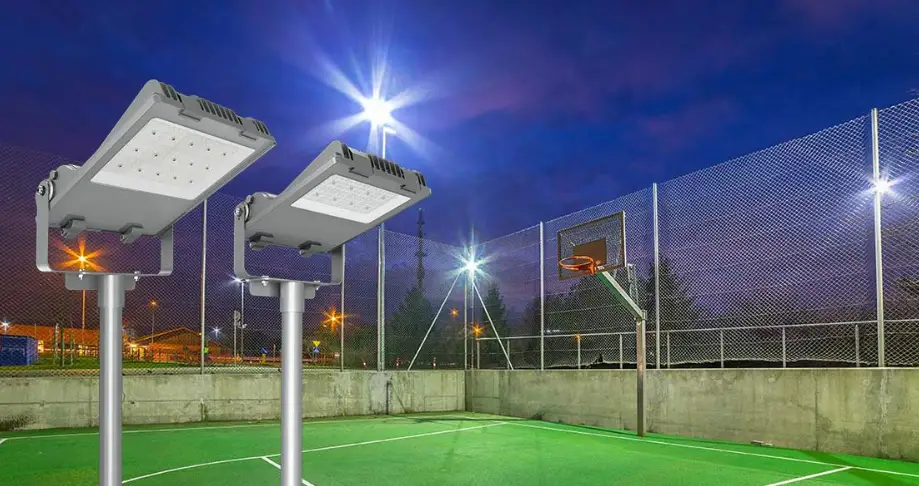
3. Photometrics and optics: achieving even coverage and low glare
Achieving consistent light across the playing area depends on three linked variables: fixture luminous output (lumens), the optical distribution (beam type), and mounting geometry. Typical optical approaches used in court fixtures include forward-throw optics for center-to-center coverage, Type III and Type V distributions for perimeter pole layouts, and asymmetric optics when fixtures mount close to the court edge.
Important photometric goals
-
Horizontal illuminance: target the average lux per design level in section 2.
-
Uniformity: aim for a minimum average to minimum point ratio of 0.5 for recreational, 0.6 or better for competition.
-
Glare control: use fixtures with cutoff angles and louvers, specify UGR or direct glare limits when players or cameras are involved.
-
Color: choose 4000K–5000K CCT for natural tone; higher CCT can improve perceived brightness but may increase skyglow. CRI 70 is minimum; CRI 80 to 90 preferred for accurate color under broadcast conditions.
-
Flicker: specify drivers with low flicker (percentage flicker and stroboscopic visibility metrics) for broadcast or high-speed capture.
When designers supply IES files for each candidate fixture, run a photometric layout that shows point-by-point lux and vertical illuminance at 1.5 m and 2 m heights. That exercise identifies dark spots, excess glare, and opportunities to reduce pole count or lower wattage.
Also read:Outdoor LED Tennis Court Lights.
4. Pole selection, mounting heights, and aiming strategies
Pole geometry determines how light spreads. Typical pole heights for outdoor basketball range between 15 and 30 feet (4.5 m to 9 m). Shorter poles suit backyard and residential courts while public or professional facilities commonly use taller poles to achieve better uniformity with fewer fixtures.
Quick reference table: pole height and common uses
| Pole height (ft) | Recommended use | Typical fixture type |
|---|---|---|
| 12–16 | Backyard half court | Low wattage, flood optics |
| 16–20 | Community full court | 150W–300W LED with forward throw |
| 20–25 | Club courts | 200W–400W LED with Type III/Type V optics |
| 25–30+ | Professional venues | Higher lumen fixtures, precise aiming, broadcast settings |
Aiming and tilt
-
Keep aiming behind typical shooter sightlines so players do not look into the source during layups and free throws.
-
Tilt angles are commonly limited to 0–15 degrees depending on fixture optical design. Aim to minimize light spill beyond the court perimeter.
-
For multi-pole layouts, stagger aim angles to eliminate hot spots and improve uniformity.
Local ordinances may limit pole height or require cut-off optics to limit light trespass into neighboring properties. Confirm local rules early in the project.
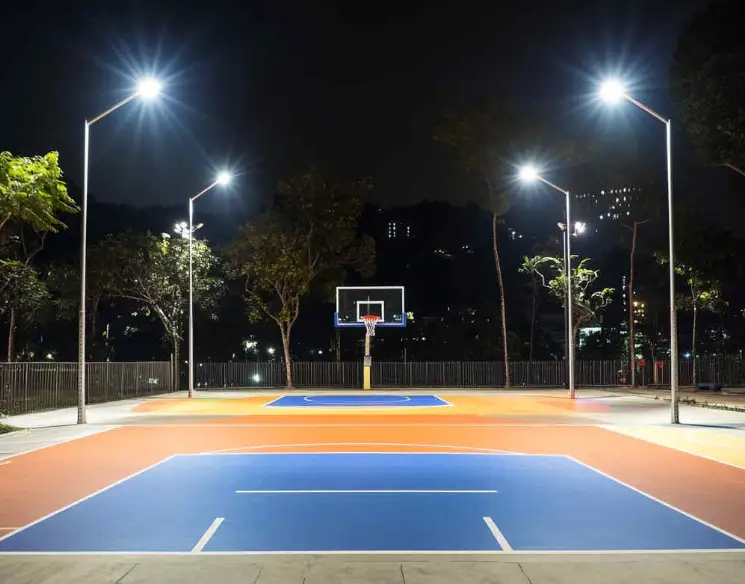
5. Typical system layouts and sample calculations
Common layouts for a standard full-size basketball court (28 m by 15 m; roughly 94 ft by 50 ft) include four-pole, six-pole, and eight-pole configurations. Fixture count, individual wattage and aiming produce the final lux map. Here are three sample design templates; these act as starting points. Final selection should follow a photometric simulation.
Table: sample layouts (estimates)
| Layout | Number of poles | Fixtures per pole | Fixture wattage (W) | Total input power (W) | Estimated average lux (recreational → competition) |
|---|---|---|---|---|---|
| Backyard / Residential | 4 | 2 | 100 | 800 | 150–300 |
| Community / Park | 6 | 2 | 200 | 2,400 | 300–600 |
| Club / Small competition | 6 | 3 or 4 | 250 | 4,500–6,000 | 500–1,000 |
Example lumen math for an average target
-
Court area: 28 m × 15 m = 420 m²
-
Target average 300 lux → required total lumens on playing plane = 300 lux × 420 m² = 126,000 lumens
-
Considering fixture utilization (U) and maintenance factor (MF), choose conservative U×MF = 0.6 → required installed lumen = 126,000 / 0.6 ≈ 210,000 lumens
-
If one fixture produces 30,000 lumens, install approximately 7 fixtures (rounded up) distributed to achieve uniformity.
Photometric software will refine those counts and show where to aim each fixture for optimal results.
6. Energy, lifetime cost, and payback considerations
LEDs often use half or less of the electricity of equivalent metal halide systems while delivering similar or better on-court lux. Key metrics to evaluate:
-
Lumen per watt (lm/W): higher figures reduce kWh for the same output.
-
Driver efficiency and power factor: aim for PF >0.9 and drivers rated for outdoor duty.
-
Rated life (L70 or L90): project maintenance savings from longer lamp life. L70 at 100,000 hours is common for quality fixtures.
-
Controls: time scheduling, occupancy sensors and dimming zones slash energy use when courts are idle.
Simple payback example
-
Old HID system: 6 fixtures of 1000W each → 6,000 W draw.
-
New LED option: 6 fixtures of 600W each → 3,600 W draw.
-
Operating 4 hours per evening, 365 days: annual energy saved = (6,000 − 3,600) × 4 × 365 = 3,504 kWh.
-
At $0.12/kWh annual savings ≈ $420, plus maintenance savings from fewer lamp changes. Real installations often show payback between 2 and 6 years depending on rebates and hours of use.
7. Mechanical, IP and impact protection requirements
Outdoor fixtures must withstand weather and potential impacts from stray balls. Typical mechanical expectations:
-
IP rating: IP65 minimum for wet locations; IP66 preferred for areas with heavy spray or cleaning.
-
IK rating: IK07 or IK08 recommended for courts where projectiles may hit fixtures or lens.
-
Material and finish: corrosion-resistant aluminum housings with powder coat finish resist long-term exposure.
-
Thermal management: heat sink design must maintain LED junction temperature within rated limits to achieve claimed lumen maintenance.
Specifying the right protection reduces warranty claims and supports long lifetime assumptions.
8. Installation, controls and maintenance best practices
Designers should coordinate civil, structural and electrical scope early. Important considerations:
-
Foundation design: pole base must match soil and wind load conditions. Anchor bolt templates and grout requirements are part of the foundation submittal.
-
Wire size and feeder routing: avoid long voltage drops to fixtures; specify surge protection and proper grounding.
-
Controls: 0–10V or DALI dimming, time clocks, and remote monitoring can be included. Smart systems reduce energy waste.
-
Service access: specify access brackets or removable door panels so drivers and surge protectors are serviceable without full pole removal.
-
Commissioning: perform on-site lux measurements and adjust aiming to match design photometrics. Provide as-built IES files if changes occur.
Routine maintenance schedule
-
Visual inspection annually for hardware and corrosion.
-
Clean optics every 1–3 years depending on local dust/pollen/salt.
-
Replace surge protectors or driver modules per manufacturer guidance. Good design reduces frequency of intervention.
9. Customization, kits, and what SunplusPro offers
SunplusPro supplies LED court fixtures, poles and brackets with factory-direct pricing and full customization for optic, CCT and mounting requirements. Typical services available:
-
Custom optical tuning and IES file generation for each project.
-
Pole and foundation kits tailored to local wind and soil conditions.
-
Integrated controls: time scheduling, dimming and remote monitoring modules.
-
Photometric report and layout delivered with order.
Because SunplusPro ships direct from factory, buyers get cost advantages and fast lead times for standard kits. For larger specification projects SunplusPro will produce photometric layouts for approval prior to shipment.
10. Buyer’s technical checklist and procurement tips
Table: quick procurement checklist
| Item | Why it matters |
|---|---|
| Photometric IES files | Needed for accurate design and permits |
| Lumen output and efficacy (lm/W) | Determines energy and fixture count |
| CRI and CCT | Affects player perception and broadcast quality |
| Driver warranty and surge protection | Reduces downtime and repair cost |
| IP / IK ratings | Ensures weather and impact durability |
| Aiming and tilt limits | Controls glare and light trespass |
| Control compatibility (0–10V, DALI) | Future-proofing for smart control |
| Local code or ordinance checks | Avoid costly redesign or fines |
| Supplier factory lead time & support | Important for project scheduling |
| Photometric verification after install | Confirms compliance with targets |
Buying tip: ask shortlisted suppliers for recent reference installations with similar court size and play level. Request measured post-install lux data when possible.
11. Comparison table: LED versus HID / Metal halide
| Feature | LED | HID / Metal halide |
|---|---|---|
| Energy efficiency | High (lm/W typically 120–200) | Lower (lm/W typically 60–100) |
| Warm-up time | Instant | Long warm-up and restrike delay |
| Dimming capability | Standard | Limited |
| Lumen maintenance | High (slow depreciation) | Faster lumen depreciation |
| Optical control | High precision optics available | Less directional, more spill |
| Maintenance | Lower (longer life) | Higher (lamp replacement, ballast issues) |
| Initial cost | Higher fixture cost, lower lifecycle cost | Lower initial, higher lifecycle cost |
| Light quality (CRI, CCT) | Chooseable and stable | Varies, may shift color over life |
This table clarifies why modern sports projects favor LEDs for nearly every outdoor court application.
12. Frequently Asked Questions
-
What lux level do I need for my outdoor basketball court?
Target depends on use. Backyard or casual play often needs 150–300 lux. Community and competitive play typically target 300–800 lux. Professional or televised events require 800–1,500 lux or more and stronger vertical illuminance for cameras. Confirm desired level with stakeholders. -
How many fixtures will I need for a full-size court?
Typical layouts use 4 to 8 poles with 2–4 fixtures each. A six-pole layout with 12–18 fixtures is common for community courts aiming for 300–600 lux. Photometric modeling gives the precise count. -
What pole height should I choose?
For backyard courts 12–16 feet is common. Community courts often use 16–20 feet. Club and professional facilities may use 20–30 feet to achieve better uniformity. Local height constraints might apply. -
What is the right color temperature and CRI for sports lighting?
4000K to 5000K balances color fidelity and perceived brightness. CRI 70 is minimum; CRI 80–90 improves clarity, especially for video capture. -
How do I reduce glare for players and neighbors?
Use cutoff optics, louvers, correct aiming and shields. Taller poles with precise optics often reduce perceived glare and spill into neighboring properties. Confirm glare criteria with standards and local rules. -
Are there rebates for switching to LED?
Many utilities and municipalities offer rebates for LED sports lighting. Rebates vary by jurisdiction and project scale. Check local utility incentive programs early in budgeting. -
What IP and IK ratings should I require?
IP65 or better for weather resistance and IK07 or IK08 for impact protection are typical requirements for outdoor court fixtures. -
How long before I recover my investment when retrofitting to LED?
Payback depends on hours of use, energy cost, rebate availability, and maintenance savings. Many projects report payback between 2 and 6 years. Run a site-specific total cost of ownership comparison for accurate forecast.
13. Case examples
-
Municipal park (community court): Six poles, two fixtures per pole, 200W fixtures, smart dimming to 50% during low use nights. Result: average 320 lux with uniformity 0.62. Energy cut by 55% vs old metal halide.
-
Private club (competition level): Four tall poles at 25 ft, three high-output fixtures per pole, asymmetric optics to avoid spill. Achieved 750 lux average and strong vertical illuminance for photographer needs. Photometric tuning reduced number of poles vs initial proposal saving foundation cost.
Final recommendations
-
Decide target lux early with facility stakeholders.
-
Request certified IES files from shortlisted fixtures and run a photometric layout.
-
Choose fixtures with proper IP/IK ratings and low flicker drivers for any broadcast intentions.
-
Prioritize fixtures with documented lumen maintenance (L70/L90).
-
Include dimming and control capability in the original purchase for energy flexibility.
-
Ask suppliers, including SunplusPro, for full kit pricing: fixtures, poles, brackets, foundations and photometric report. Factory-direct orders can reduce cost and speed delivery.