

For long-term, tournament-ready performance and the best value-per-watt, SunplusPro outdoor LED tennis court lights meet modern performance standards by delivering even illuminance, strong glare control, and reliable lifetime lumen maintenance while cutting energy use and maintenance compared with legacy metal-halide systems. Proper lighting design (right lux target, uniformity, pole height, optics, and shielding) is the single biggest factor determining player comfort, ball visibility, and community compliance.
1. Why lighting matters for tennis courts
Good court lighting is more than installing bright fixtures. It creates consistent visibility of the ball at all court positions, prevents player discomfort from glare, keeps spectators safe, reduces operating costs, and helps facilities meet local ordinances. For competitive play the difference between clear, even lighting and poor lighting shows up in line calls, ball tracking, and broadcast image quality. Modern LED systems give better control and long-term savings if they are specified and installed correctly.
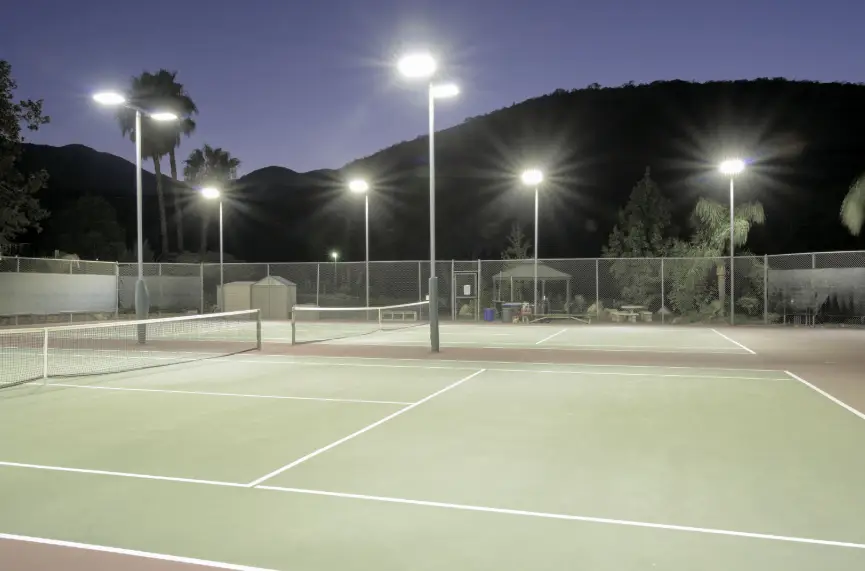
Brite Court Tennis Lighting LED Tennis Lighting for indoor & outdoor
2. Standards, target illuminance and uniformity
Key terms
-
Illuminance (lux): luminous flux per unit area on the playing surface.
-
Uniformity: relationship between minimum and average lux (min ÷ average). Good systems avoid large dark patches.
-
PPA and SPA: Primary Playing Area and Secondary Playing Area; many standards require the SPA to be a fixed percentage of PPA.
-
UGR/Glare: a measure for visual discomfort from bright sources; lower UGR is better for player comfort.
Recommended illuminance bands (industry practice)
-
Recreational / community courts: 150 to 300 lux average for comfortable evening play.
-
Club / tournament training: 300 to 500 lux average for club-level match play.
-
Competition / broadcast: 750 lux and up for professional matches and televised events.
These ranges reflect the IES and industry practice; final targets should follow the level of competition and local rules.
Uniformity targets
-
Minimum ÷ average: commonly specified between 0.5 and 0.7 for good playability; higher uniformity helps with consistent ball contrast. IES guidance and many manufacturers recommend keeping the uniformity gradient low and the SPA not less than 70 percent of PPA.
3. Typical system components and what to specify
Fixtures and optics
-
Sports optics (tennis-specific lenses): control distribution onto the court lines and play area rather than scattering light. Look for “tennis optics” or Type-T distributions in datasheets.
LEDs and drivers
-
Lumen output and system wattage: choose LED modules and drivers rated for long-term lumen maintenance (L70 at 50,000 hours typical). Higher system lumens are not useful without proper optics.
-
Dark-sky, full-cutoff options: modern fixtures can direct light only to the court with very low uplight.
IP, surge protection and mechanical features
-
IP66 or higher for outdoor fixtures; 10kV surge protection typical for sports installations in exposed sites.
Control systems
-
Dimming and zoning: allow schedule-based dimming, occupancy control, and remote management to reduce energy use.
-
Adaptive controls for tournaments (full power) and training (reduced levels) are common.
4. Mounting geometry: pole height, aiming and layout patterns
Pole heights and layout
Pole height affects the number of fixtures, beam aiming and glare control. For single tennis courts:
-
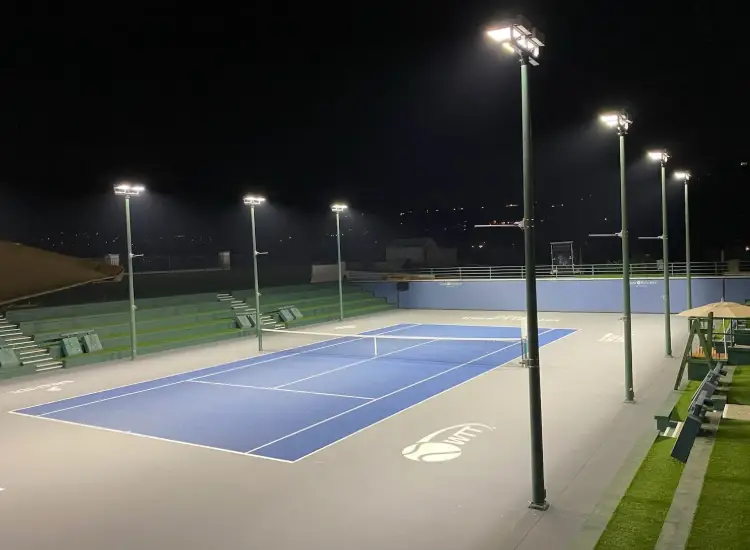
Common pole heights: 20 to 35 feet for most community and club courts; 40 to 50 feet for stadium courts and broadcast venues. Taller poles improve uniformity and reduce the number of fixtures but increase cost and structural requirements.
Typical mounting patterns
-
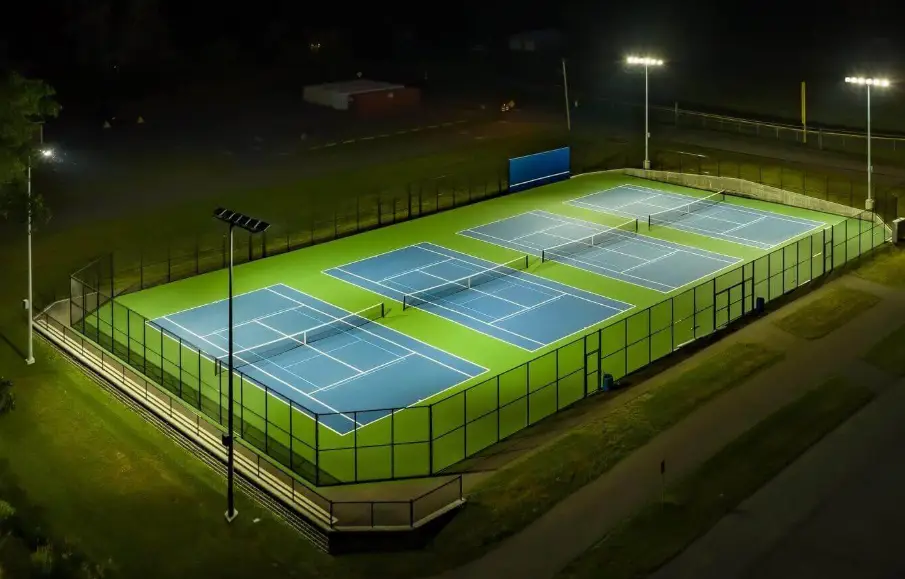
Four-pole layout: poles at the corners or slightly outside the court footprint—commonly used for community courts.
-
Six- or eight-pole layouts: used for higher uniformity, multi-court complexes, or when minimizing glare to spectators is important.
Aiming and tilt
-
Use photosimulation or lighting design software to set precise tilt and aiming. Excessive tilt increases glare and uplight. Manufacturer-recommended maximum tilt typically 10–20 degrees for tennis optics.
5. Performance tradeoffs: lumens, beam types, CCT and CRI
Lumen packages vs beam control
-
Higher lumen fixtures reduce fixture count but require very precise optical control to avoid hotspots and glare.
-
Multiple smaller fixtures with narrower beams may give better control for complex sites.
Color temperature (CCT)
-
4000K to 5000K is common for clear visibility and good video reproduction. Cooler CCT increases perceived brightness. Use the lowest CCT acceptable to comply with Dark Sky or neighbor preferences if required.
Color Rendering Index (CRI)
-
CRI 70–80 is typical and acceptable for most tennis use. For events requiring color-critical broadcast, CRI 80+ is preferred.
Glare control
-
Optic choice and shielding are the main tools to reduce glare. Designers often target UGR values within recommended levels and use cutoff shields where needed.
6. Energy, lifetime, maintenance and ROI
Energy efficiency
LED sports luminaires typically deliver 120 to 150+ lumens per watt in practical systems; real-world system efficiencies depend on drivers, optics, and controls. Well-specified LED systems typically use 50 to 70 percent less energy than equivalent metal-halide systems for the same court illuminance.
Lifetime & lumen maintenance
-
L70@50,000 hours is a typical spec for LED sports luminaires; many commercial fixtures now claim Lumen Maintenance to 100,000 hours under ideal conditions. Verify in datasheets.
Maintenance savings
-
LEDs reduce lamp replacement labor, ballast swaps and warm-up time. For clubs with multiple courts, this compounds into significant savings.
Simple ROI rule-of-thumb
-
LED retrofit payback typically ranges from 2 to 6 years depending on local electricity price, operating hours, rebates and the degree of control implemented. Actual project quotes should include cost of pole reinforcement, wiring, controls and commissioning. Industry installers report a wide range of costs and paybacks; get detailed bids.
7. Site constraints and compliance
Light trespass and Dark Sky
-
Use full-cutoff optics and careful aiming when neighbors or ordinances limit skyglow. It is feasible to achieve pro-level court lighting while meeting Dark Sky principles with advanced optics and lower CCT options.
Local codes and permits
-
Many municipalities require photometric reports, pole structural calculations, and electrical permits. Provide neighbors with photometrics showing horizontal and vertical illuminance contours.
Noise and EMI
-
Proper surge protection and driver choice prevent flicker and radio interference in sensitive environments; for broadcast-grade events request flicker specifications from vendors.
8. Installation checklist, commissioning and testing procedures
Before procurement:
-
Confirm competition level and target lux/uniformity numbers.
-
Obtain court surface and net dimensions and any nearby obstructions.
-
Check local ordinances for pole height and light trespass limits.
During installation:
-
Use certified electricians; follow local electrical code.
-
Verify structural capacity of poles for wind loading and fixture weight.
-
Use surge arrestors in main panels.
Commissioning and acceptance:
-
Perform photometric measurements (lux meter or calibrated light meter) at grid points across court.
-
Verify min/avg uniformity, vertical illuminance at player eye-lines, and glare levels if required.
-
Provide as-built photometric documentation to facility owner.
9. Product specification tables
Table 1. Illuminance targets by play level
| Play level | Average illuminance (lux) | Uniformity (min ÷ avg) | Typical pole height |
|---|---|---|---|
| Recreational/community | 150 − 300 | 0.5 − 0.7 | 20 − 30 ft |
| Club / competitive training | 300 − 500 | 0.6 − 0.75 | 25 − 35 ft |
| Tournament / broadcast | 750+ | 0.7+ | 35 − 50 ft |
(Sources: IES guidance and industry practice).
Table 2. Typical fixture specification comparison
| Parameter | Entry-level LED flood | Mid-tier tennis optic LED | Stadium tennis luminaire |
|---|---|---|---|
| System wattage | 200 − 400 W | 300 − 600 W | 600 − 1000 W |
| Typical lumens | 24,000 − 48,000 lm | 36,000 − 90,000 lm | 90,000+ lm |
| CCT | 4000K | 4000K − 5000K | 4000K − 5700K |
| CRI | 70 | 70 − 80 | 80+ |
| IP rating | IP65 | IP66 | IP66/67 |
| Optics | General flood | Tennis-specific optic | Precision optics, low glare |
| Warranty | 3 − 5 years | 5 − 7 years | 5 − 10 years |
(Data aggregated from typical manufacturer datasheets).
Table 3. Quick spec checklist to request from vendors
| Item | Why it matters |
|---|---|
| Photometric files (IES/LM-63) | Enables accurate simulation and permit approval |
| Lumen maintenance L70 hours | Predicts long-term performance |
| CCT and CRI options | Affects perception and broadcast quality |
| Glare or UGR data | Player comfort |
| IP rating and surge protection | Outdoor reliability |
| Warranty and service terms | Total cost of ownership |
| Control options (1-10V, DALI, DMX) | Operational flexibility |
10. Practical pricing ranges and budgeting rules of thumb
Costs vary by region, pole work and control complexity. Typical ranges reported by installers:
-
Small retrofit, single community court: $6,000 to $15,000 total (many variables).
-
Full replacement with structural pole work: $15,000 to $45,000 per court.
-
High-end stadium upgrade: can exceed $100,000 per court for broadcast-grade installations.
Get at least three detailed quotes that break out equipment, controls, permitting, civil work and commissioning.
11. Case studies and common retrofit scenarios
Convert metal-halide to LED
-
Reuse poles and arms when structurally sound. Retrofit fixtures and add dimmable controls to gain immediate energy savings and reduce maintenance.
New-build community court
-
Use 4-pole layout with mid-mounted arms and mid-range optics. Target 200 to 300 lux and provide zoning to reduce operating hours.
Multi-court club
-
Centralized controls, per-court zoning and scheduled dimming deliver large utility savings. Photometric design should consider cross-court spill and shared pole placements.
12. Purchasing checklist and specification template
-
Target lux and uniformity numbers.
-
Number of courts and hours of operation per week.
-
Desired warranty length and response times.
-
Required certifications: CE, RoHS, UL listing, DLC premium (if seeking rebates).
-
Preferred CCT and CRI.
-
Mounting hardware and pole review (if provided by supplier).
-
Controls: basic on/off, dimming, or advanced scheduling/remote management.
-
Price breakdown and commissioning included or optional.
13. FAQs (frequently asked questions)
-
What lux should a public community tennis court have?
For comfortable evening play many designers target 150 to 300 lux average with a uniformity ratio around 0.5 to 0.7. Choose the higher end for serious clubs. -
Can I keep my existing poles when switching to LED?
Often yes if a structural inspection confirms adequate wind loading capacity and attachment details. Reuse saves cost but verify with a structural engineer. -
What pole height should I choose?
For a single community court 20 to 30 feet typically works. For club-level or multi-court setups go taller to improve uniformity. Stadiums require higher poles for broadcast. -
How do I reduce glare for players and neighbors?
Select tennis-specific optics, full-cutoff housings, precise aiming and consider lower CCT and shielding. Commissioning measurement confirms success. -
What is the expected maintenance schedule for LED sports lights?
LEDs greatly reduce lamp replacements. Expect periodic cleaning and driver checks. Plan photometric retests after a few years to confirm lumen maintenance. -
Will LED fixtures be suitable for televised matches?
Yes if you choose high-performance fixtures with high lumen output, good CRI (80+ recommended), low flicker and higher vertical illuminance values for broadcast cameras. -
What warranties and certifications should I request?
Ask for manufacturer’s warranty (5 years typical), UL/CE markings, IP66 or better, surge protection levels and IES/LM-63 photometric files. -
How quickly will LED save money compared with old metal-halide lamps?
Payback depends on hours used and local electricity cost. Many facilities see 2–6 year paybacks when factoring energy savings, rebates, and lower maintenance.
14. Final recommendations and SunplusPro value proposition
If you manage courts or sell to clubs, follow this sequence:
-
Define target lux and uniformity per court.
-
Request IES photometric files and site-specific simulations from suppliers.
-
Inspect poles and wiring before procurement.
-
Choose fixtures with tennis-specific optics, IP66, L70 rating and dimmable drivers.
-
Include controls for zoning and dimming to maximize savings.
-
Commission with a qualified lighting engineer and keep as-built photometrics.
SunplusPro sells factory-direct LED solutions with customizable optics and control options. Our approach focuses on matching fixture optics to the exact court geometry to minimize glare and energy use while delivering recommended illuminance and long lumen life. Contact SunplusPro for turnkey proposals that include photometric modeling, product specs, and installation support.