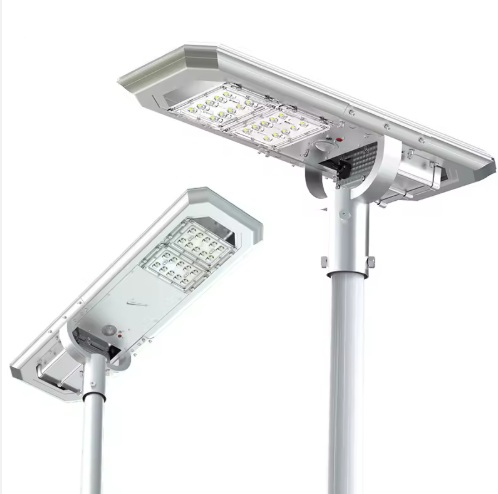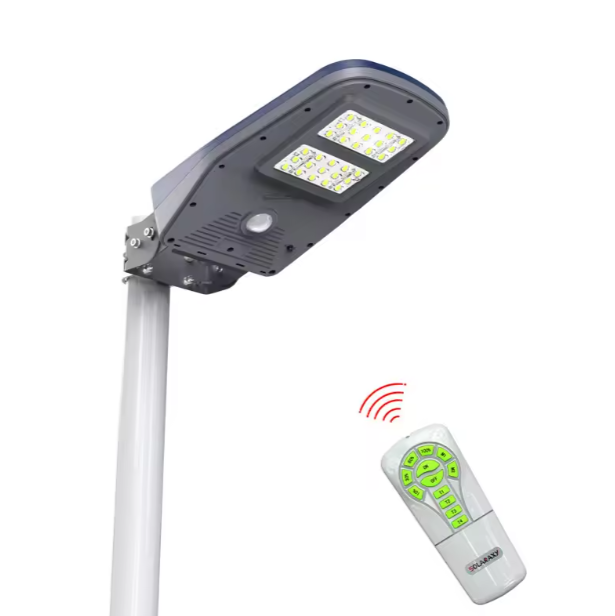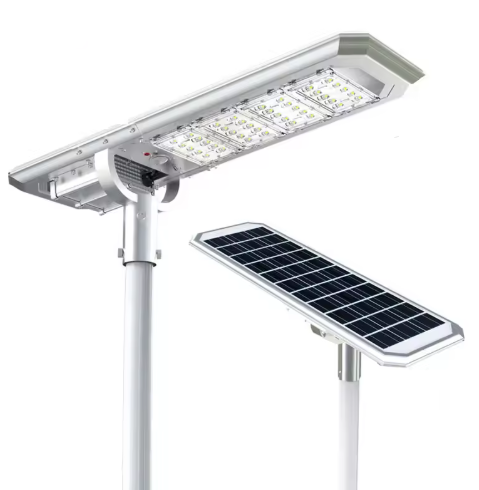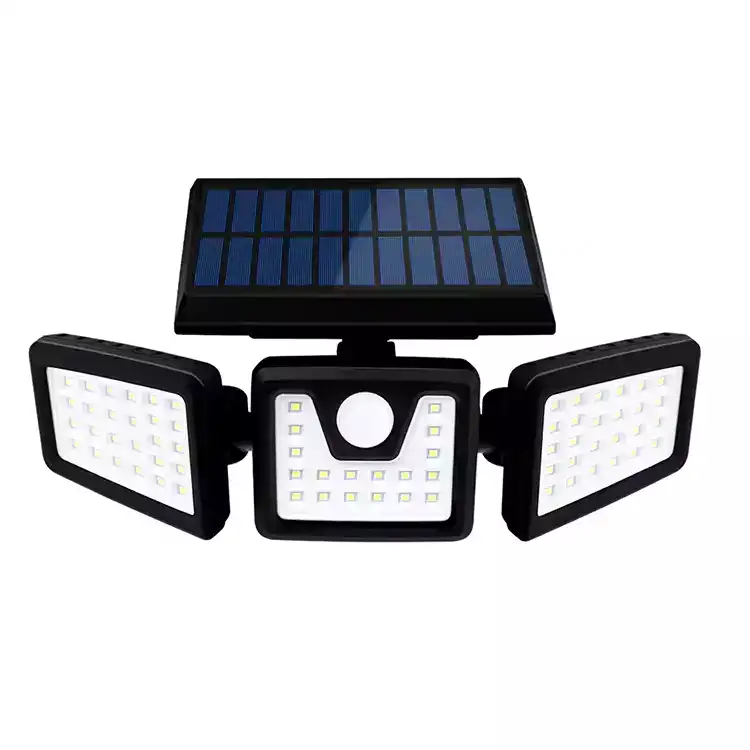

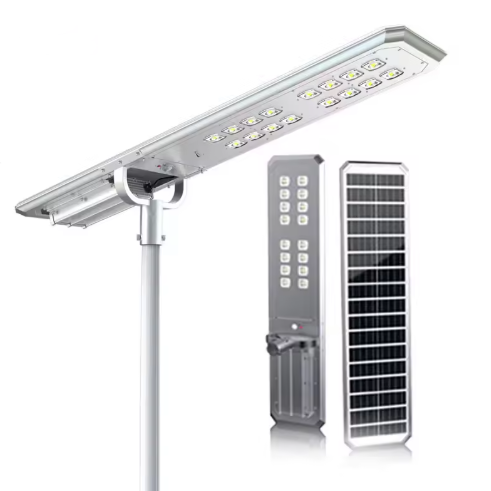
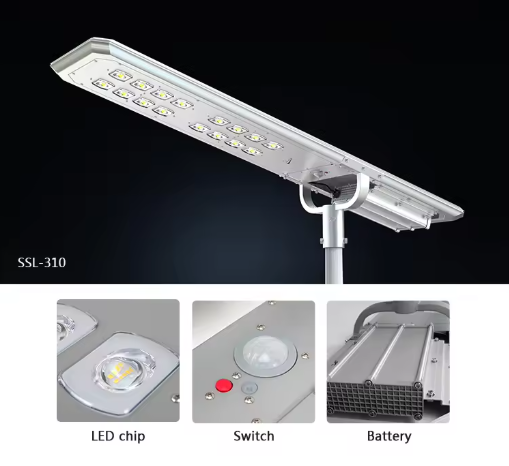
For typical urban and rural roadside installations where grid power is limited or deployment speed matters, a well-specified 100W all-in-one LED solar street light equipped with a passive infrared motion sensor and IP65 enclosure delivers a cost-effective balance of illumination, autonomy, and low maintenance. When specified correctly — high-efficacy LEDs tested under LM-80/TM-21 standards, a monocrystalline PV panel qualified to IEC 61215, a LiFePO4 battery sized for the required nights of autonomy, and an IP65 mechanical rating for outdoor exposure — the system will satisfy common roadway lighting requirements while minimizing lifecycle cost and complications related to wiring and trenching.
1. Overview and product anatomy
An “all-in-one” solar street light is a self contained luminaire that integrates the photovoltaic module, LED array, battery, power electronics (MPPT or PWM controller), and sensor(s) into a single housing or compact assembly. The 100W model label normally refers to the nominal LED power rating rather than the solar panel or battery power; it is intended to provide lighting comparable to a 150W–250W traditional sodium/metal halide fixture depending on LED efficacy and optics. Manufacturer published products in this class typically offer 10,000 to 20,000 lumens at the LED module, with LED system efficacies sometimes exceeding 150 lm/W and in special designs reaching 200 lm/W under controlled test conditions. Practical installed light at roadway level will depend on luminaire distribution, mounting height, spacing, and local luminaire aiming.
2. Core components explained
Below is a concise breakdown of the parts you will find in a professionally designed 100W all-in-one solar street light.
LED module and driver
-
High-power SMD or mid-power LED chips on metal core PCB or ceramic MCPCB, grouped to deliver the rated 100W electrical input.
-
Driver usually constant current with dimming options and surge protection. Look for LM-79 photometric reports and LM-80 test data for the LED brands used. LM-80 data plus TM-21 projection gives credible lumen maintenance numbers.
Solar panel
-
Typically monocrystalline cells to maximize power per area. Panel nominal power for a 100W street light commonly ranges from 80W to 200W depending on tilt, latitude, and desired autonomy. For module qualification insist on IEC 61215 (crystalline silicon module design qualification).
Battery pack
-
LiFePO4 or lithium-ion packs are most common today for cycle life and depth-of-discharge performance; some lower-cost units still use sealed lead acid (SLA) or GEL but at shorter life and heavier weight. Battery capacity (Ah) and system voltage must be sized to provide required night autonomy. Shipping rules and tests (UN 38.3 / airline and IATA guidance) apply to lithium battery transports.
Controller and charge regulation
-
MPPT controllers are preferred for improved energy harvest from the PV panel, especially where partial shading or variable irradiance occurs. Controllers integrate dusk/dawn sensing, dimming schedules, and motion-based boost modes.
Passive infrared (PIR) motion sensor
-
Detects movement of warm bodies; typically enables a low power “standby” mode (e.g., 20% output) and a rapid increase to full output when motion is detected. Sensor field of view, sensitivity and delay time are tunable in higher-end models.
Housing, heat sinking and optics
-
Die-cast aluminum heat sink and optical lens or reflector to create Type II/III/T distribution patterns for roadways. Thermal design is critical: LED life and lumen maintenance depend strongly on junction temperature control.
Ingress protection and sealing
-
For exposed outdoor use pick IP65 minimum for dust protection and water jets; higher ratings (IP66 or IP67) offer greater robustness in harsher installations. IP codes are defined by IEC 60529.
3. Optical and electrical performance fundamentals
This section covers the performance metrics you must evaluate when selecting a 100W all-in-one unit.
Luminous flux and efficacy
-
Lumen output = LED power × system efficacy. Example: a 100W LED system at 150 lm/W = 15,000 lumens at fixture. Manufacturer claims of >200 lm/W are achievable at module level but check LM-79 reports for the complete luminaire. Typical practical range: 120–180 lm/W for installed fixtures.
Color temperature and color rendition
-
Correlated color temperature (CCT) options commonly 3000K, 4000K, 5000K. For roadway work, 4000K is often a compromise between visual acuity and glare control; 3000K reduces skyglow and blue light content at night. CRI (Ra) of 70–80 is common; for high-visibility applications seek CRI ≥80.
Photometric distribution
-
Roadway luminaires require guidance on longitudinal and lateral distribution (Type II/III/IV). Check IES files (IES TM-XX) or manufacturer photometric files to perform lighting calculations against the design standard (ANSI/IES RP-8).
Lumen maintenance
-
Look for LM-80 data for LED chips and TM-21 projections for useful life (L70 hours — time to 70% of initial lumen output). Quality products will quote L70 > 60,000 hours when backed by LM-80/TM-21 testing.
Electrical protections
-
Surge protection (e.g., SPD class II), reverse polarity protection for battery, overcharge/discharge protection, and temperature compensation for charging improve lifetime and safety.
4. Solar powertrain: panel, battery and autonomy calculations
Selecting the PV panel and battery for a 100W all-in-one fixture requires careful calculation of energy in vs. energy out, factoring geographic irradiance and system inefficiencies.
Basic energy balance (simplified)
-
Estimate nightly energy demand = LED rated watt × (average nightly on-time) × (dimming factor). Example: 100W × 12h = 1,200 Wh (if run full power all night).
-
Add system losses (driver efficiency, wiring, thermal derating) ≈ 10–20%. So adjusted demand = 1,320–1,440 Wh.
-
Determine autonomy target (n nights without sun): common targets 3–5 days for remote installations. Multiply daily energy by autonomy days to get required usable battery energy.
-
Add depth-of-discharge and battery efficiency: LiFePO4 usable fraction typically 80–90% of rated capacity; SLA usable fraction 30–50%.
-
Solar array sizing: use local peak sun hours (PSH) and derating factors (panel temp, dirt, controller losses). Solar energy harvested per day = panel watt × PSH × derating. Choose panel size so harvested energy meets expected daily demand plus recharge margin.
Practical example (ballpark)
-
Nightly runtime target 12 hours with motion dimming (standby 30%, active 100% for 20% of night). Effective average power ≈ 100W×0.2 + 30W×0.8 = 44W average. Energy per night ≈ 528 Wh.
-
For 3 nights autonomy and LiFePO4 battery (usable 85%) required battery energy ≈ 528 × 3 / 0.85 ≈ 1,862 Wh → at 12.8V nominal ≈ 145 Ah.
Notes on real world
-
All-in-one manufacturers sometimes reduce costs by claiming shorter autonomy or by expecting motion dimming schedules to lower average power. Validate the quoted autonomy with an independent energy budget and consider worst-case winter irradiance. Web product pages often quote “3–5 days backup” but check the PV wattage, battery Ah, and region for realism.
5. PIR motion sensor: behavior and energy strategies
PIR motion sensors in street lighting detect infrared changes caused by moving bodies and switch the light from a low-power standby state to full output. Typical configurations:
-
Standby (eco) mode: 10%–40% output until motion triggers full output.
-
Trigger response: immediate ramp to full or to a preset intermediate level, with adjustable hold time (10s–20min).
-
Sensitivity and range: depends on lens and mounting height; typical detection radii at road level are 5–15 meters for pedestrian speed, longer for vehicles.
Advantages
-
Dramatic energy savings during low traffic periods. Extends battery autonomy, allows smaller PV array and battery for equal nights operation.
Caveats
-
False triggers from animals, windblown objects or temperature transients can create unnecessary switching. Choose sensors with adjustable sensitivity and time delay. For highway installations where frequent switching may be undesirable use lower sensitivity or disable PIR.
6. Mechanical design, ingress protection and environmental resilience
IP65 meaning and practical implications
-
IP65 per IEC 60529 indicates complete protection against dust ingress and protection against water jets from any direction. This rating ensures the electronics do not fail from routine rain or light washdown, but it does not guarantee indefinite submersion. For installations with exposure to heavy dust storms or salt spray consider IP66/IP67 or additional coatings.
Thermal management
-
LEDs require efficient thermal paths to keep junction temperatures low. Anodized die-cast aluminum housings with fins and thermal interface materials are standard. Poor thermal design reduces lumen maintenance and shortens life.
Corrosion resistance
-
For coastal or industrial sites, select corrosion-resistant coatings, stainless steel fasteners, and sealed battery compartments with desiccants or breather membranes.
Lightning and surge protection
-
Roadside fixtures face surge risk. Internal SPD and proper grounding reduce equipment failure risk. Consider external lightning protection in high-risk regions.
7. Standards and certifications (procurement checklist)
When procuring street lighting for public projects, insist on documented conformity and testing:
-
IEC 60529 — IP code for ingress protection.
-
IEC 61215 / IEC 61730 — PV module design qualification and safety for crystalline silicon modules.
-
LM-79 — Standard for photometric measurements of LED luminaires (full luminaire testing).
-
LM-80 and TM-21 — LED chip lumen maintenance testing and projection methodology. These underpin any lifetime statement for LED lumen maintenance.
-
UN 38.3 / IATA guidance — Testing and transport responsibilities for lithium batteries. Essential if you import/export fixtures with lithium cells inside.
-
IEC 60598-1 — Luminaires — general safety requirements, relevant for electrical safety.
-
CE, RoHS, FCC — region specific regulatory marks (safety, electromagnetic compatibility, hazardous substances) — require lab reports.
Request copies of test reports: LM-79 for the finished luminaire, LM-80 for the LED package, battery test reports, PV module IEC certificates, and environmental IP ingress test records.
8. Sizing example and selection matrix (step-by-step)
Follow this selection matrix to size a 100W all-in-one system for a given site.
-
Define illumination target: specify average lux or luminance and uniformity per the local roadway standard (use IES RP-8 or local authority).
-
Determine mounting height and spacing: higher mounting reduces poles but increases lumen requirements.
-
Calculate required lumens at ground: perform photometric calculations using the luminaire IES file.
-
Derive luminaire count: total lumens required divided by luminaire delivered lumens accounting for light loss factors (LLF).
-
Energy budget: determine nightly hours and motion dimming schedule to compute daily Wh required.
-
Battery and solar sizing: use local peak sun hours (PSH), set autonomy days, and pick battery chemistry and size accordingly.
-
Select model: choose an all-in-one with matching LED lumens, PV wattage, battery Ah and controller type (prefer MPPT).
-
Procurement checklist: verify LM-79, LM-80/TM-21, IEC PV certificate, IP test and battery safety reports.
9. Installation, aiming and commissioning
Mounting and pole interface
-
Use the specified pole bracket adapter and tighten per torque specifications. Poles should be structurally rated for wind loads; the integrated panel area acts like a sail so confirm total wind profile.
Aiming and tilt
-
Some all-in-one models allow panel tilt adjustments; optimize tilt for latitude and seasonal irradiance. Luminaire aiming should honor roadway alignment for minimal glare and uniformity.
Commissioning checklist
-
Verify on-site dusk/dawn operation, check PIR sensitivity, confirm dimming schedule, record battery voltage and charge current under sun, and measure initial lux distribution with a light meter. Log serial numbers and test report attachments for warranty.
10. Operation, maintenance and troubleshooting
Routine inspections
-
Visual: check seals, lens condition, hardware torque, and bird/nest obstructions every 6–12 months.
-
Electrical: measure battery voltage, charge cycles, and check for fault codes in controller quarterly for the first year.
Cleaning
-
Dust and bird droppings reduce PV output. Clean panel surface when soiling noticeably reduces open circuit voltage or short-circuit current; frequency depends on the environment (urban, desert, agricultural).
Common faults and remedies
-
Undercharging: check panel orientation, shading, or degraded battery.
-
Flicker or dimming: verify driver temperature and wiring.
-
Non-responsive PIR: check sensor lens, wiring, and replace if failed.
Spare parts
-
Keep spare batteries, drivers and seals for fleets larger than 10 units to accelerate maintenance.
11. Comparative tables
Table 1 Typical technical specification (example 100W all-in-one)
| Parameter | Common value (example) |
|---|---|
| LED rated power | 100 W |
| System luminous flux | 12,000–18,000 lm (depends on efficacy) |
| Efficacy | 120–180 lm/W typical |
| CCT | 3000K / 4000K / 5000K |
| CRI | 70–80 |
| PV panel | Monocrystalline 120–200 W |
| Battery | LiFePO4 12.8V / 60–200 Ah (depending on autonomy) |
| Controller | MPPT with dimming and PIR input |
| Motion sensor | PIR, adjustable hold, sensitivity |
| IP rating | IP65 (minimum) |
| Warranty | 3–5 years typical for fixture; battery 2–5 years |
Table 2 All-in-one vs separated system (summary)
| Criteria | All-in-one | Separate PV + luminaire + battery |
|---|---|---|
| Installation speed | Fast (single unit) | Slower (multiple components) |
| Serviceability | Moderate (battery inside housing) | Easier (replaceable separate units) |
| Energy optimization | Integrated system may be tuned | Can be optimized more flexibly |
| Theft risk | Higher per unit value | Batteries or panels can be secured separately |
| Scalability | Good for small/medium projects | Preferable for large, engineered projects |
Table 3 Battery chemistry quick comparison
| Chemistry | Cycle life | Depth of discharge recommended | Temperature resilience | Typical use |
|---|---|---|---|---|
| LiFePO4 | 2000–5000 cycles | Up to 80–90% | Good to excellent | Preferred for long life |
| Lithium-ion NMC | 1000–3000 cycles | 70–80% | Good | Higher energy density |
| SLA (sealed lead acid) | 300–700 cycles | 30–50% | Poor | Low cost, short life |
12. Lifecycle, performance guarantees and procurement tips
Warranty and expected life
-
LED modules: manufacturer should provide ≥5 years warranty on the light engine and lumen maintenance projection (LM-80/TM-21).
-
Battery: specify cycle-based warranty (e.g., 80% capacity after 2,000 cycles) and calendar year duration.
-
PV module: standard industry warranty usually 10 years product and 25 years performance (power output retention) for high quality modules, though integrated panels in all-in-one fixtures sometimes carry shorter guarantees.
Procurement tips
-
Require measured photometric IES files, LM-79 for luminaire, LM-80 for LED chips, and IEC certificates for PV modules.
-
Ask for independent lab test reports; do not rely purely on factory certificates.
-
Clarify spare part support, firmware update procedures for controllers, and end-of-life recycling plan for batteries.
13. Use cases and deployment recommendations
Where 100W all-in-one is appropriate
-
Secondary roads, residential streets, pathways, rural roads, parking lots, and areas where trenching to the grid is cost prohibitive. Also useful for rapid deployment in disaster response and temporary projects.
Where not ideal
-
Major arterials requiring high uniformity and strict photometric compliance with municipal standards may be better served by engineered grid luminaires with central control.
Climate considerations
-
Cold climates reduce battery available capacity; increase battery Ah. Hot climates accelerate battery degradation; prefer LiFePO4 with proper thermal management and choose higher IP/venting protection in dusty or coastal sites.
14. Frequently asked questions
-
What does the “100W” label mean for an all-in-one solar street light?
It usually refers to the LED electrical input rating of the luminaire. The actual delivered luminous flux depends on LED efficacy and optical losses. -
How many nights will a 100W all-in-one work without sun?
That depends on the battery Ah, night hours, and dimming strategy. Typical manufacturer claims of 3–5 days are credible only when battery capacity and solar panel size match the claim; always run an energy budget. -
Is IP65 enough for roadside use?
IP65 protects against dust and water jets. It is adequate for ordinary urban and rural installations; in high salt or flood-prone areas consider IP66/IP67 or additional protections. -
Can I use the light in very cold places?
Yes, but battery performance drops at low temperatures. Select battery chemistry rated for the climate and consider battery insulation or heater options. -
What testing should I ask for before procurement?
LM-79 for the luminaire photometry, LM-80 for LEDs with TM-21 projections, IEC PV module certificates (IEC 61215), IP test reports, and battery safety/UN 38.3 shipping tests. -
Are PIR sensors reliable for vehicle detection?
PIR sensors work best for warm bodies and can detect vehicles by the thermal signature; for very high speed or long-range vehicle detection consider passive or active radar sensors. -
How often should panels be cleaned?
Cleaning interval depends on site soiling; inspect quarterly in dusty environments and semi-annually elsewhere. Reduced open circuit voltage or short circuit current indicates soiling. -
What is the expected LED lifetime?
Using LM-80/TM-21 data with proper thermal management many modern LEDs project L70 beyond 60,000 hours; real world results depend on temperature and drive current. -
Is it better to buy an integrated unit or separate components?
For one-off or small projects integrated units are fast and cost effective. For large, engineered systems separate PV arrays, battery banks and remote luminaires offer flexibility and easier servicing. -
What are transport rules for fixtures with lithium batteries?
Fixtures with lithium batteries must comply with UN 38.3 testing and IATA/DOT shipping rules; batteries often must be set to specified state-of-charge for air transport.