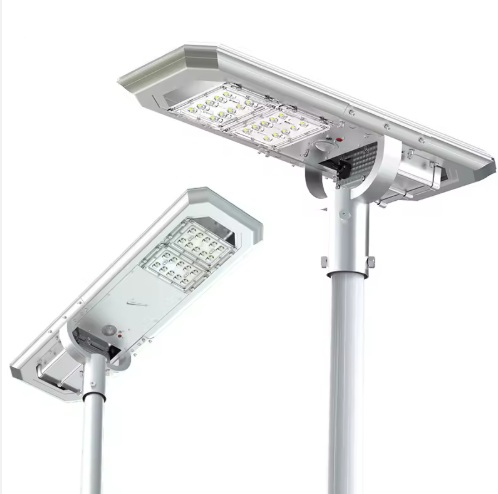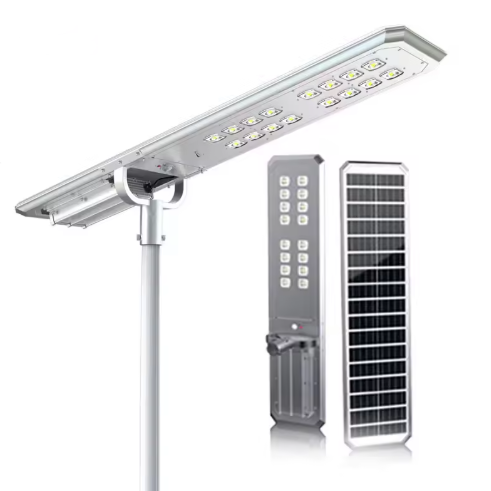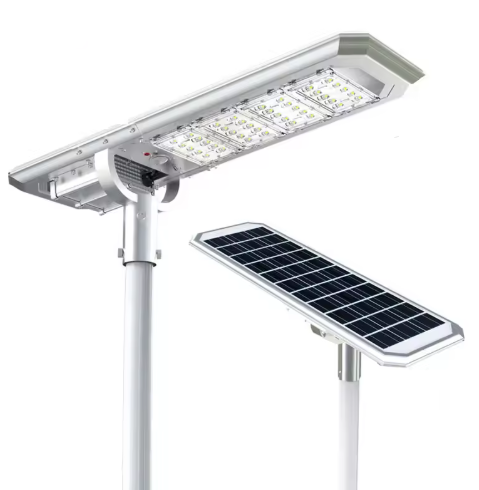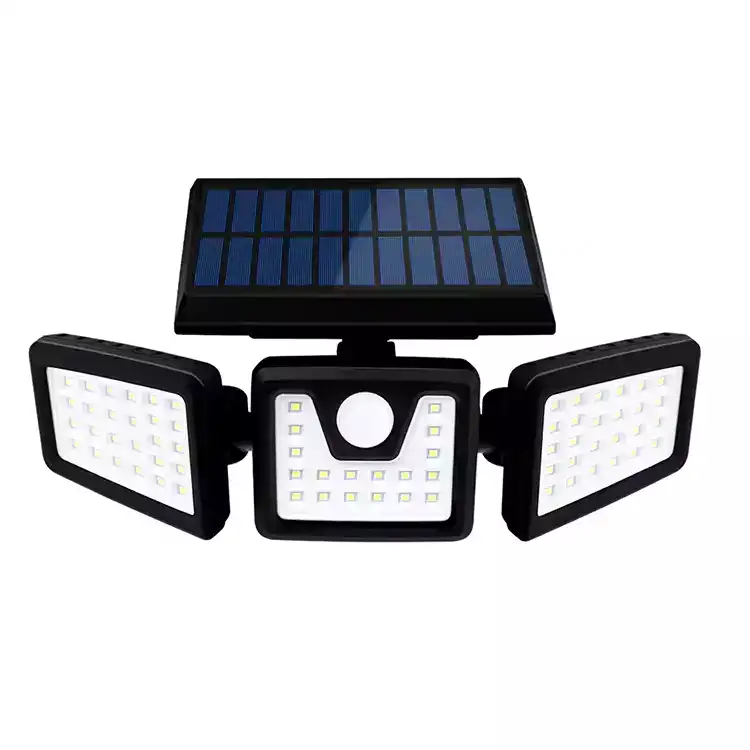

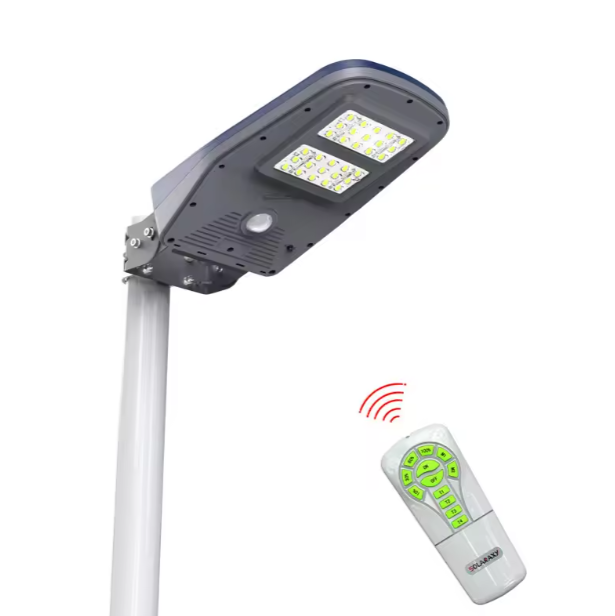
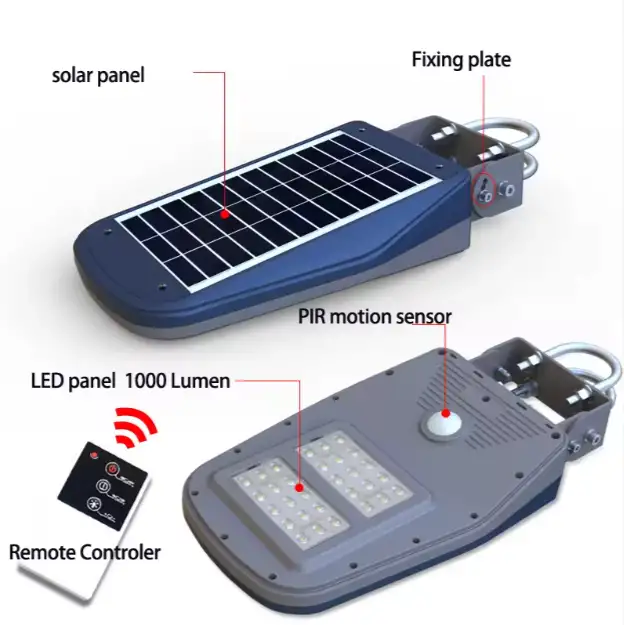
For courtyard and similar outdoor spaces, a separated (split) solar street light with IP65-rated housings offers the best balance between reliability, maintainability, and lighting performance when components meet internationally recognized standards and the system is sized for local solar resource and lighting requirements. Properly specified split systems provide easier servicing, improved thermal management, and flexible panel orientation, while meeting safety and performance criteria set by IEC and industry lighting practices.
1. What “IP65” means for courtyard solar lights and why it matters
IP codes describe enclosure resistance to solid particles and liquids. IP65 denotes full protection against dust ingress (6) and protection from low-pressure water jets from any direction (5). For courtyard solar luminaires and external batteries, IP65 requires that electrical enclosures block dust that could degrade optics or electronics, and resist rain, sprinkler spray, and cleaning operations. IP65 therefore sets a practical baseline for durability in most outdoor courtyard installations, though coastal, flood-prone, or immersion-prone locations may require higher ratings (for example, IP66 or IP67).
Key attributes
| IP Rating | IP65 | Lighting solutions service | Lighting And Circuitry Design, Dialux Evo Layout, Litepro DL.. |
| Warranty(Year) | 3 | Place of Origin | Guangdong, China |
| Application | ROAD/Courtyard | Color Temperature(CCT) | 5000K (Daylight) |
| Light Source | LED | Power Supply | Solar |
| Model Number | SCL-01N | Brand Name | SRESKY |
| Beam Angle(*) | 135*50 | Certification | Bv, CE, FCC, Pse, RoHS, Saso, VDE |
| Input Voltage(V) | 5.5V | Lamp Luminous Flux(lm) | 1000 |
| Working Temperature(°C) | 0 – 45 | Type | solar street light separated |
| Certification | CE,ROHS,FCC,BV,BSCI, ISO | LED | 1000Lumens,30 LEDs |
| Battery | Li-ion | Install height | 2.5~3.5 meters |
| Waterproof | IP 65 | Solar charging time | 9-10 hours by bright sunlight |
| Lighting time | More than 7 nights(Dimmer mode) | Material | PC+Aluminum Alloy |
| Size | 450*246*86mm |
2. Separated (split) solar street light: architecture and advantages
“Separated” or “split” solar street-light systems separate the PV array and battery/controller from the LED luminaire. Typical layout: solar panel mounted to building roof or pole with independent bracket, battery and controller housed in an IP65/IP66-rated enclosure (sometimes at base of pole), and LED head mounted at the luminaire point. This contrasts with all-in-one units where panel, battery, controller, sensor, and LEDs share a single fixture housing. Industry comparisons show split systems offer easier maintenance and flexible panel siting while integrated units reduce initial wiring and pole clutter.
Advantages of separated systems for courtyards
-
Component swap-out without lowering entire lamp.
-
Solar panels can be optimally oriented away from shading caused by buildings or trees.
-
Batteries housed in ventilated, locked enclosures improve thermal conditions and extend life.
-
Flexible scaling and replacement strategy reduces life-cycle costs in many municipal projects.
Tradeoffs
-
More installation wiring and separate mounting hardware increase upfront labour and material cost.
-
System design must manage cable runs and security for separate components.
3. Core components and technical specifications (what to specify when buying)
Below are the essential components of an IP65 separated solar street light and recommended technical parameters for courtyard installations.
Table 1 — Component checklist and recommended baseline specs
| Component | Recommended baseline specification | Why it matters |
|---|---|---|
| LED luminaire | 20–80 W LED module (choose per required lux) with >100 lm/W system efficacy; CCT 3000–4000 K for warm-white pedestrian comfort | Efficiency reduces battery size and cost; CCT affects comfort |
| Optical lens | Type II/Type III distribution for walkways and courtyard lanes | Proper distribution avoids glare and dark spots |
| Solar PV module | Monocrystalline, 12 V or 24 V system; Wp sized by energy budget (see sizing); anti-PID and tempered glass | Longevity, temperature coefficient, mechanical strength |
| Battery | LiFePO4 or high-cycle li-ion battery, IEC 61427-aware, capacity sized for 3–5 days autonomy | Cycle life and safety for off-grid PV applications. IEC 61427 tests apply. |
| Charge controller | MPPT preferred when panel voltage higher than battery; or high-quality PWM for cost-constrained small systems | MPPT increases charging efficiency, especially in cold or partial-shade conditions. |
| Enclosures (battery/controller) | Minimum IP65 for housings, lockable, thermally managed with vents or passive heat sinks | Protects electronics from weather and vandalism. |
| Sensors & controls | Photocell for dusk-dawn, PIR or microwave motion sensor for dim-to-bright operation, remote monitoring optional | Extends autonomy and improves utility |
| Mounting hardware | Corrosion-resistant galvanised or stainless brackets; tamper-proof fasteners | Ensures service life and reduces maintenance |
| Cabling/connector | UV-resistant solar cable, MC4 or equivalent connectors, surge arrestors | Reduces failure risk from UV and transient surges |
(Notes: specify local temperature extremes, expected daily solar insolation, and municipal lighting levels to finalize selections.)
4. Standards, safety tests, and certifications to require
Mandate compliance with relevant, recognized standards when selecting equipment. Below are high-priority standards and what they cover for procurement and specification.
-
IEC IP ratings (IEC IP code) — ingress protection classification for enclosure rating; IP65 is a minimum for most courtyard fixtures.
-
IEC 60598 series — luminaire safety and performance; apply to outdoor luminaires and accessories. Ensure fixtures are tested for electrical safety and photobiological safety when appropriate.
-
IEC 61215 / IEC 61730 — PV module design and safety tests (durability, thermal cycling, damp heat). Require these to ensure panel longevity.
-
IEC 61427 — battery testing methods and general requirements for PV off-grid batteries; useful for battery specifications to ensure cycling endurance.
-
IEC 62133 / UL 62133 — lithium battery cell and pack safety testing for portable and embedded batteries; important if using lithium chemistries.
-
ANSI/IES RP-8 or IES standards — recommended practices for roadway, pedestrian, and area lighting to determine maintained illuminance, uniformity, and glare criteria. Use these for specifying lumen output and aiming angles.
Procurement checklist: request test certificates, model-level data sheets, and third-party lab reports for each of the standards above prior to contract award.
5. Performance sizing: how to translate lighting requirements into PV, battery, and luminaire specs
Sizing for split solar street lights uses an energy budget approach: determine required luminous flux and operation profile, convert to electrical demand, then size PV array and battery for required autonomy.
Step-by-step sizing summary
-
Define lighting requirement. Use IES or local municipal lux targets (for courtyards typically 5–20 lux average depending on path type).
-
Select luminaire wattage and control profile. Example: 40 W LED at 120 lm/W; night schedule: 100% for 4 hours, 50% for remainder 6 hours.
-
Calculate daily energy consumption: energy (Wh/day) = Σ (power × hours at that level) × driver losses.
-
Add system losses and inefficiencies: include controller losses (MPPT ~95–98% efficiency), wiring losses (~2–5%), LED driver efficiency.
-
Determine battery capacity: battery Wh = daily energy × days of autonomy / DoD (depth-of-discharge acceptable) / battery efficiency. For LiFePO4 assume 80–90% usable at conservative DoD 80%.
-
PV array sizing: required Wp = (daily energy required × derating factor) / average peak sun hours. Use NREL or local solar resource for peak sun hours.
Table 2 Example calculation (illustrative)
Assume: courtyard pathway, target average illuminance met by a single lamp 40 W LED, operation: 4 hours at 100%, 6 hours at 50%; controller & cabling losses 10%; days of autonomy 3; average peak sun hours 4.0.
| Calculation step | Value |
|---|---|
| LED energy per night = (40×4) + (40×0.5×6) = 160 + 120 = 280 Wh/night | |
| Add system losses (10%) → required from battery = 280 / (1−0.10) = 311 Wh/night | |
| Battery capacity for 3 nights, DoD 80% → Battery Wh = 311 × 3 / 0.8 = 1,166 Wh (~1.17 kWh) | |
| PV array Wp = (311 × 1.3 derating) / 4 = 101 Wp → for 3-day model, add margin → choose 160–200 Wp |
(Real designs should include temperature derating, seasonal worst-case insolation, tilt/orientation and site shading analysis, and safety margin.)
Key references: NREL sizing methodologies and DOE field guides.
6. Electronics: controllers, sensors, remote monitoring
Selecting the charge controller and smart controls is crucial for system reliability.
MPPT vs PWM
-
MPPT controllers track the solar module’s maximum power point and convert higher voltage from panels efficiently into battery charge current; this often yields 10–30% more charge under typical conditions, beneficial for small arrays or cold climates. PWM controllers are simpler and cheaper, adequate for small panel-to-battery voltage-matched setups. For courtyard installations where panels may be mounted optimally at different voltages or shaded at times, MPPT is usually recommended.
Control functions to include
-
Photocell (dusk-to-dawn automatic on/off)
-
Motion-based dimming profile to extend autonomy (PIR or microwave sensor)
-
Timer profiles for seasonal adjustment
-
Overcharge, deep-discharge, and temperature compensation for battery protection (especially for lead-acid; LiFePO4 requires cell-level BMS)
-
Remote monitoring (4G/LoRa/Wi-Fi) optional for large estates to track health, alarms, and runtime remotely
Surge protection: Include surge arrestors on both PV and luminaire circuits for sites with lightning exposure.
7. Materials, thermal design, and durability for courtyard use
Courtyards may present microclimates (radiant heat from paved surfaces, shading from trees), so materials and mechanical design must manage thermal and corrosion loads.
-
Housing materials: die-cast aluminium (with corrosion-resistant powder coat) for luminaires; stainless or galvanised steel for brackets. Powder coat must adhere to salt-spray testing if near coast.
-
Thermal paths: LED lifetime depends on junction temperature. Provide sufficient heatsinking and airflow. Separate battery enclosures allow batteries to be kept out of high-heat zones, prolonging cycle life.
-
Cable protection and UV: Use UV-stabilised cable jackets, and conduits for exposed runs.
-
Vandal resistance: tamper-proof fasteners and lockable battery boxes are recommended for public courtyards.
Testing and evidence: require manufacturer thermal tests and salt-spray / corrosion reports when property exposure indicates risk.
8. Mounting, aiming, and glare control
Proper mounting height, aiming, and optical selection determine visual comfort and safety.
-
Mounting height: for courtyards and pedestrian paths, typical pole heights range 3–6 m depending on space geometry and required illuminance. Lower heights yield better uniformity; higher heights increase coverage but reduce lux. Use IES recommended tables.
-
Optics: choose Type II or III light distributions for linear pathways, Type IV for larger open courtyards where offset mounting is used. Anti-glare louvers and precise cut-off optics preserve neighbour comfort.
-
Aim and tilt: ensure panels are tilted to maximize local sun exposure; luminaires aimed to avoid direct line-of-sight glare into windows.
9. Installation checklist and commissioning steps
Follow a methodical sequence that verifies safety, performance, and compliance.
Pre-installation
-
Confirm site plan and pole/anchor design.
-
Verify shading analysis and select PV mount positions.
-
Obtain datasheets, test certificates, and mechanical drawings.
Installation
-
Mount panels at recommended tilt, secure with anti-theft hardware.
-
Mount luminaire, connect control wiring, ground system properly.
-
Install battery and controller in ventilated IP65 enclosure; ensure BMS integration.
-
Surge protection and proper cable routing installed.
Commissioning
-
Measure open-circuit PV voltage and short-circuit current; compare to datasheet.
-
Verify charge controller settings (battery type, voltage set points).
-
Photometric test: lux meter measurements along walkway to confirm target averages and uniformity. Use IES/ANSI RP-8 targets.
-
Document baseline battery voltage and initial state-of-charge, upload to remote telemetry if used.
10. Operation, maintenance, and troubleshooting
A preventative maintenance plan lengthens service life and keeps courtyards lit and safe.
Routine quarterly checks
-
Inspect PV surface cleanliness and clean if transmittance drops; verify mounting bolts.
-
Check cable connectors and enclosure seals for corrosion; reseal gaskets if needed.
-
Confirm battery health: voltage, charging behavior, BMS fault logs.
-
Test motion sensors and photocell response.
Annual tasks
-
Full photometric test to confirm lumen depreciation trends.
-
Cycle test of battery if indicated by telemetry.
Common faults and quick fixes
-
Low output at night: check battery voltage, charge controller error codes, panel orientation or soiling.
-
Flicker or unstable output: examine LED driver and wiring for loose neutrals or ground faults.
-
Reduced autonomy over seasons: verify battery capacity and increase PV or battery size if necessary.
Safety note: Lithium battery maintenance must be performed by trained technicians following IEC62133/UL62133 guidance and local hazardous-material handling rules.
11. Comparative tables and procurement decision aids
Table 3 Pros and cons: Separated (split) vs All-in-one solar street lights
| Feature | Separated (split) system | All-in-one system |
|---|---|---|
| Maintenance | Replace single component in enclosure without lowering lamp – easier | Requires lowering or dismantling whole unit for battery replacement |
| Panel siting | Panel can be sited for optimal sun angle independently | Panel fixed on lamp top, limited orientation |
| Theft/vandalism risk | More points to secure (enclosures) but easier to lock | Single point; anti-theft designs possible |
| Initial cost | Generally higher due to extra housing and cabling | Lower initial cost; compact logistics |
| Thermal management | Batteries in separate enclosures allow better ventilation | Heat build-up in sealed lamp may reduce battery life |
| Scalability | Modular replacements and upgrades feasible | Limited modularity |
(Use split systems for medium-to-large courtyard installations where long-term O&M savings outweigh initial cost. Use all-in-one for small, low-budget private installations.)
Table 4 Quick procurement checklist (must-have items)
| Item | Required (Y/N) |
|---|---|
| IP65-rated luminaire and IP65 battery enclosures | Y |
| PV modules with IEC 61215 / IEC 61730 certification | Y |
| Batteries tested to IEC 61427 (PV-capable cycles) | Y |
| Lithium battery safety certificate IEC 62133 if Li-ion used | Y |
| MPPT controller with temperature compensation and BMS interface | Recommended |
| Photocell + motion sensor | Recommended |
| Remote monitoring option | Optional but recommended for estates |
12. Environmental and lifecycle considerations
-
Light pollution and neighbour impacts: limit upward light components and specify cutoff optics to reduce skyglow. Use lower correlated color temperature (3000–4000K) to reduce blue-rich emission.
-
Battery recycling: specify take-back or recycling arrangements for end-of-life batteries; lithium and lead-acid must be processed correctly. Require supplier EOL plan.
-
Carbon footprint: although panels manufacture carries embodied carbon, off-grid LED street lights reduce utility emissions over operational life; lifecycle analysis depends on battery chemistry and replacement cycles. Use procurement clauses favoring higher cycle-life batteries to reduce lifecycle replacements.
13. FAQs
-
Q: Is IP65 sufficient for courtyard solar lights?
A: For most courtyards IP65 is sufficient because it prevents dust ingress and resists water jets from any direction. Choose higher ratings (IP66, IP67) if immersion or salt-spray exposure is likely. -
Q: What battery chemistry is best for separated solar street lights?
A: LiFePO4 offers a strong tradeoff of safety, long cycle life, and thermal stability. Ensure batteries comply with IEC 61427 for PV applications and IEC 62133 for lithium battery safety. -
Q: Should I choose MPPT or PWM controllers?
A: For most courtyard projects MPPT is recommended because it extracts more power from panels under variable temperature and partial shading, improving autonomy. PWM works for very small, cost-sensitive projects with strict voltage matching. -
Q: How many days of autonomy should I specify?
A: Three days autonomy is a commonly used baseline for reliability; increase to 4–5 days for regions with extended poor weather or if maintenance visits are infrequent. -
Q: How often should I clean solar panels in a courtyard?
A: Cleaning frequency depends on local soiling rates; inspect quarterly and clean when transmittance loss exceeds ~5–10%. Urban dust or bird droppings may require more frequent cleaning. -
Q: Can split systems reduce lifecycle costs?
A: Yes. Though initial cost may be higher, the ability to replace single components (battery, lamp, controller) often reduces lifetime O&M costs in municipal or commercial installations. -
Q: What is the expected useful life of LED luminaires and PV modules?
A: Modern LEDs typically last 50,000–100,000 hours depending on thermal management; PV modules are commonly warranted for 25 years performance, with gradual degradation. Ensure manufacturer warranties and third-party tests. -
Q: How do I prevent glare affecting residents?
A: Use proper photometric distribution, lower CCT (3000–4000 K), cut-off optics, and aim fixtures to keep output away from windows. Follow IES guidelines for uniformity and glare control. -
Q: Are split systems vulnerable to theft?
A: They have more components to secure, but with lockable enclosures, tamper-proof fasteners, and smart alarms, risk can be managed. Include anti-theft clauses in procurement. -
Q: What documentation should I demand from vendors?
A: Datasheets, third-party test reports for IEC 61215/61730 (PV modules), IEC 61427 (batteries), IEC 62133 (lithium safety) test certificates, IP test reports, and photometric files (IES or LM-79/LM-80) for LEDs.