

All in One Solar Steet Light
Products
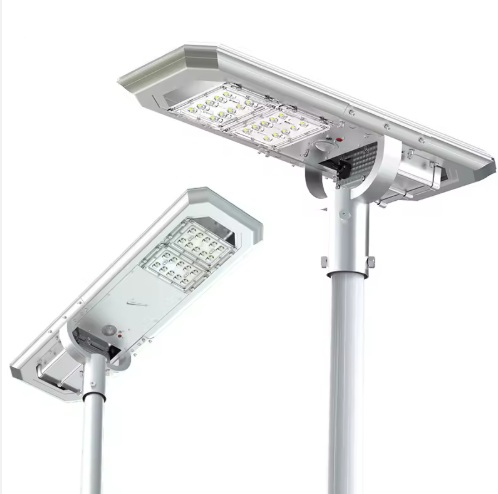

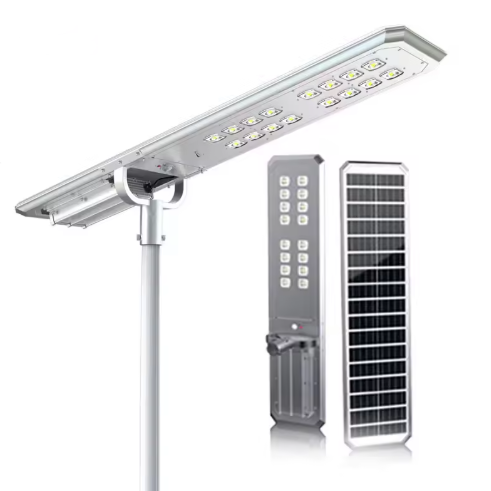
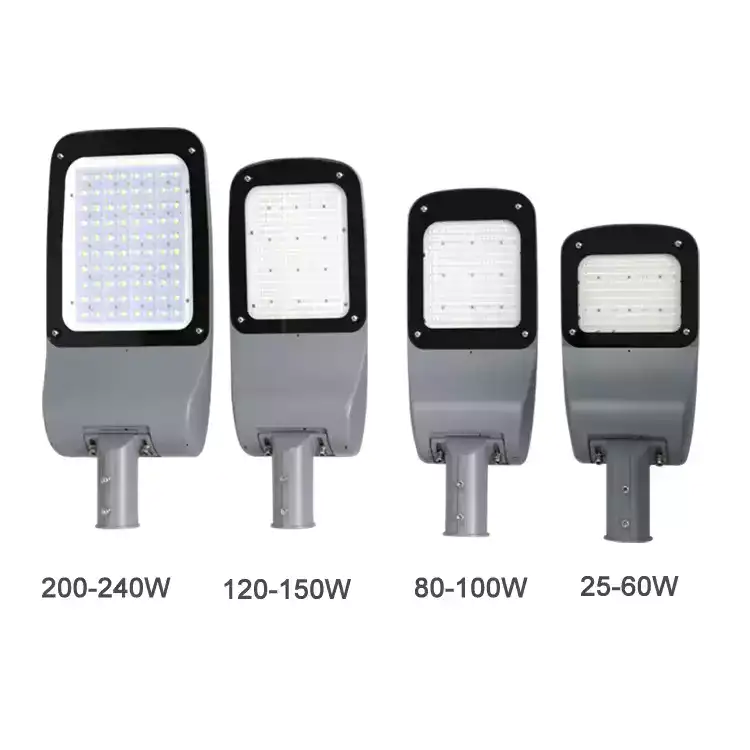
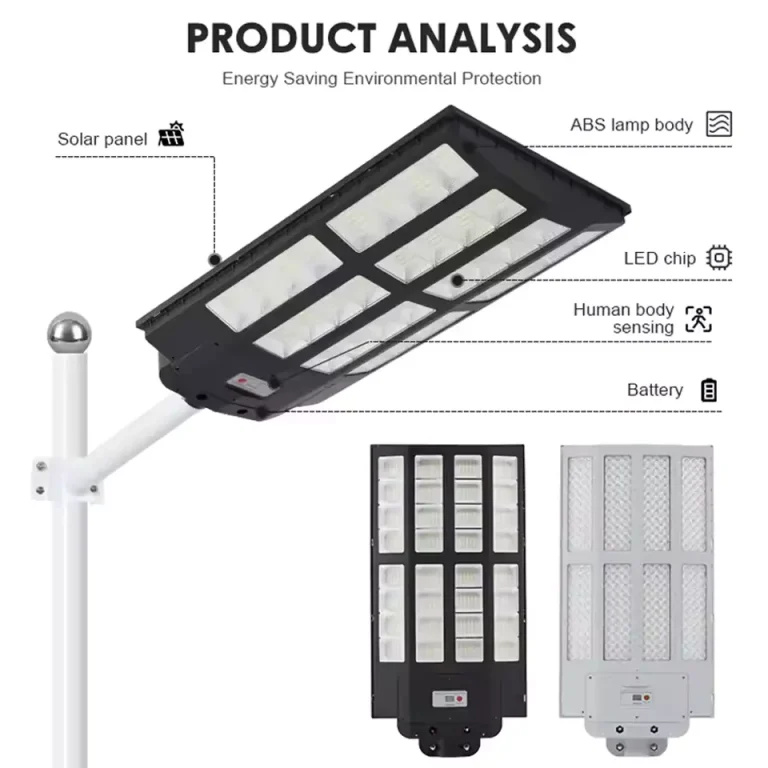
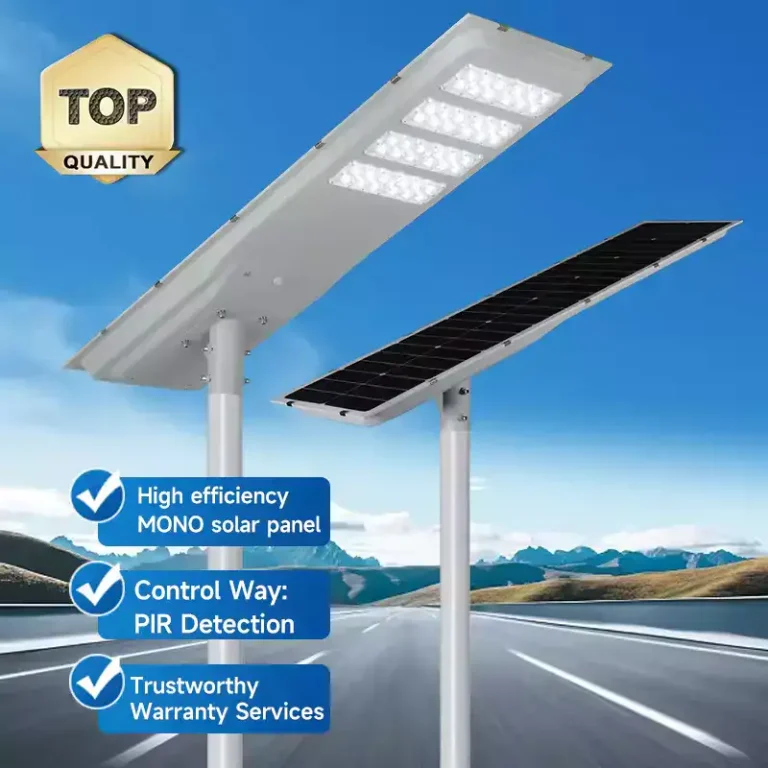
All in one solar street lights are compact, self-contained luminaires that combine a photovoltaic panel, energy storage, LED light engine, charge controller and sensors inside a single weatherproof housing, delivering dependable off-grid illumination with minimal installation overhead and attractive lifecycle economics.
Product summary and key benefits
All in one solar street lights remove the need for separate solar faces, external batteries or remote controllers. They arrive pre-assembled, pre-wired and largely set up for automatic operation: photovoltaic charging by day, and scheduled or sensor-based lighting by night. This trimmed architecture reduces labor at installation, eliminates conduit runs, and simplifies spare-part management on projects.
Primary advantages:
-
Rapid deployment and low civil works.
-
Predictable energy balance tuned for site insolation and desired autonomy.
-
Lower operational expense because there is no grid consumption.
-
Growing adoption of LiFePO₄ storage for safety and long cycle life.
What’s inside the integrated unit — component breakdown
Each integrated module contains a small ecosystem of engineered parts. Short paragraphs for clarity.
Solar module: Typically mono-crystalline PV cells enclosed within a tempered-glass assembly. Panel efficiency, tilt, and orientation determine daily charging potential.
Battery pack: Many modern units use lithium ferro phosphate (LiFePO₄) packs with an internal management system (BMS). This chemistry trades slightly lower energy density for much higher cycle life and thermal stability.
LED engine: High-efficacy SMD arrays or discrete high-power LEDs mounted on thermally conductive metal-core PCBs. Optical lenses or secondary reflectors shape the beam to road and pathway patterns.
Charge controller: MPPT controllers are common in higher-quality models because they extract more energy from a given panel under variable irradiance. MPPT increases effective charging efficiency compared with basic PWM controllers.
Sensors and logic: Light sensors (photocells), PIR motion detectors, radar sensors, and clock-based schedulers allow the light to change brightness depending on time, presence, or pre-set dimming curves.
Enclosure and pole interface: Die-cast or extruded aluminum housings with gasketed seals encapsulate the kit. Fasteners are typically stainless steel to resist corrosion.
Technical specification matrix — typical family
Below is a representative specification table that SunplusPro uses when advising municipal and commercial clients. Values are typical: custom variants are common.
| Model family | LED power (W) | Typical luminous flux (lm) | Solar module (Wp) | Battery type / capacity | Autonomy (no sun) | Recommended pole height (m) | IP/IK |
|---|---|---|---|---|---|---|---|
| S-30 | 30 | 4,800–6,300 | 60–80 Wp | LiFePO₄ 192–288 Wh | 2–3 nights | 4–6 | IP65 / IK08 |
| S-60 | 60 | 9,600–12,600 | 120–160 Wp | LiFePO₄ 384–576 Wh | 3–5 nights | 6–8 | IP65 / IK08 |
| S-100 | 100 | 16,000–21,000 | 200–320 Wp | LiFePO₄ 768–1152 Wh | 3–6 nights | 8–10 | IP66 / IK09 |
| S-150 | 150 | 24,000–31,500 | 300–450 Wp | LiFePO₄ 1152–1600 Wh | 4–7 nights | 9–12 | IP66 / IK10 |
Notes:
-
Luminous flux range depends on binning, optics and thermal environment.
-
Autonomy figures assume typical dimming profiles and moderate cloud cover. Manufacturer datasheets frequently list expected autonomy in nights.
Materials, thermal design and mechanical engineering (metal-focused)
My background is in metals and outdoor fixtures, so I focus on how the choice of materials affects performance.
Housings: Extruded aluminum (commonly 6063 or 6061 alloys) is favored for its balance of strength, corrosion resistance, and machining friendliness. Die-cast aluminum is used where complex shapes and integrated heat sinks are necessary.
Surface treatment: Powder coating, anodizing or thermal spray protects the metal from corrosion and UV degradation. For coastal or industrial sites, additional sealing and marine-grade coatings are recommended.
Thermal path: LEDs produce heat. The housing doubles as the heat sink. A good design provides low thermal resistance from LED junction to ambient; that means wide fins, direct conduction paths and enough frontal area. Proper thermal design preserves lumen output and prolongs driver and battery life.
Fasteners and interfaces: Stainless-steel screws (A2 or A4 grade depending on corrosive exposure) and EPDM or silicone gaskets prevent water ingress and galvanic damage.
Mounting brackets and poles: Steel poles are usually hot-dip galvanized or stainless-steel for durability; aluminum poles can be used for height-sensitive installations to reduce weight.
Metals summary table
| Component | Typical material | Key requirement |
|---|---|---|
| Housing | Aluminum extrusion / die-cast | Thermal conduction, rigidity |
| Fasteners | Stainless steel (A2/A4) | Corrosion resistance |
| Pole | Steel (hot-dip galvanized) or aluminum | Structural load, wind rating |
| Lens frame | Polycarbonate / PMMA + metal clamps | UV stability, seal integrity |
Power management, battery chemistry and charging strategy
Solar input varies by season, latitude and shading. Effective systems pair a PV module sized for worst-case winter insolation with a battery that provides the required autonomy.
Battery chemistry choices:
-
Lead-acid (older systems): cheap upfront but heavy and short-lived. Not recommended for modern all-in-one units unless cost is the sole constraint.
-
Lithium-ion (NMC and others): higher energy density, lighter but can be less thermally stable.
-
LiFePO₄ (LFP): preferred in many commercial all-in-one products for safety, long cycle life and predictable performance under high-depth-of-discharge duty. Modern LFP packs often include a compact BMS that prevents overcharging, deep discharge and cell imbalance.
Controller functionality:
-
MPPT controllers adjust panel operating voltage to harvest maximum power across temperature and irradiation variations. For many kits, MPPT yields a measurable increase in charging efficiency over PWM controllers—especially under partial or low-light conditions. That increases usable energy and can reduce required panel area.
Sizing rule of thumb:
-
Estimate daily consumption from desired night hours and lumen output.
-
Allow a Reserve bank sized for several consecutive poor-irradiation nights.
-
Choose a PV array that can recharge the bank within the typical number of sunlight hours available.
Photometrics, placement rules and recommended lumen levels
Street lighting is about useful light where people and vehicles need it. Photometric planning keeps brightness within comfortable and safe ranges.
General target illuminance:
-
Major thoroughfares and collector roads: ~20–30 lux average.
-
Local streets and residential lanes: ~6–12 lux average.
-
Paths, cycleways and small pedestrian routes: ~2–6 lux average.
Pole height and spacing:
-
Higher poles increase uniformity but require more luminous flux to maintain ground-level lux.
-
For single-sided installations, pole height is often at least equal to roadway width to reach the opposite curb. Tailor spacing so average lux and uniformity meet local standards.
Beam control:
-
Optics and secondary lenses shape distribution; narrow beams suit highways, broader batwing spreads suit streets and plazas.
Color temperature and CRI:
-
The typical color temperature for roadways is 3000–5000 K depending on desired perception. Higher CCT (cool white) often reads brighter to eye while lower CCT reduces glare and enhances color fidelity at night.
Electronics, control modes and smart features
Modern units ship with flexible control schemes.
Common modes:
-
Full-night constant output — simplest setting.
-
Time-based dimming curve — full power at evening peak, then stepped dimming to conserve energy during low-activity hours.
-
Motion-triggered boost — low baseline brightness with short-term increase when motion is detected; excellent for energy savings on low-traffic streets.
-
Remote telemetry and IoT — higher-tier systems provide remote commissioning, fault reports and energy analytics.
Sensing technology:
-
PIR sensors detect human movement; radar gives more reliable detection in certain conditions but adds cost.
-
Photocells provide dusk-to-dawn switching.
Protection and safety features:
-
Over-current, short-circuit, reverse-polarity protection and BMS safeguards come standard on well-engineered products.
Durability, IP/IK ratings and expected life of components
Ingress and impact resistance matter for location reliability.
Ingress protection:
-
IP65 is a common baseline: dust-tight and protected from jets of water. Many higher-rated units use IP66 for additional water resistance. Selecting the correct rating depends on local weather patterns and cleaning regimes.
Impact resistance:
-
IK ratings (IK08–IK10) indicate the unit’s ability to survive mechanical abuse. High-traffic installations or areas prone to vandalism may demand IK10-rated designs.
Component life expectancy:
-
Solar panels commonly degrade slowly; high-quality modules still perform above 80–90% after 20–25 years.
-
LEDs typically exceed 50,000 hours and maintain useful light for years when thermal management is correct.
-
Batteries commonly require replacement every 5–10 years depending on chemistry and cycling. When LiFePO₄ is used, lifetimes of several thousand cycles are feasible, translating to a decade of service in many scenarios.
Project selection, sizing and cost-justification framework (ROI)
How to present a rational business case?
Step 1 — Define the service level: Decide average lux target, uniformity and hours of operation.
Step 2 — Estimate energy demand: Convert lumen requirements into luminaire wattage and nightly consumption.
Step 3 — Size PV and battery: Factor worst-case consecutive cloudy days and safety margin.
Step 4 — Compare capital and operating costs: Contrast all-in-one system capex plus occasional battery replacement with grid electrification costs and ongoing energy bills.
Key financial drivers:
-
Local electricity tariffs and grid-connection cost.
-
Solar insolation and consequent PV size.
-
Maintenance frequency and local labor rates.
Practical note: For remote or rural locations, rapid installation and zero-grid expenses often produce payback in a few years. For urban retrofit projects, include permit and pole-work savings in the calculation.
Typical applications, installation notes and maintenance plan
Use cases:
-
Rural roads, highways, villages.
-
Parks, campus pathways, parking lots.
-
Perimeter and security lighting at industrial sites.
-
Temporary deployments for events or construction.
Installation tips:
-
Verify pole strength and wind-loading for the chosen unit.
-
Orient the integrated solar face toward the sun path; avoid nearby shadows from buildings or trees.
-
Commission dimming schedules and test motion sensors on-site.
Maintenance checklist (annual):
-
Inspect seals and gaskets.
-
Clean the PV surface if soiling exceeds 10–15% of rated output.
-
Check torque on mechanical fixings.
-
Firmware and controller logs — review fault codes.
Practical endurance: Many all-in-one products advertise 3–7 nights of autonomy in heavy cloud; designing to the local weather history is essential to meet performance promises.
Comparison: all-in-one versus split/multi-element systems
All-in-one units
-
Pros: Simplified supply chain, single-lift installation, less civil work, predictable performance when properly sized.
-
Cons: If the battery or panel fails, the entire unit may need replacement; limited options for ground-level battery replacement unless modular design is used.
Split systems (separate panels, inverter, battery bank)
-
Pros: Modular maintenance, larger capacities, easier to upgrade battery capacity independently.
-
Cons: Higher cabling cost, more complex installation, greater theft and vandalism exposure for separated parts.
Choice depends on project scale, local maintenance capacity and security environment.
Representative technical comparison table
This concise table helps clients compare options quickly.
| Feature | Low-end all-in-one | Mid-tier all-in-one | Premium all-in-one |
|---|---|---|---|
| Battery | Lead-acid / small Li-ion | LiFePO₄ mid-capacity | High-density LiFePO₄ with robust BMS |
| Controller | PWM basic | MPPT, simple scheduling | MPPT, motion sensing, remote comms |
| Optics | Basic lens | Cut-off lens, improved uniformity | Engineered reflector, high U0 |
| IP/IK | IP54 / IK06 | IP65 / IK08 | IP66 / IK10 |
| Warranty | 1–2 years | 2–3 years | 3–5 years |
| Typical application | Garden paths | Local streets, campuses | High-traffic roads, security perimeters |
Environmental impact and end-of-life considerations
Solar street lights reduce operational carbon by removing grid consumption. However, lifecycle thinking requires planning for battery end-of-life and recycling of electronic modules.
Best practices:
-
Specify recyclable battery chemistries and established recycling channels.
-
Use modular connections for easy replacement of battery or driver modules without discarding whole luminaire.
-
Choose long-lived LEDs and PV modules to reduce embodied-energy payback time.
Customization, commissioning and upgrade paths
Manufacturers often offer customization in:
-
Photometric patterns, to match road geometry.
-
Pole interface and adapter sizes.
-
Battery capacity and autonomy specification.
-
Connectivity: from simple remote controls to full-city IoT platforms.
Commissioning should always include:
-
Verification of charge/discharge cycles under site conditions.
-
Photometric validation at ground level.
-
Controller schedule programming and sensor sensitivity adjustment.
Evidence-based performance claims
A few core claims to anchor decisions:
-
Integrated designs include panel, battery, LED, and controller in one enclosure — this is the defining trait of the product family.
-
LiFePO₄ batteries are widely chosen for safety and extended cycle life compared with many alternatives.
-
MPPT controllers provide meaningful gains in charging efficiency under variable light and partial shading, improving energy harvest.
-
Typical street lighting illuminance bands guide sizing: major roads around 20–30 lux, residential streets 6–12 lux, walkways 2–6 lux.
-
Component longevity: solar panels and LED engines often last multiple decades and tens of thousands of hours, while batteries are usually the maintenance item replaced in the field.
Purchase checklist
Before committing, verify:
-
Clear product datasheet with lumens per watt, CCT, CRI and photometric files.
-
Battery chemistry, cycle life rating, BMS features and replacement policy.
-
Controller type (MPPT vs PWM) and dimming logic.
-
Ingress and impact protection ratings appropriate for environment.
-
Manufacturer warranty terms and local service availability.
-
Reference projects in similar climates.
FAQs
-
How long will an all-in-one solar street light run through cloudy weather?
Typical autonomy is 2–7 nights depending on battery capacity and settings. When specifying a project, design for the maximum expected stretch of poor weather plus an operational margin. Manufacturer datasheets usually provide autonomy numbers for common modes. -
Which battery type should I choose for long life and safety?
LiFePO₄ (LFP) offers a superior safety profile and more cycles than many alternatives. It is therefore a common choice in commercial products where long service life and low maintenance are priorities. -
Is MPPT worth the extra cost?
For sites with partial shading, variable irradiation or when maximizing energy harvest from compact panels, MPPT typically is worth the cost due to higher charging efficiency. -
What IP rating do I need in coastal or dusty environments?
IP66 is safer in coastal and high-soiling locations. Pair that with corrosion-resistant coatings and marine-grade fasteners for extended life. -
How often do I need to clean the solar panel?
Cleaning frequency depends on local dust deposition. In many places, annual cleaning suffices. If soiling reduces panel output by more than 10–15%, plan cleaning interventions. -
Can the battery be replaced without replacing the whole luminaire?
Some modular designs allow battery replacement; others are sealed for protection and require more effort. When maintenance access is constrained, specify a modular design. -
Do these lights need a controller update or firmware maintenance?
Advanced units with remote communications may receive firmware upgrades. For basic units, field firmware updates are rare; check manufacturer support for critical fixes. -
What is the typical warranty and expected service life?
Warranties vary. LED modules and PV panels often carry long performance warranties; the battery commonly has a shorter warranty window. Many manufacturers offer 3–5 year product warranties with batteries warranted separately.
Closing guidance and practical sample specification
If you are tendering for a typical residential-street project, consider this sample spec:
-
Integrated luminaire, 60 W nominal LED, 11,000–13,000 lm, CRI ≥70, CCT 4000 K.
-
PV module: mono-crystalline, 140 Wp minimum.
-
Battery: LiFePO₄, BMS-protected, minimum 480 Wh usable capacity.
-
Controller: MPPT with dimming schedule and PIR motion detection.
-
Ingress: IP65 or higher; impact IK08 or higher.
-
Expected autonomy: minimum 3 nights at medium dimming profile.
-
Warranty: LED + PV 5 years; battery 3 years minimum; full product support and spare parts list.
Final notes — professional perspective from SunplusPro
From a metals and product-engineering viewpoint, the long-term success of an all-in-one solar street light depends on two often-overlooked factors: thermal design and serviceability. An elegant aluminum housing that moves heat away from LEDs and driver electronics will preserve lumen output and reduce stress on the battery. Meanwhile, designing the unit so a technician can replace the battery or controller without discarding the whole fixture preserves lifecycle value and lowers total cost of ownership.