

Light poles are typically made from steel, aluminum, concrete, fiberglass, or treated wood. Each material has a distinct set of mechanical, environmental, and economic tradeoffs that determine which one is best for a particular installation. For solar LED street lights supplied by SunplusPro, aluminum and fiberglass often deliver the best balance of corrosion resistance, installation speed, and lifecycle cost for public and commercial sites, while concrete and steel remain common for heavy-duty highway or very tall installations.
1. Which materials show up most often
Typical modern light poles fall into five groups:
-
Steel (rolled, tapered, or sheet-welded).
-
Aluminum (extruded or spun).
-
Concrete (spun or prestressed).
-
Fiberglass or fiber-reinforced polymer composites.
-
Treated wood (utility poles).
Municipal specifications, highway authorities, and commercial designers choose among these based on structural demands, environmental exposure, visual requirements, and budget.

2. Steel poles — highest strength and broadest use
What they are: Typically made from carbon steel formed into tapered round or polygonal shafts by rolling and welding. Common finishes include hot-dip galvanization and powder coating.
Advantages
-
High structural strength for tall poles and heavy loads.
-
Economical for many applications because steel raw material is inexpensive and fabrication methods are mature.
-
Good for custom shapes and welded brackets.
Limitations
-
Steel corrodes unless protected by galvanizing, paint, or a duplex (galvanize plus paint) system. Maintenance cost can be substantial in corrosive environments.
-
Heavier than aluminum or fiberglass, which can increase foundation and handling costs.
Typical uses
- Highway lighting, tall city standards, areas where heavy luminaires, CCTV, or banner loads are required.
Engineering note
-
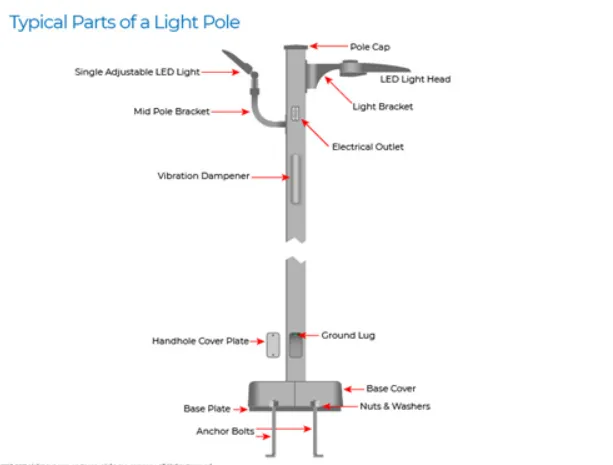
Anchor base poles require high-quality anchor bolts and a corrosion-controlled base plate. Steel connection details should follow local structural codes and fatigue design practices.
3. Aluminum poles — corrosion resistant and lightweight
What they are: Usually 6061-T6 or similar alloys formed by extrusion or spun fabrication. Many are natural or anodized, with powder coat available for color.
Advantages
-
Excellent corrosion resistance without heavy coatings, making aluminum ideal for coastal or high-humidity sites.
-
Lightweight, which reduces shipping and installation costs and allows smaller cranes for erection.
- Recyclable and often long lived with limited maintenance.
Limitations
-
Lower elastic modulus and yield strength than steel, so aluminum poles must be sized larger for the same stiffness or strength.
- Conductive, so electrical isolation considerations apply for lightning and fault protection.
Typical uses
-
Urban street lighting, parking lots, residential streets, and many solar LED applications where corrosion resistance and fast installation matter.
4. Concrete poles — extreme durability and mass
What they are: Spun-cast, prestressed, or cast-in-place concrete poles used especially on highways and in locations where impact resistance and longevity are priorities.
Advantages
-
Exceptional resistance to corrosion and fire.
-
Very high compressive strength and robust against impact.
-
Low maintenance and long service life for high-demand infrastructure projects.
Limitations -
Heavy, demanding larger foundations and lifting equipment.
-
Less flexible for design shapes and harder to integrate decorative details without molds.
Typical uses -
Highway and major arterial lighting, bridge-mounted fixtures, and remote areas where maintenance visits should be minimal.
5. Fiberglass and composite poles — corrosion-proof and non-conductive
What they are: Glass-fiber-reinforced polyester or epoxy tubes built by filament winding, pultrusion, or molding.
Advantages
-
Excellent corrosion resistance because composite matrix resists salts and chemicals.
-
Non-conductive, which can be safer near electrical apparatus or for certain utility uses.
-
Lightweight and resistant to harmonic vibration when designed correctly.
Limitations -
Cost per unit can be higher than aluminum or steel for equivalent heights.
-
Long-term UV exposure and localized impact damage require appropriate resin selection and protective outer coats.
Typical uses -
Coastal locations, stadiums, bridge overpasses, and industrial sites where corrosion or electrical isolation are priorities.
6. Wood poles and specialty materials
Wood
-
Still a mainstay for utility poles that carry power lines, cables, and sometimes luminaires. Species like Douglas fir, southern pine, or western cedar are treated for longevity.
-
Best used where a rustic aesthetic or utility co-location is important. Wood requires periodic inspection for rot, insect damage, and mechanical deterioration.
Specialty alloys and hybrid poles
-
Cast iron historic replicas, stainless steel for high-end architectural work, and hybrid poles that combine concrete bases with aluminum shafts appear in specialty installations.
7. How solar LED requirements change material selection
Integrating PV panels, batteries, and controllers modifies pole selection in several ways:
-
Solar arrays add wind area at the top of the pole. Wind load controls diameter and wall thickness.
-
Battery enclosures mounted near the pole base need theft-resistant and ventilated housings.
-
Cable routing, access doors, and maintenance clearances must be built into the shaft design.
-
Corrosion resistance is more critical because a failed pole leads to downtime for solar equipment.
For many solar LED projects, aluminum poles with integrated PV mounting brackets, or fiberglass poles with cargo boxes, deliver a good lifecycle cost balance. When very tall or heavy equipment is required, steel or concrete may be required because of their higher load-bearing capacity.
8. Key engineering considerations (what engineers check before specification)
When selecting a material, follow these checks:
-
Wind load: Use local wind speed tables and compute projected area of luminaire plus PV. Choose pole class and wall thickness to meet ULS and SLS.
-
Fatigue: Some locations generate cyclic loads that produce fatigue failures in welded steel; review fatigue categories for welded connections.
-
Corrosion environment: Select material and coating for coastal, industrial, or deicing-salt exposure.
-
Electrical safety: For conductive poles, plan grounding and surge protection. Fiberglass may remove the need for routine grounding but lightning protection still matters.
-
Foundations: Pole weight changes foundation size. Light, long poles may need deeper foundations because of moment.
-
Vandalism and impact risk: Concrete and steel take impacts better than aluminum or fiberglass.
Municipal and state highway design manuals contain prescriptive requirements for design and installation. Follow local codes and AASHTO practice where applicable.
9. Corrosion protection, finishes, and maintenance
Common systems
-
Hot-dip galvanizing for steel sources long-term sacrificial protection.
-
Powder coating for aesthetics and additional corrosion barrier; apply over proper pretreatment.
-
Anodizing for aluminum to provide a thin oxide film that resists corrosion.
-
Gelcoats and protective paints for fiberglass; UV inhibitors prolong surface life.
Maintenance tips
-
Inspect base plates, anchor bolts, and hand-hole seals annually in aggressive environments.
-
Clean bird droppings and airborne salts from surface finishes to reduce corrosive attack.
-
Repair coating damage promptly to avoid progression to active corrosion.
10. Tables: quick comparison for procurement
Table 1: Material comparison (summary)
| Material | Typical heights | Corrosion resistance | Weight | Typical life expectancy | Typical initial cost |
|---|---|---|---|---|---|
| Steel | up to 60 m for heavy designs | Low without treatment | High | 20–50 years with protection | Low–Medium |
| Aluminum | up to ~20 m common, can be higher | High | Low | 30–50 years | Medium |
| Concrete | up to very tall heights used on highways | Very high | Very high | 50+ years | Medium–High |
| Fiberglass | usually up to 20–25 m | Very high | Low | 25–50 years | Medium–High |
| Wood | utility heights | Medium with treatment | Medium | 25–40 years | Low |
(Estimates depend on local conditions and maintenance programs.)
Table 2: Best matches by environment and need
| Priority | Coastal / salt spray | Highways / impact | Aesthetic streetscapes | Rapid install / low crew | Electrical isolation needs |
|---|---|---|---|---|---|
| Best material | Aluminum or fiberglass | Concrete or steel | Cast aluminum or decorative steel | Aluminum | Fiberglass |
11. Cost, lifecycle, and sustainability
-
Total cost of ownership matters more than sticker price. Aluminum often wins when factoring reduced maintenance and easier installation.
-
End-of-life recycling: Aluminum is highly recyclable with low energy for remelt; steel also recycles well. Concrete may be crushed for aggregate reuse. Fiberglass recycling is more limited and can be handled by specialty facilities.
-
Sustainability note: Selecting longer-life materials reduces embodied carbon per year of service.
12. Common project scenarios and recommended materials
-
Coastal city park with solar LED fixtures: Aluminum or fiberglass for corrosion resistance and light installation.
-
Highway median lighting with heavy luminaires: Concrete or structural steel for strength and impact tolerance.
-
Historic downtown street where appearance is crucial: Decorative cast-aluminum or powder-coated steel with custom finials.
-
Industrial plant with electrical hazards and stray currents: Fiberglass for electrical isolation plus lightning protection.
-
Remote rural path lighting powered by SunplusPro solar LED: Aluminum extrusions with integrated mounting for PV and battery enclosure for straightforward maintenance.
13. Integration details for solar LED poles
-
Provide a PV mounting kit sized to minimize added moment.
-
Specify lockable, ventilated battery cabinets at base, with theft-resistant fasteners.
-
Include quick-disconnect wiring harnesses for fixture replacement in the field.
-
Design hand-hole and base-door access for battery swap and controller servicing.
-
Verify pole finish and gasketed access covers for NEMA-rated enclosures used with electrical components.
SunplusPro offers factory-level customization of pole height, bracket type, and integrated battery box options at competitive pricing, which reduces engineering coordination time on site.
14. Recommendations for procurement teams
-
Define environmental exposures: coastal, deicing salts, industrial fumes, traffic collision risk.
-
Define mechanical loads: luminaire weight, PV area, signage, banners, CCTV.
-
Require vendor drawings with wind and moment calculations and anchor bolt charts.
-
Ask for finish warranties and sample test reports for galvanizing, anodizing, or gelcoat UV performance.
-
Specify surge protection and grounding requirements if using conductive poles.
15. Fequently asked questions
Q1: Which pole material requires the least maintenance?
A1: Concrete and aluminum generally need the least ongoing maintenance. Concrete resists corrosion and does not require repainting, while aluminum resists rust and keeps its finish longer under normal conditions.
Q2: Are fiberglass poles safe during lightning storms?
A2: Fiberglass is non-conductive, which reduces the chance of conducting stray current. However, lightning can still strike fixtures or attached metal and grounding or lightning mitigation should be included in system design.
Q3: Is aluminum strong enough for solar panels on top?
A3: Yes, when sized correctly. Aluminum poles need larger cross-sections or thicker walls to match steel stiffness for the same span or wind load. Engineering input is required to size the pole with the added PV area.
Q4: What finish is best for steel poles in coastal locations?
A4: Hot-dip galvanizing plus high-quality powder coating delivers strong protection. Local codes may require duplex systems for maximum life. Regular inspections remain necessary.
Q5: Can we mount CCTV and banners on the same pole used for solar LED?
A5: Yes, if the pole is designed for combined loads. Add the moment from the banner and camera into wind and fatigue calculations before finalizing the pole spec. Include maintenance access for cables.
Q6: Which material is most economical for a large parking lot rollout?
A6: Aluminum often strikes the best balance between up-front cost, installation time, and lifecycle maintenance for parking lots using solar LED luminaires. Steel can be cheaper upfront but may cost more to maintain.
Q7: How tall can typical aluminum or fiberglass poles be?
A7: Typical commercial aluminum or fiberglass poles range between 6 to 20 meters. Taller requirements push the design toward steel or concrete depending on load. Manufacturer tables give exact limits by section and wall thickness.
Q8: What should be included in a procurement specification for solar LED poles?
A8: Include material, grade, finish, mounting details, anchor-bolt layout, hand-hole size, base enclosure dimensions, PV mounting details, loading assumptions for wind and luminaire, warranty terms, and factory acceptance test requirements.
16. How SunplusPro helps with pole selection and customization
SunplusPro manufactures integrated solar LED systems and offers:
-
Factory customization for pole height, bracket styles, and battery boxes.
-
Bulk pricing for large rollouts, cutting procurement cost per unit.
-
Pre-tested combinations of pole plus solar fixtures to reduce on-site commissioning time.
If you supply your site-specific wind speed and luminaire specs, SunplusPro can produce stamped drawings and load calculations to speed approval by municipal engineers.
17. Procurement checklist
-
Confirm site wind speed and terrain category.
-
Confirm luminaire plus PV projected area.
-
Choose material based on environment and maintenance plan.
-
Require anchor bolt plan and foundation drawing.
-
Request finish warranties and test reports.
-
Plan surge protection and access for battery maintenance.
Closing summary
Selecting a material for a light pole requires balancing structural demands, local environment, lifecycle cost, and integration needs for solar LED equipment. Aluminum and fiberglass often offer the best match for solar LED fixtures due to corrosion resistance, lighter weight, and installation economy. Steel and concrete remain indispensable for very tall, heavy-duty, or impact-prone installations. Work with vendors who can supply engineering calculations, finish warranties, and integrated solar mounting options so the final system performs reliably with minimal maintenance.