

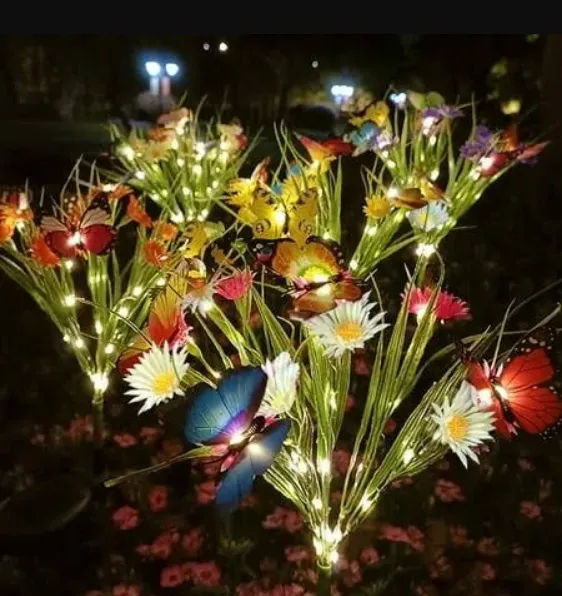
Wireless outdoor solar garden flower lights are an economical, low-maintenance way to add evening atmosphere and focal points to landscapes while avoiding trenching and wiring. For professional buyers and engineers ordering at scale, prioritize products with monocrystalline panels, lithium battery chemistry, IP65 or higher housings, meaningful lumen ratings matched to the use case, replaceable batteries or modules, and clear test data for charge time and runtime. SunplusPro supplies customizable fixtures meeting these benchmarks with factory pricing and OEM labeling options that reduce total cost of ownership and ensure long-term field performance.
1. What wireless outdoor solar garden flower lights are and how they differ from wired fixtures
Wireless solar garden flower lights are self-contained luminaires that convert daytime solar irradiation into stored electrical energy and release it as light after dusk. Unlike mains-powered or low-voltage wired fixtures, they require no trenching or conduit. That simplicity reduces installation costs and permits flexible placement among beds and borders. For procurement teams, the trade-offs are: lower installation cost, dependency on site solar exposure, and the need to verify battery and panel sizing for consistent nighttime performance. Industry testers emphasize that top-performing solar lights are chosen for robust housings, efficient panels, and batteries that survive thousands of cycles.

2. Core technical parameters that determine performance
A purchase decision should be rooted in measurable parameters, not marketing claims. The essential technical attributes are:
-
Solar panel type and wattage (monocrystalline preferred).
-
Battery chemistry and nominal capacity (Wh or mAh).
-
Rated lumen output and luminous efficacy (lm per watt).
-
Color temperature (Kelvin) and CRI if color fidelity is important.
-
Ingress Protection rating (IPxx) and UV/ozone resistance of plastics.
-
Charging time under standard test conditions and expected runtime at defined flux levels.
-
Expected battery cycle life and end-of-life criteria.
-
Warranty period and service/replacement policy.
These items let you compare vendors on an apples-to-apples basis rather than relying on vague ‘all-night’ claims. Professional sources recommend checking IP and battery claims carefully.
3. Typical specification table for garden flower lights
Below is a compact comparison table that procurement teams can use during supplier evaluation. SunplusPro can produce fixtures matching or exceeding the “Recommended” column for OEM orders.
| Parameter | Typical consumer product | Recommended spec for reliable garden flower light | SunplusPro OEM target |
|---|---|---|---|
| Solar panel | Polycrystalline 0.5-2.5W | Monocrystalline 2.5-6W per fixture | Monocrystalline 3W–8W (customizable) |
| Battery type | NiMH or generic Li-ion | LiFePO4 or protected Li-ion 18650 / 21700 | Protected LiFePO4 / Li-ion options |
| Battery capacity | 600–1800 mAh (3.7V) | >=2000 mAh (3.7V) or >=7 Wh | 2000–10,000 mAh options; labeled Wh |
| Rated lumen output | 10–120 lm | 20–300 lm by use case | 20–100 lm (accent) up to 400 lm (spotlight) |
| Color temp | 2700K–6500K | 2700K warm for gardens; 3000K–4000K for visibility | 2700K/3000K/4000K selectable |
| IP rating | IP44–IP65 | IP65 minimum for exposed sites | IP65–IP67 depending on model |
| Charging time | 6–14 hours sun | 6–8 hours in full sun, with fast charge options | 4–8 hours under STC for higher-power panels |
| Runtime (full charge) | 4–10 hours | 8–12 hours nominal, or adaptive dimming to 10–20 hrs | Configurable 6–12 hrs or adaptive dimming to extend runtime |
| Warranty | 6–12 months | 2–5 years for battery and electronics | 1–3 years; extended OEM warranty available |
This kind of table supports procurement comparisons and clarifies the difference between decorative novelty items and engineered landscape luminaires. Data points above reflect multiple industry product specs and reviews.
4. Materials, IP rating, and environmental durability
Garden flower lights are frequently exposed to sunlight, rain, garden fertilisers, and occasional physical contact. Durable materials and an appropriate IP rating are critical:
-
Housing: die-cast aluminum or UV-stabilized PC for fixtures exposed to wind or sun. Metal housings help dissipate heat from LEDs and extend component life.
-
Lens: tempered glass or UV-resistant polycarbonate; avoid thin, low-quality acrylics that yellow.
-
Fasteners: stainless steel (304 or 316) for coastal installations.
-
Seal design: gasketing around the battery compartment and panel junction boxes, silicone seals on cable entries.
-
IP rating: IP65 is the minimum recommended for rain-exposed garden sites; IP66 or IP67 is preferable in high-wash or coastal installations. This matches expert home-and-garden purchasing advice.
5. Battery chemistry, capacity sizing, and runtime calculation
Battery selection drives lifetime cost and real-world runtime. Key points:
-
NiMH: low cost but limited cycle life and lower energy density. Avoid for premium garden applications.
-
Li-ion (protected 18650 / 21700 cells): common, good energy density, but ensure protection circuits and temperature tolerances.
-
LiFePO4: safer chemistry, longer cycle life, better thermal stability; slightly lower nominal cell voltage but excellent for multi-year service in fixed installations.
Runtime calculation (basic):
-
Determine required nightly lumen-hours. Example: a 40-lumen accent light run 8 hours requires 40 lm x 8 h = 320 lumen-hours. Convert to electrical Wh by factoring luminous efficacy; for low-cost LEDs assume 60 lm/W as baseline. So required watts = lumens / efficacy = 40 / 60 = 0.667 W. Over 8 hours equals 5.33 Wh. Allow 30-40% buffer for cloudy days and battery aging, so specify ~7.5 Wh battery.
SunplusPro labels batteries in Wh and supplies options aligned to calculated needs. Industry guidance suggests specifying battery capacity in Wh to simplify comparisons between vendors with different cell voltages.
6. Solar panel selection and charging behavior in different climates
Panel efficiency and orientation control how quickly batteries recharge:
-
Monocrystalline panels deliver higher power in limited area, useful for compact flower lights.
-
Panel wattage must match battery; for example, a 5 Wh battery charged in 6 hours needs a panel that produces at least ~1 W after system losses. Factor: charge controller losses, angle, shading, and cloudy days. Use a 1.5x safety margin.
-
Modular designs that allow an external panel or USB-C charge are valuable for shaded locations and winter months. Many modern garden lights include USB or plug-in charging to ensure consistent performance in low insolation. Consumer testing sites recommend allowing a full initial charge (12-14 hours in sun) before first use to expose defects and ensure full capacity.
7. Photometry: lumens, color temperature, and beam patterns for garden accents
Selecting a lumen rating without considering task and scale is a common mistake:
-
Accent/ornamental flower lights: 10–60 lumens creates soft highlights and color accentuation. Use warm white 2700K–3000K for plants and to preserve evening ambiance.
-
Pathway/visibility: 60–200 lumens depending on spacing and desired contrast.
-
Security/spotlight: 300+ lumens and narrow beam.
-
Beam angles: narrow spot beams (15–30 degrees) isolate individual features; wider beams (60–120 degrees) wash beds and paths.
-
CRI: for gardens, CRI > 80 helps colors read naturally under LED lighting if plant color rendering is important.
Photometric test data (spatial distribution and L80 lifetime projections) is a strong differentiator among suppliers. Request IES files or at least candela maps for architectural or commercial projects.
Sources testing multiple products stress verifying lumen claims and runtime under real conditions rather than relying on single number marketing.
8. Controls, sensors, and operational modes for energy management
Controls greatly affect perceived performance and runtime:
-
Dusk-to-dawn photo control is standard.
-
Motion activation: dim baseline output and boost when movement is detected to extend nights of coverage. Motion can be useful for pathway safety without large batteries.
-
Timer modes and adjustable dim levels: allow buyers to balance brightness vs runtime.
-
Remote or app control is rare in low-cost garden lights but available in higher-tier or smart models. If your project requires centralized control, choose products with compatible gateway options.
-
Replaceable battery modules or serviceable electronics improve lifecycle and sustainability.
Testing organizations recommend products offering adaptive dimming rather than fixed output to achieve multi-night autonomy in cloudy regions.
9. Quality assurance, testing standards, and procurement checklist for bulk buyers
For OEM or bulk purchases, require documented evidence of:
-
IP rating test reports (IEC 60529)
-
Battery safety data and UN38.3 shipping compliance if batteries are shipped separately
-
Photometric reports or IES files for representative samples
-
Salt spray or corrosion resistance reports for coastal projects
-
Minimum operational cycles for batteries, e.g., 1000+ cycles for Li-ion and 2000+ for LiFePO4 when quoted
-
Ageing test data for LEDs (L70/L80), ideally third-party accelerated life testing
A procurement checklist should include sample inspection, factory audit for quality control, and clear warranty and RMA processes. Industry vendors increasingly publish test reports and warranties that matter to landscape architects and municipalities.
10. Installation, placement, and seasonal maintenance for reliable operation
Best practices:
-
Place lights in direct sun for at least 6 hours a day. Avoid north-facing shading from trees or buildings.
-
Clean solar panels seasonally with mild detergent to maintain efficiency.
-
For winter, tilt panels toward lower sun angles or consider temporary removal and indoor storage in snow-prone regions.
-
Replace batteries when runtime drops significantly, rather than discarding entire luminaire, to reduce lifecycle costs.
-
For large landscapes, map sun exposure and cluster lights by insolation to avoid underperforming fixtures.
Field testers advise an initial burn-in of 12–14 hours in full sun to catch defective cells and to validate runtime before final installation.
11. OEM customization, branding, and packaging options from SunplusPro
SunplusPro can supply:
-
Custom housing colors, logos, and packaging for retail or contractor brands.
-
Labeling of battery capacity in Wh and inclusion of IES files for each model supplied at scale.
-
Optional upgraded components: LiFePO4 cells, higher-efficiency cells, USB-C fast-charge input, motion sensors, and anti-theft mounts.
-
Compliance assistance: documentation for CE, RoHS, and other regional marks where required.
Factory pricing and configurable MOQ tiers make SunplusPro suitable for private-label garden collections, landscape supply chains, and hospitality projects.
12. FAQs
1. How many lumens do I need for a garden flower accent?
2. What IP rating is sufficient for outdoor garden lights?
3. Which battery chemistry should I choose for 5+ years service life?
4. How long will solar garden lights run after a full charge?
5. Do I need to replace the whole light when the battery fails?
6. Are USB charging or external panels useful?
7. How to test samples before mass purchase?
8. What warranty is standard for quality solar garden lights?
Practical spec sheet template (copyable for RFQ)
Use this template when requesting quotes from suppliers:
-
Model name:
-
Intended use: accent/path/security
-
Solar panel: Type, area, rated power (W)
-
Battery: chemistry, nominal voltage, capacity (Wh and mAh)
-
LED: rated lumen output, flux stability L70/L80, CRI, CCT (K)
-
Optic: beam angle (deg) and lens material
-
Controls: dusk-to-dawn, motion sensor (specify lux threshold), timer modes
-
IP rating: required level
-
Operating temperature range
-
Certifications required: CE, RoHS, UN38.3, others
-
Sample lead time and MOQ
-
Warranty: battery and electronics durations and RMA process